Argument Mapping for Founders: 5–10 Minute Decision Logs
Argument mapping for founders and teams: use 5–10 minute decision journal templates, enforce revisit dates, and run quarterly audits to keep judgment sharp.

On this page
- What Argument Mapping Means Inside a Decision Journal
- The Fields Every Decision Entry Needs
- What Decisions Are Worth Logging?
- How to Map a Decision, Step by Step
- Making Logs Actually Get Used Again
- Turning Logged Decisions Into Better Judgment
- Tree, Flowchart, or Toulmin: Which Structure Fits?
- Software Options for Capturing and Mapping Arguments
- Argument Maps at Work: Academic, Legal, and Personal Cases
- What Makes an Argument Map Good vs. Weak
- What Actually Changes When Teams Adopt This
- Try the Template Instead of Building Your Own
- Sources
- FAQ
Argument mapping, in a decision journal, means writing down the reasoning behind a choice before you know how it turns out: the options weighed, the level of confidence expressed qualitatively, the trade-offs accepted, and the exact condition that would make you revisit it. It matters because teams that skip this step relearn the same lessons every year. Some decision journals build this discipline into a structured log so judgment, not just outcomes, gets tracked.
TL;DR:
- Only decisions with significant stakes, irreversible choices, or recurring questions should be logged to ensure the record remains focused and useful.
- Each entry must include a clear decision statement, options considered, rationales, load-bearing assumptions, confidence level, revisit conditions, and next steps to support quick retrieval and review.
- Regular audits should verify entries are properly indexed, revisit conditions have fired, and stale actions are closed to maintain a practical and actionable log.
- Using structured templates or dedicated decision-journal software enhances consistency, retrieval, and team adoption compared to informal notes or generic tools.
- Reviewing past decisions periodically helps calibrate confidence levels, surface weak assumptions, and improve judgment over time through comparison of predicted versus actual outcomes.
What Argument Mapping Means Inside a Decision Journal
Argument mapping here has nothing to do with the boxes-and-arrows diagrams used in philosophy classes or debate training. Academic mapping visualizes claims, objections, and sub-conclusions to test the logic of an argument. That practice has real value for critical thinking exercises, but it is not what founders need when they are deciding whether to fire a vendor or raise a Series A.
Inside a decision journal, argument mapping means recording the rationale for a specific organizational decision at the moment you make it: what you chose, why, how confident you were, and what would prove you wrong. The academic version studies arguments about ideas. The decision journal version tracks reasoning about actions, and it changes behavior on its own. When people know a future version of themselves (or a new hire) will read the entry, they get more honest about the shaky assumptions they might otherwise gloss over. Researchers exploring decision and argument mapping note that mapping reasoning surfaces implicit assumptions that would otherwise stay invisible. That same effect works even in a plain text log.
The Fields Every Decision Entry Needs
A useful entry is not a journal in the diary sense. It is a compact record built for retrieval, not reflection. The strongest decision logs include a small, fixed set of fields, and skipping any one of them weakens the whole record.
- Decision: one sentence, written as a statement, not a question.
- Owner: the person accountable for the call.
- Options considered: the two or three alternatives you actually weighed.
- Rationale: why this option beat the others, in plain language.
- Load-bearing assumptions: the facts that, if wrong, would flip the decision.
- Confidence: a qualitative expression of confidence, instead of a precise percentage.
- Expected outcome and timeframe: what success looks like and by when.
- Revisit_on: the specific trigger that forces a second look.
- Review date: a calendar date, not “later.”
- Next_action: the immediate task that follows.
A compact decision-log template built around fields like these takes five to ten minutes to fill out, which is short enough that teams actually keep doing it past the first month.
What Decisions Are Worth Logging?
Not every choice deserves a journal entry, and trying to log everything is how teams abandon the practice within a quarter. Three questions filter out the noise.
- Are the stakes real? A decision that costs money, headcount, or reputation belongs in the log. A lunch order does not.
- Is it hard to reverse? One-way doors, like a pricing model change or a cofounder split, deserve a full entry even when confidence is high.
- Will it get re-asked? If someone brings this exact question back up in six months, write it down now so you are not relitigating from memory.
A practical filter is the reconstruction test: if rebuilding the reasoning from memory or old messages would take more than 30 minutes, it should have been logged the first time. Over-logging buries the decisions that matter under routine ones, and a bloated journal is nearly as useless as an empty one. Selective logging keeps the record signal rich enough that a quarterly review is actually worth the time it takes.
How to Map a Decision, Step by Step
Treat the entry as part of the decision, not paperwork that follows it. Here is the sequence that keeps the record honest and fast to write.
- Write the one line decision first. State the call before you justify it, so the rationale doesn’t drift into a defense of a conclusion you have not actually reached.
- List the options you considered. Two or three real alternatives, not a straw man you never seriously weighed.
- Write the rationale. One or two sentences on why this option won.
- Name the load-bearing assumptions. The two or three facts that, if false, change the answer.
- Assign a confidence percentage. Force a number. “Fairly confident” hides more than it reveals.
- Set revisit_on and a review date. The trigger condition and the calendar date go in the same entry, never one without the other.
- Write the next_action. What happens in the next 48 hours because of this decision.
For one-way doors (decisions that are expensive or impossible to undo) add a premortem before you commit: write down how this fails, in specific terms, before you find out for real. A decision-log template that separates decision quality from outcome makes room for exactly this step, and it is what lets a good decision that goes badly still count as good process.
Here is a filled micro-template for a hiring call:
*Decision: Hire the senior engineer candidate over the two junior candidates. Options: senior hire, two junior hires, contractor. Rationale: need architecture ownership now, not just output volume. Assumptions: senior hire ramps in under six weeks; budget holds through Q3.
Revisit_on: if ramp time exceeds eight weeks. Review date: 90 days out. Next_action: schedule 30 day check in.*
Making Logs Actually Get Used Again
A log nobody can find is not a record, it is a diary entry nobody reads twice. The most under implemented practice in decision journaling is retrieval, not writing. A running index, often kept as a single MEMORY.md file, and backlinks from your team wiki into specific entries turn a pile of notes into something a future teammate can actually search.
Run a retrieval test regularly: pick a decision from three months ago and time how long it takes someone new to find it and understand the reasoning. If that takes more than a couple of minutes, the indexing has failed, not the memory of the person searching.
- Check quarterly for logs that were never indexed at all.
- Flag every entry whose revisit_on condition has already fired.
- Pull out next_actions that went stale and were never closed.
Pro Tip: Sort your quarterly audit results into three buckets: superseded, still open, and needs follow-up. That single sort turns a vague “review the logs” task into something your team can finish in an afternoon.
Turning Logged Decisions Into Better Judgment
The payoff shows up in the review, not the writing. Scheduled sessions where you fill in outcomes, assign a verdict, and record the lesson are what separate a decision journal from a diary. Structured entries paired with scheduled reviews let a team compare what they predicted against what actually happened, entry by entry.
Calibration is a training process: if you tag decisions as fairly confident, roughly that proportion should go your way. A wide gap between stated confidence and actual outcomes signals a need to recalibrate your expectations, not necessarily to blame results.
Tree, Flowchart, or Toulmin: Which Structure Fits?
Even outside the decision-journal context, argument maps come in a few recognizable shapes, and knowing them helps you borrow the right piece when you need one. The tree structure branches a main claim into supporting reasons and objections, each one nested under the point it supports or attacks. It is the most common shape in academic and legal reasoning because it shows at a glance which objections were actually answered.
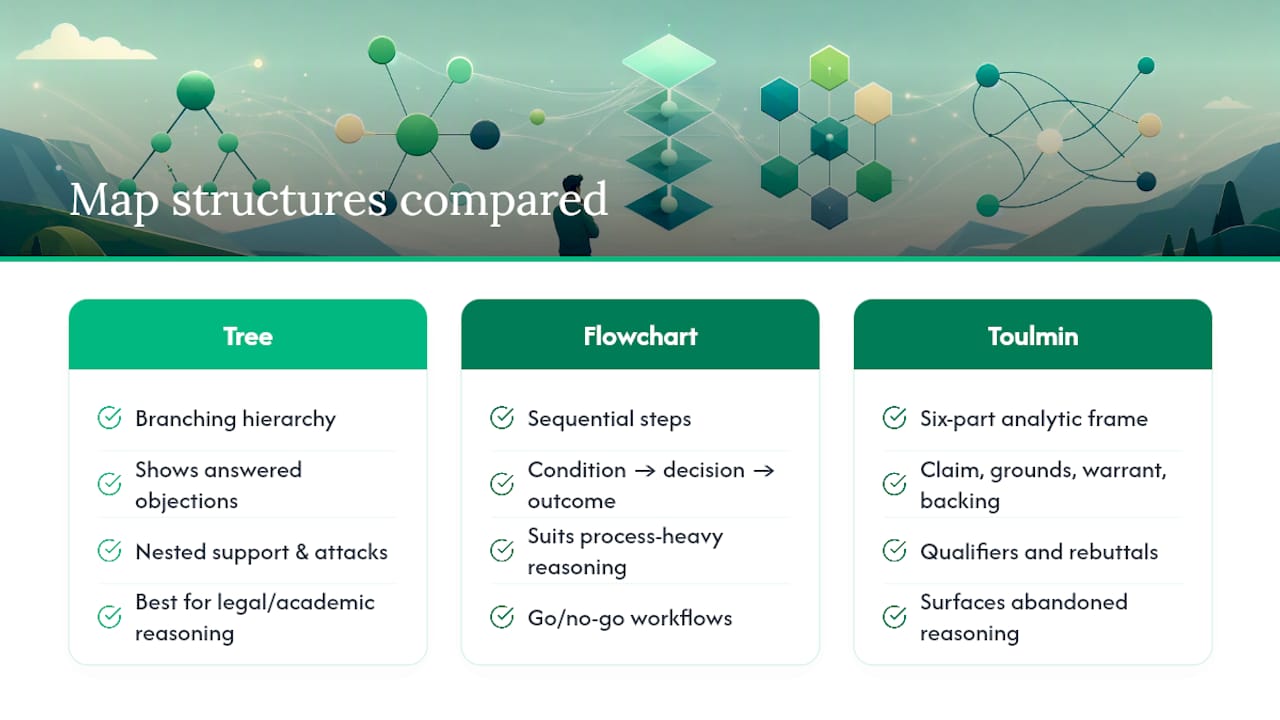
Flowchart-style maps follow a sequence instead of a hierarchy: this input leads to this decision point, which leads to that outcome. They suit process heavy reasoning, like a go/no go call that depends on a chain of conditions being met in order.
The Toulmin model, developed for analyzing everyday argumentation, breaks a claim into six parts: the claim itself, the grounds behind it, the warrant connecting grounds to claim, backing for the warrant, qualifiers on how confident the claim is, and rebuttals that would undercut it. Toulmin’s structure is where a decision journal’s confidence percentage and load-bearing assumptions fields actually come from, even if nobody in the room calls it that. Applied mapping work on real decisions shows this kind of structured breakdown is what surfaces abandoned lines of reasoning, the options a team considered and then quietly dropped without writing down why.
For a founder logging a pricing decision, you do not need the full academic apparatus. Borrow the discipline (grounds, warrant, rebuttal) and compress it into the fields your journal already tracks.
Software Options for Capturing and Mapping Arguments
Most teams start with what they already have: a shared document, a spreadsheet, or a wiki page per decision. That works for a handful of entries a month, but it breaks down fast once nobody remembers which document holds last quarter’s pricing rationale.
Purpose built decision-journal software solves the retrieval problem structurally instead of relying on someone’s memory of file names. Some decision-journal software is built around the fields this article covers: hypotheses, confidence levels, trade-offs, and outcome tracking, rather than a blank text box you have to structure yourself every time.
General purpose note tools (Notion, Obsidian, or a plain wiki) can be adapted into a decision log with enough discipline, and some teams prefer that flexibility. The tradeoff is that you build and maintain your own template, your own indexing convention, and your own reminder system for review dates. A team that wants facilitation techniques for surfacing disagreements before they get logged can find practical exercises in MYB Workshops’ collection on visual reasoning and clear communication, which pairs well with whatever tool holds the actual record.
The right choice depends less on features and more on whether the tool makes the review and retrieval steps easy enough that your team actually does them every quarter.
Argument Maps at Work: Academic, Legal, and Personal Cases
The mapping structures above show up well outside a startup’s decision log, and seeing them in other settings makes the pattern easier to spot in your own work.
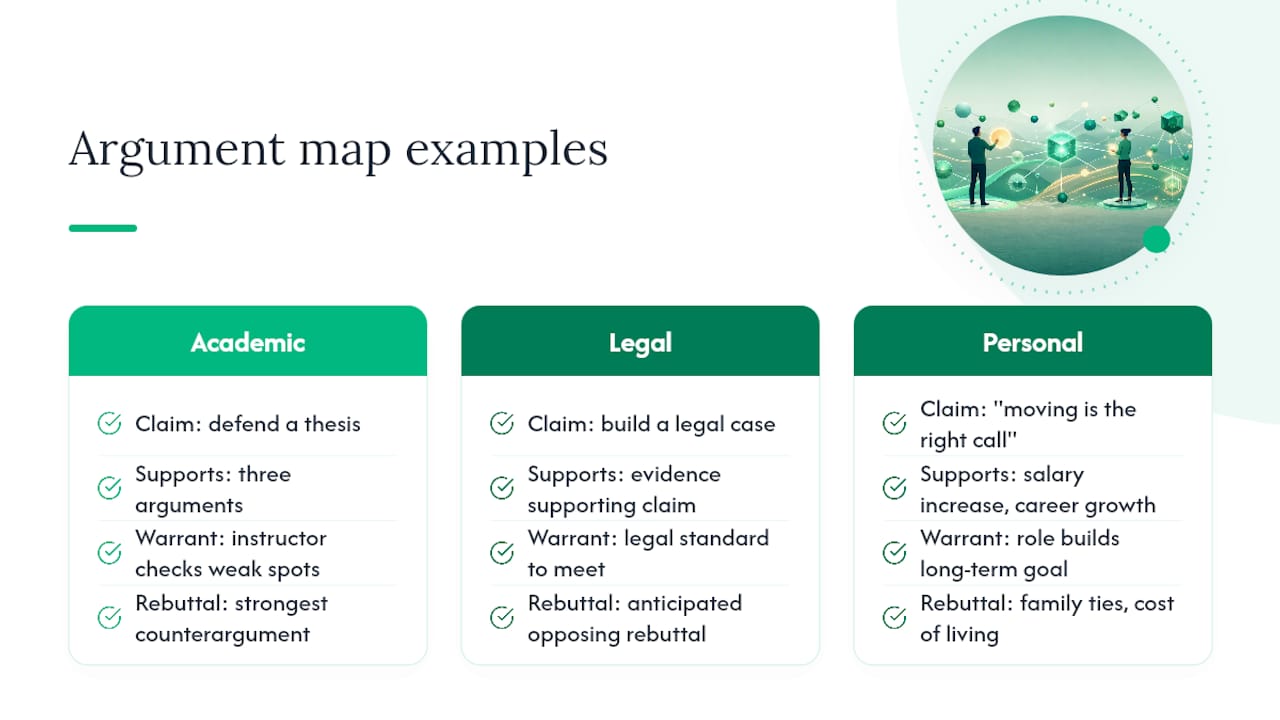
In academic writing, a student defending a thesis might map the central claim, three supporting arguments, and the strongest counterargument to each, then draft the paper directly from that structure. Instructors often use this to catch weak spots before a single paragraph gets written.
In legal reasoning, attorneys building a case map out the claim, the evidence supporting it, the legal standard that has to be met, and the anticipated rebuttal from opposing counsel. This is close to the Toulmin structure by design, since Toulmin’s model grew out of studying how legal and everyday arguments actually get made and defended.
A personal decision, like whether to relocate for a new role, maps just as cleanly: the claim (“moving is the right call”), the grounds (salary increase, career growth), the warrant (this role builds toward a specific long-term goal), and the rebuttal (family ties, cost of living). Write that structure down before deciding, and you get most of the benefit of a full decision-journal entry without the formal fields.
The throughline across all three cases is the same: forcing the reasoning into a visible structure exposes weak assumptions before they cost you something.
What Makes an Argument Map Good vs. Weak
A map is only as useful as its weakest assumption, so evaluating quality starts there, not at the conclusion. Ask whether each load-bearing assumption is actually testable. “The market will probably grow” is not testable.
Check for abandoned branches. A strong map shows the options you considered and rejected, along with why, not just the option you picked. If a map only shows the winning path, it was probably built after the decision to justify it, not before the decision to inform it.
Watch for circular support, where a claim is backed by evidence that itself depends on the claim being true. This shows up constantly in optimistic revenue projections that assume the exact growth rate they are trying to prove.
Finally, revisit the map against outcomes. A map’s real quality only becomes clear once you compare its confidence levels to what actually happened, which is why a decision journal without a review cadence never improves past the first draft. Calibration reviews that check stated confidence against real hit rates are the only reliable way to know whether your maps are getting sharper over time or just longer.
What Actually Changes When Teams Adopt This
Most teams underestimate how fast this becomes cultural rather than clerical. Within a few months, arguments in meetings shift because someone can pull up the reasoning from a similar call made in March instead of relitigating it from scratch. Onboarding gets faster too, since new hires read the log instead of asking around for context nobody quite remembers correctly.
The mistakes are predictable: editing a past entry instead of adding a new one, writing revisit_on as “if things change,” and logging every minor call until the signal disappears. Some decision journals include structure around confidence percentages and explicit trade-offs rather than outcome scoreboards, which matches this discipline directly instead of bolting it on as an afterthought.
— Phil
Try the Template Instead of Building Your Own
Building this system from scratch in a shared doc works for a while, until nobody remembers which file holds the March pricing decision or whether the revisit_on condition ever fired. Some decision journals provide structured fields like decision, rationale, confidence, revisit_on, and outcome already built into a format teams can use, instead of a blank page everyone formats differently.
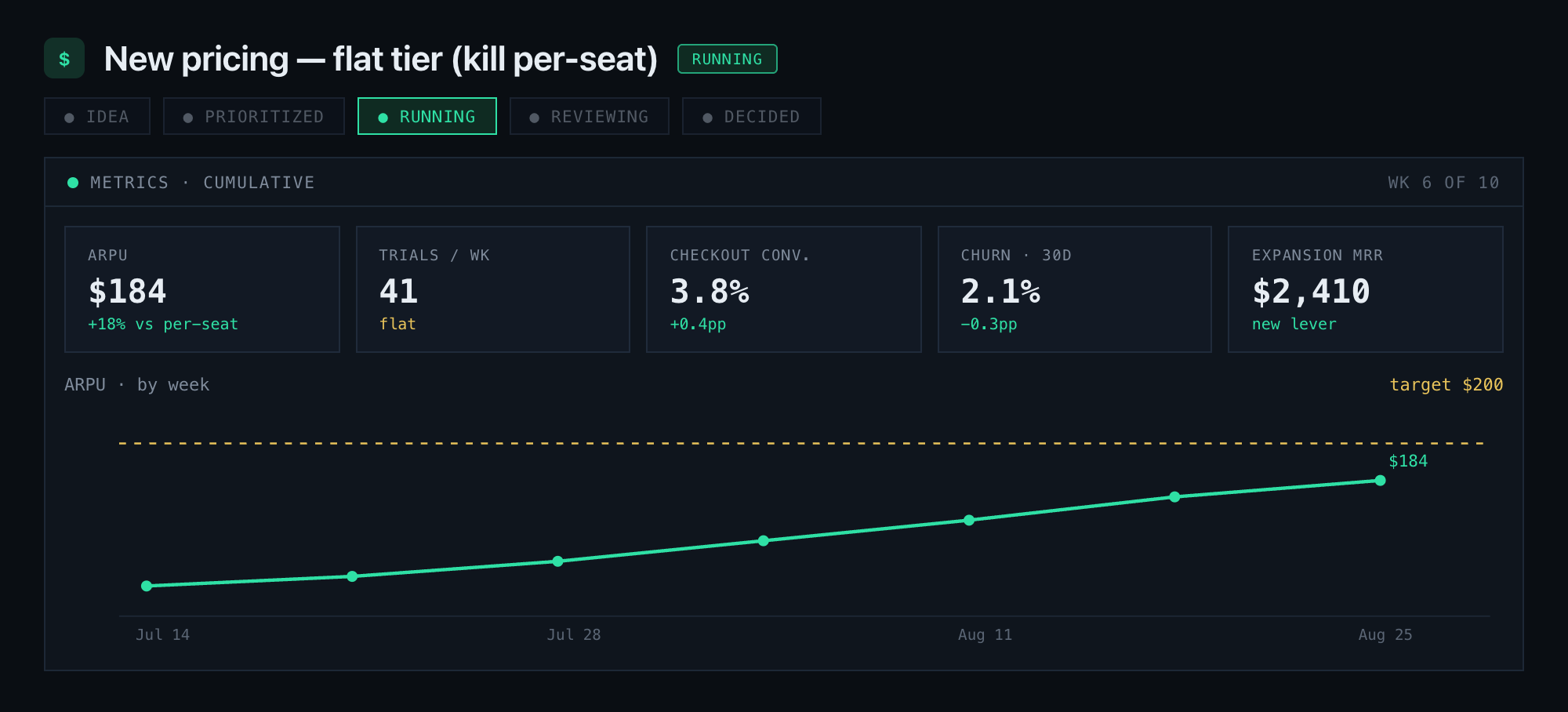
You do not need to design a taxonomy or convince your team to adopt a new habit cold. Betlog’s decision journal starts with a free tier, so you can log your next real decision today and see whether the practice sticks before committing to anything. Set up your first entry, add a revisit_on date, and check back on it when it fires.
Sources
- The Decision Log Template: Train Judgment Like a Muscle | falkster
- Decision Journals: Track Your Thinking to Improve It · Expected Value
- Decision Logs and Organizational Memory
- Decision logs in practice — TruPath Labs · Operating · 19
FAQ
What Is Argument Mapping in a Decision Journal?
It means recording the rationale behind a decision, including options considered, confidence level, and revisit conditions, at the time the decision is made rather than after the outcome is known.
How Is This Different From Traditional Argument Mapping?
Traditional argument mapping diagrams the logical structure of claims and objections for debate or philosophy; the decision-journal version tracks reasoning behind real organizational choices for future review.
How Often Should a Team Audit Its Decision Log?
A quarterly audit works well: check for unindexed entries, revisit_on conditions that have fired, and stale next_actions, then triage each into open, superseded, or follow-up.
What Belongs in the Revisit_on Field?
A specific, testable condition, like a metric crossing a threshold, never a vague phrase like “if circumstances change,” since vague triggers rarely get flagged during a review.
Does Betlog Support This Kind of Logging?
Betlog is built around the fields this workflow needs, hypotheses, confidence levels, trade-offs, and outcome tracking, so teams can start logging decisions without building their own template first.


