30–60 Minutes: Red Team Review With a Decision Journal for Founders
A 30–60 minute red team review for founders: a timed premortem with copyable templates and a decision journal that sets a 4–6 week revisit.

On this page
- When Does a Decision Actually Need a Red Team Review?
- Step-by-Step Red Team Review Protocol You Can Run Today
- Capturing the Review in a Decision Journal
- Copyable Templates and a Facilitator Checklist
- Getting the Habit to Stick
- A Practical Way to Run the Journal and Schedule Revisits
- Where to Go Deeper
- Sources
A red team review is a short, structured premortem and devil’s-advocate session where a small group imagines a decision has already failed, writes down why independently, then clusters the reasons into risks and mitigations before anyone commits. Run it for 30 to 60 minutes on any high-stakes, hard-to-reverse choice, and log the results in a decision journal. Skip it for anything you can undo in a week.
TL;DR:
- Red team reviews are most valuable for high-stakes decisions that are expensive or difficult to reverse, such as launching new products or signing multi-year contracts.
- The process emphasizes silent individual failure writing and clustering risks into categories like market or team risks, to avoid groupthink and surface sharper concerns.
- Allocate 10 to 20 minutes for risk clustering and prioritize mitigations, accept risks, or decide to kill the decision based on likelihood and severity scores.
- Document the decision, assumptions, risks, mitigations, and review date in a decision journal to ensure follow-up and learning over four to six weeks.
- Overuse diminishes credibility; start with one critical decision and strictly enforce the silent write and revisit process to maintain effectiveness.
When Does a Decision Actually Need a Red Team Review?
Most decisions don’t deserve one. Ordering the wrong software plan, picking a Tuesday meeting slot, testing a new subject line: these are cheap to reverse, so a formal session wastes time and trains your team to tune out when a real one matters.
The triage rule is simple: weigh stakes against reversibility. A decision that’s expensive to undo and hard to walk back deserves a full session. One that’s cheap or easily reversed gets a five-minute gut check at most, if that.
Decisions that consistently earn a red team review include:
- Pivoting your core product or business model
- Hiring a senior leader who will shape culture and decisions long after the hire
- Changing pricing in a way customers will notice and remember
- Launching something publicly that’s hard to walk back once it ships
- Signing a contract or lease with a multi-year commitment
The method works because of a psychological trick called prospective hindsight: telling people to assume failure has already happened, rather than asking “what could go wrong,” pulls out sharper, more specific answers. Harvard Business Review’s research on project premortems found that framing alone changes what people generate, and that writing individually before discussing produces more independent, less groupthink-driven ideas than an open conversation. Formalizing a devil’s advocate role does something similar: it gives one person social permission to disagree, which research on structured dissent links to more voiced concerns and fewer suppressed doubts.
Step-by-Step Red Team Review Protocol You Can Run Today
Here’s the version you can actually run this week, no facilitator training required.
1. Prep the brief (before the meeting). Write one paragraph: the decision on the table, the option you’re leaning toward, and the date you need to decide by. Send it to three to six invitees who understand the stakes, not just people who agree with you.
2. Silent write (5 to 10 minutes). Everyone opens the meeting by writing individually: “It’s six months from now and this decision failed badly. Why?” No talking, no typing in a shared doc where others can see it yet. This step is the one people skip first, and it’s the one that matters most, because talking first anchors the whole room to whoever speaks first.
3. Round-robin reading and clustering (10 to 15 minutes). Go around the room. Each person reads their failure reasons aloud, one at a time, no rebuttals yet. Someone (the note-taker) groups similar reasons into clusters: execution risk, market risk, team risk, financial risk.
4. Prioritize and decide (10 to 20 minutes). For each cluster, rate likelihood and severity, roughly high, medium, or low. Anything that lands high on both gets one of three labels: mitigate (assign an owner and an action), accept (write down why you’re accepting the risk), or kill (this decision doesn’t survive contact with this risk).
5. Assign a devil’s advocate for the next big decision now, before this meeting ends. Rotating the role matters. The same person playing devil’s advocate every time gets typecast as the office pessimist and starts holding back, which defeats the point.
Pro Tip: Keep the facilitator out of the debate entirely. Their only job is running the clock and making sure the silent-write phase actually stays silent. The moment a facilitator argues a position, half the room stops arguing theirs.
Timebox the whole thing to about an hour for major decisions and about half an hour for moderate ones. If discussions run longer, consider wrapping up and moving on to capturing the outcomes.
Capturing the Review in a Decision Journal
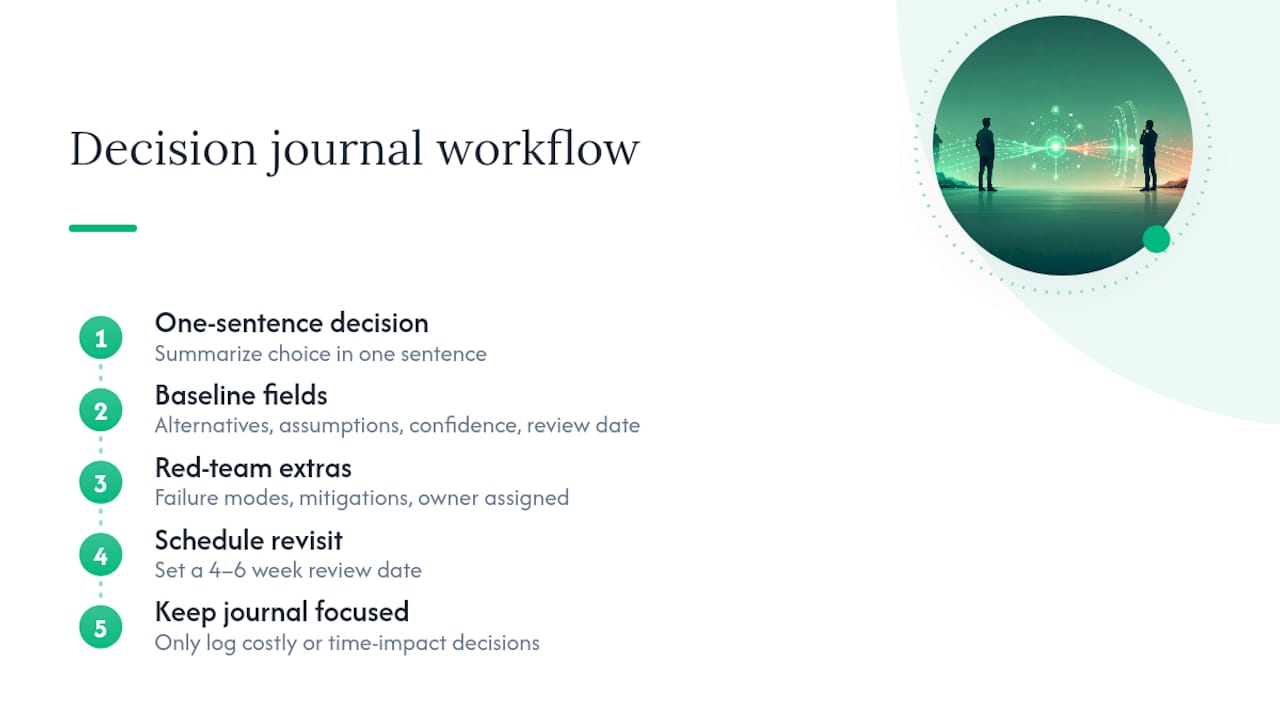
A red team session that isn’t written down evaporates by the next fire drill. The fix is a decision journal entry with five baseline fields plus a handful of red-team extras.
Each journal entry should capture the decision in one sentence, the alternatives seriously considered and rejected, key assumptions, a stated confidence level, and a planned review date several weeks later.
The red-team extras layer on top: the failure modes your team surfaced, the mitigations assigned to each one, and an owner responsible for checking whether those mitigations actually happened. A short decision log entry paired with a scheduled revisit is what turns a static archive into an actual learning loop, rather than a graveyard of good intentions nobody rereads.
The revisit is the part almost everyone skips, and it’s the part that makes the whole ritual worth the hour you spent on it. Come back four to six weeks after the decision and ask: did the assumptions hold? Did the mitigations happen? Was the confidence level justified? Feedback loops like this one are what groupthink and organizational-dissent research points to as the mechanism that actually corrects overconfidence over time, not the initial session itself.
One more thing worth saying plainly: don’t log everything. A journal cluttered with what-to-order-for-lunch entries buries the pivots and hires that actually need rereading. Reserve it for decisions where being wrong costs you real time or money, and assign one person to own the revisit calendar so it doesn’t quietly die.
Copyable Templates and a Facilitator Checklist
Paste these into whatever tool your team already uses.
Meeting brief (one paragraph): “We’re deciding [X] by [date]. Current leaning: [option]. Stakes if wrong: [cost/time/reputation]. Please come with your own read before we talk.”
Red-team worksheet prompts: “If this fails in six months, what’s the headline?” Then cluster answers into execution, market, team, and financial risk buckets, per the Asana premortem framework, which treats these outputs as risk-register entries rather than a venting exercise.
Facilitator checklist:
- Timebox announced and visible to the room
- Silent write actually enforced, no early talking
- Every high-likelihood, high-severity risk gets a mitigation or a kill decision
- Review date set before anyone leaves the room
| Element | What it captures |
|---|---|
| Decision statement | One sentence, unambiguous |
| Assumptions | What has to be true for this to work |
| Confidence level | Numeric or banded estimate |
| Mitigations + owner | Action tied to a name |
| Review date | four to six weeks later |
Getting the Habit to Stick
Most teams that try this once and quit made the same mistake: they ran it on everything, including decisions nobody was actually worried about. That kills credibility fast. Start with one real decision, the one keeping you up at night, and protect the silent-write phase like it’s the whole point, because it is.
The traps are predictable. Overuse turns the ritual into theater. Skipping the follow-up turns the journal into a filing cabinet nobody opens. A compact, timed script beats an open-ended workshop every time, because founders don’t have room for another meeting that could run long.
— Phil
A Practical Way to Run the Journal and Schedule Revisits
A decision journal tool is built for exactly the ritual described above: a place where you log the decision instead of letting a red team review live and die in a single meeting. Such a tool can record the hypothesis behind a decision, confidence level, trade-offs weighed, and mitigations assigned, then set the review date automatically so the four-to-six-week revisit happens without anyone having to remember it.
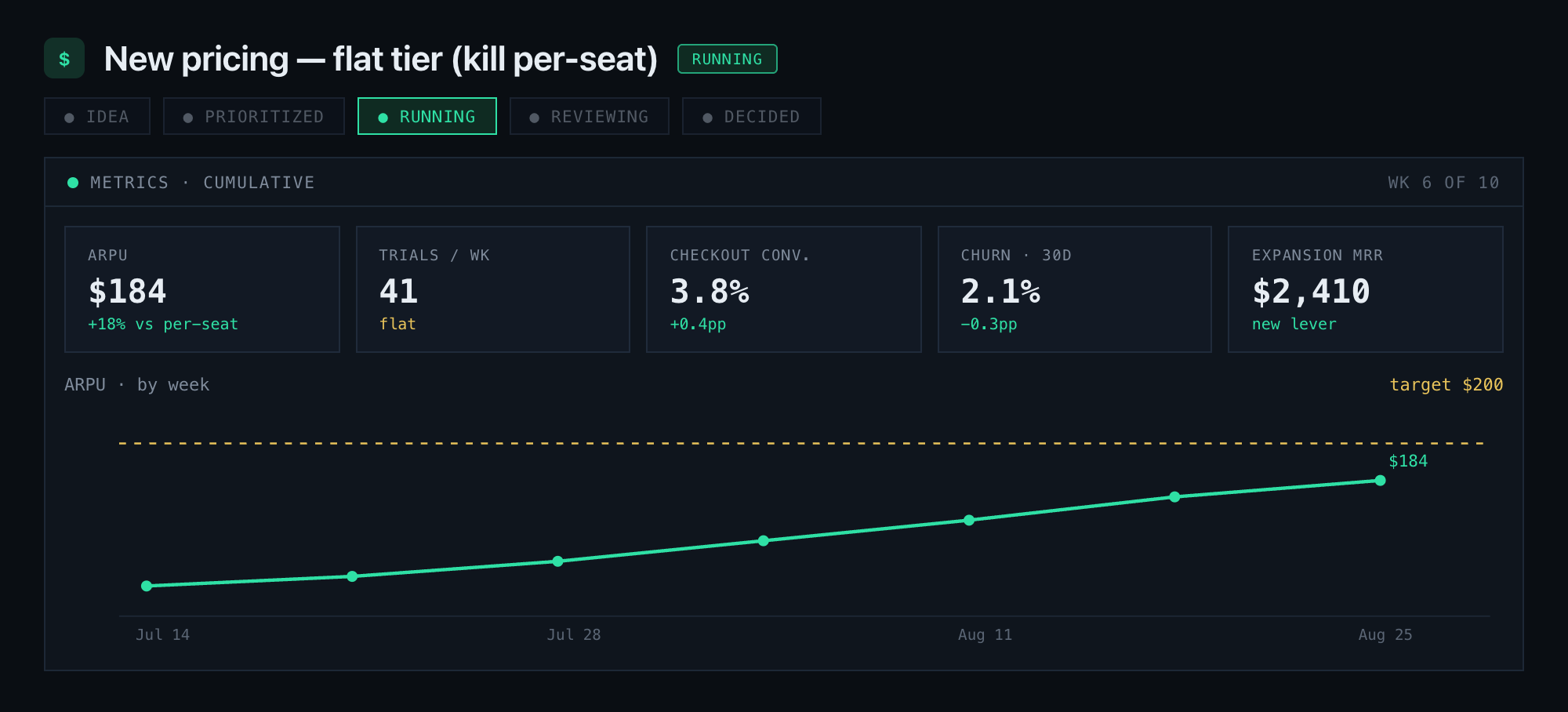
Every field from the templates above maps directly onto a decision journal entry: the assumptions, the owner, the status, the outcome once known. No spreadsheet to maintain, no calendar reminder you’ll eventually ignore. If you want to see what a completed entry actually looks like before you commit your own team to it, visit Betlog and walk through a sample decision from premortem to revisit.
Where to Go Deeper

For the original research behind the premortem method, read Gary Klein’s Harvard Business Review piece on project premortems. For the academic grounding on structured dissent, see the devil’s advocacy literature review. Practical writeups worth bookmarking include Expected Value’s guide to pre-mortems, Asana’s premortem resource, and Inc.'s piece on starting a decision journal.


