Log Your Next 3 Bets: Six Field Business Wargaming for Founders
Founders: use six field entries and a five stage lifecycle to log bets, sharpen calibration, and view a pricing bet example.

On this page
- What Is Business Wargaming as a Decision-Journal Practice?
- Why Does Decision Journaling Reduce Outcome Bias?
- How Do You Run Business Wargaming as a Team Workflow?
- A Worked Example: Logging a Pricing Experiment
- Common Pitfalls in Business Wargaming (and How to Fix Them)
- Strategy Is a Portfolio, Not a Scoreboard
- How Betlog Puts This Into Practice
- Useful Reading on Decision Journaling and Calibration
- Sources
- FAQ
Business wargaming, in this article, means one thing: a decision journal that treats every consequential choice as a bet. You log the decision, a numeric confidence, and a review date before you know how it turns out. That single habit does what most strategy meetings don’t. It separates whether you decided well from whether you got lucky, and it gives you the data to tell the difference next time.
TL;DR:
- Business wargaming relies on immutable decision entries with clear reasoning, assumptions, and falsifiability, making it possible to evaluate decision quality independently of outcomes.
- Logging a confidence level for each decision allows teams to measure calibration over time and identify overconfidence or bias in their judgment.
- Short-term bets are reviewed in two to four weeks, medium-term bets in one to three months, and long-term bets quarterly, based on the decision’s horizon.
- Premortems expose hidden failure modes by imagining the decision has already failed, improving the team’s ability to anticipate risks before making bets.
- Maintaining discipline and consistency in decision journaling, including avoiding editing past entries and logging all bets, is crucial for developing decision-making skill and calibration.
What Is Business Wargaming as a Decision-Journal Practice?
Business wargaming, in the sense used here, is not a facilitated simulation with actors playing competitors. It’s decision journaling applied to real bets: pricing changes, hires, roadmap calls, pivots. Every entry captures six fields, and every bet moves through a predictable lifecycle before you’re allowed to call it won or lost.
The six fields matter because each one closes off a different way teams fool themselves later:
- Decision: the specific choice, stated plainly (“Raise the Pro plan from $29 to $39”).
- Reasoning: why this option beat the alternatives you considered.
- Assumptions: the facts you’re taking on faith, which is where most bad bets actually break.
- Expected outcome and confidence: a stated result plus a number, like “70% chance churn stays under 4%.”
- Falsifiability: what result would prove you wrong. Without this, every outcome gets reinterpreted as a win.
- Review date: a fixed point when the bet gets judged, not whenever it’s convenient.
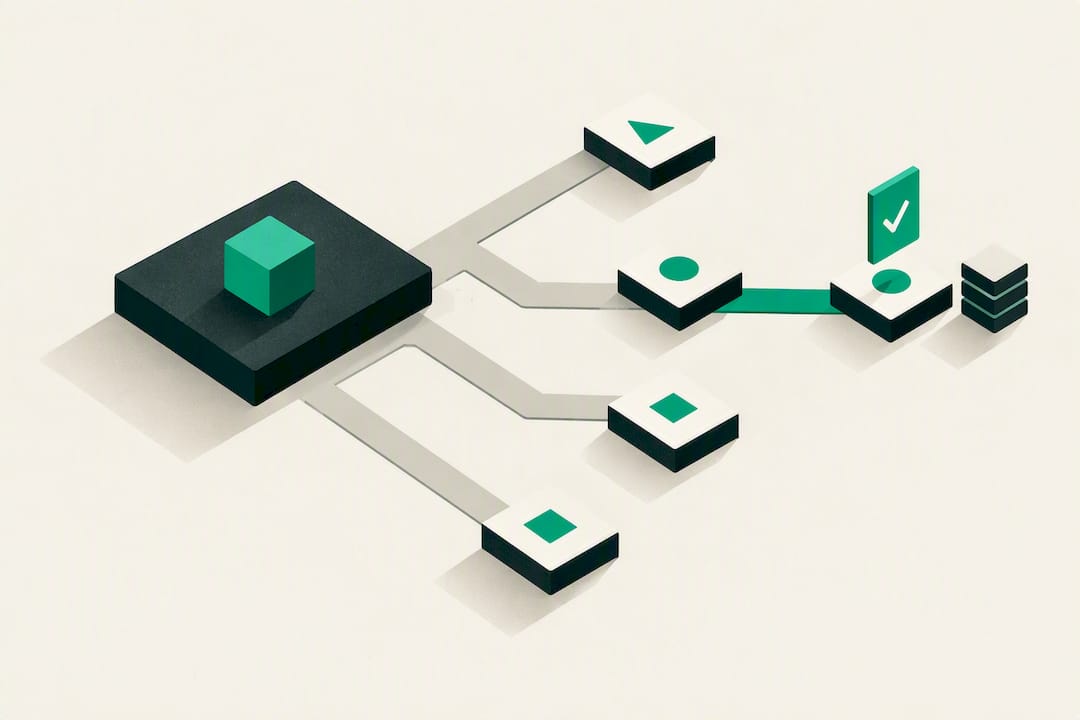
Bets then move through five stages: Idea, Prioritized, Running, Reviewing, and Decided. Each transition is a decision in itself. Moving something from Idea to Prioritized means you’ve committed resources; moving it to Decided means the verdict, Won, Killed, or Inconclusive, is now permanent. Most teams find a real entry takes 5 to 10 minutes, per practical decision journal guidance. The catch is that entries have to stay immutable once written. Editing a past prediction after you know the outcome doesn’t clean up the record. It erases the only thing that made the record useful.
Why Does Decision Journaling Reduce Outcome Bias?
Poker players call it “resulting”: judging a decision purely by how it turned out, as if a good process and a good result were the same thing. A smart pricing test that loses to bad market timing gets filed as a mistake. A reckless hire that happens to work out gets filed as good judgment. Neither conclusion is true, and both get baked into company memory unless something stops them.
That something is a timestamped record written before the outcome exists. Hindsight bias research shows people systematically distort their own past reasoning once they know how things turned out, often convincing themselves they “knew it all along.” A written confidence number closes that loophole because it can’t be quietly revised.
The calibration signal: if you log 20 decisions at “80% confident” and only 12 actually pan out, you’re overconfident by a wide margin, and now you know it instead of guessing.
Comparing predicted probabilities against real outcomes over a batch of bets produces a calibration score. That’s the actual payoff. It’s not a philosophy, it’s a number your team can watch improve, and it makes dissent safer because disagreement is about a probability estimate, not a personal attack.
How Do You Run Business Wargaming as a Team Workflow?
The mechanics are simple enough to start this week, but the discipline is where most teams quietly quit after three entries.
- Assign ownership. The person accountable for the decision writes the entry, even for group calls. Someone still has to synthesize the room into one confidence number.
- Set cadence by horizon. Short bets (a pricing tweak, an onboarding copy change) get a review date 2 to 4 weeks out. Medium bets (a new feature line, a hiring plan) land at 1 to 3 months. Long bets (market entry, a pivot) get quarterly checkpoints even before the final verdict.
- Run a short premortem before committing. Give the group 5 to 15 minutes to imagine the bet has already failed and write down why. This format, studied directly in premortem field and lab research, reliably surfaces more failure modes than an open pro/con discussion, and a short group version can run in as little as 5 to 15 minutes.
- Decide what triggers an update versus a new entry. New information doesn’t get folded into the old text. It becomes a dated addendum, so the original prediction survives untouched.
- Score calibration in batches. Group closed bets by category (pricing, hiring, product) and compare average stated confidence to the actual win rate in that category.
Pro Tip: Run the premortem out loud with the whole group before anyone writes their confidence number down. People anchor hard on the first number spoken, and a premortem first breaks that anchor before it forms.
Ownership without cadence just produces a pile of orphaned entries. Cadence without the premortem step produces confident predictions with the obvious failure modes never written down anywhere.

A Worked Example: Logging a Pricing Experiment

Here’s what a real entry looks like, using a founder testing a price increase on a single SKU.
The setup: monthly recurring revenue has plateaued, and the founder suspects the Pro plan is underpriced relative to the value customers report getting from it.
- Decision: Raise Pro plan pricing from $29/month to $39/month for new signups only, existing customers grandfathered for 90 days.
- Reasoning: Support tickets and win/loss calls both suggest price is not the top objection; usage data shows heavy adoption of features gated behind Pro.
- Assumptions: Conversion rate from trial to paid won’t drop by more than 15%, and competitors won’t undercut visibly within the test window.
- Expected outcome and confidence: Net new MRR increases by at least 20% within 60 days. Confidence: 65%.
- Falsifiability: If trial-to-paid conversion drops more than 20% or churn among new cohorts exceeds 8%, the bet is wrong regardless of MRR.
- Review date: 60 days out, on the calendar the day the price change ships.
The founder’s premortem had flagged “sales team resists explaining the increase” as the top failure mode, and that’s exactly what softened results, not price resistance itself. The post-mortem separates that cleanly: the pricing hypothesis wasn’t wrong, the rollout support was. The bet closes Inconclusive rather than Killed, and the recorded learning is about sales enablement, not price elasticity.
Common Pitfalls in Business Wargaming (and How to Fix Them)
Most decision journals fail quietly, not dramatically. The four failure modes to watch for:
- Inconsistent use. Logging only the wins or only the dramatic bets biases the whole calibration dataset.
- Editing past entries. Once an outcome is known, even a small wording tweak to the original reasoning corrupts the record.
- Skipping the confidence number. A prediction without a percentage can’t be scored later, which quietly defeats the entire point.
- Treating outcome as verdict. A loss doesn’t automatically mean bad process, and a win doesn’t automatically mean good process.
Premortems are the single best-evidenced fix for the first problem. HBR’s original framing describes teams imagining the project has already failed and working backward to explain why, a format that surfaces failure modes a standard risk review misses. A workable script: 10 minutes silent writing, “this bet failed, what went wrong,” followed by a round where everyone reads one reason aloud before discussion opens.
For the reversal problem, that moment when a team wants to quietly abandon a bet mid-flight because early signal looks bad, a precommitment device helps. Revocable precommitments, used sparingly, work by requiring a deliberate override step rather than an easy exit, and current research on reducing impulsive decisions supports the pattern. Use it for the two or three bets a quarter that matter most, not everything.
Strategy Is a Portfolio, Not a Scoreboard
Founders tend to treat each decision like a verdict on their judgment. That’s the wrong frame. A single bet tells you almost nothing; a portfolio of 40 or 50 logged bets a year starts telling you something real about your calibration, and calibration is the actual skill worth building.
Expect the first quarter of entries to feel clumsy and the confidence numbers to feel made up. They are, a little, at first. That changes once you have enough closed bets in one category, pricing, hiring, product, to compare stated confidence against actual results. Don’t try to log everything. Log the decisions that would embarrass you to get wrong twice, and the pattern will show up faster than you expect.
— Cesar
How Betlog Puts This Into Practice
Betlog is built directly around the six-field entry and the staged lifecycle described above. Every bet moves through Idea, Prioritized, Running, Reviewing, and Decided with the reasoning, assumptions, confidence number, and falsifiability criteria locked in before anyone knows the outcome.
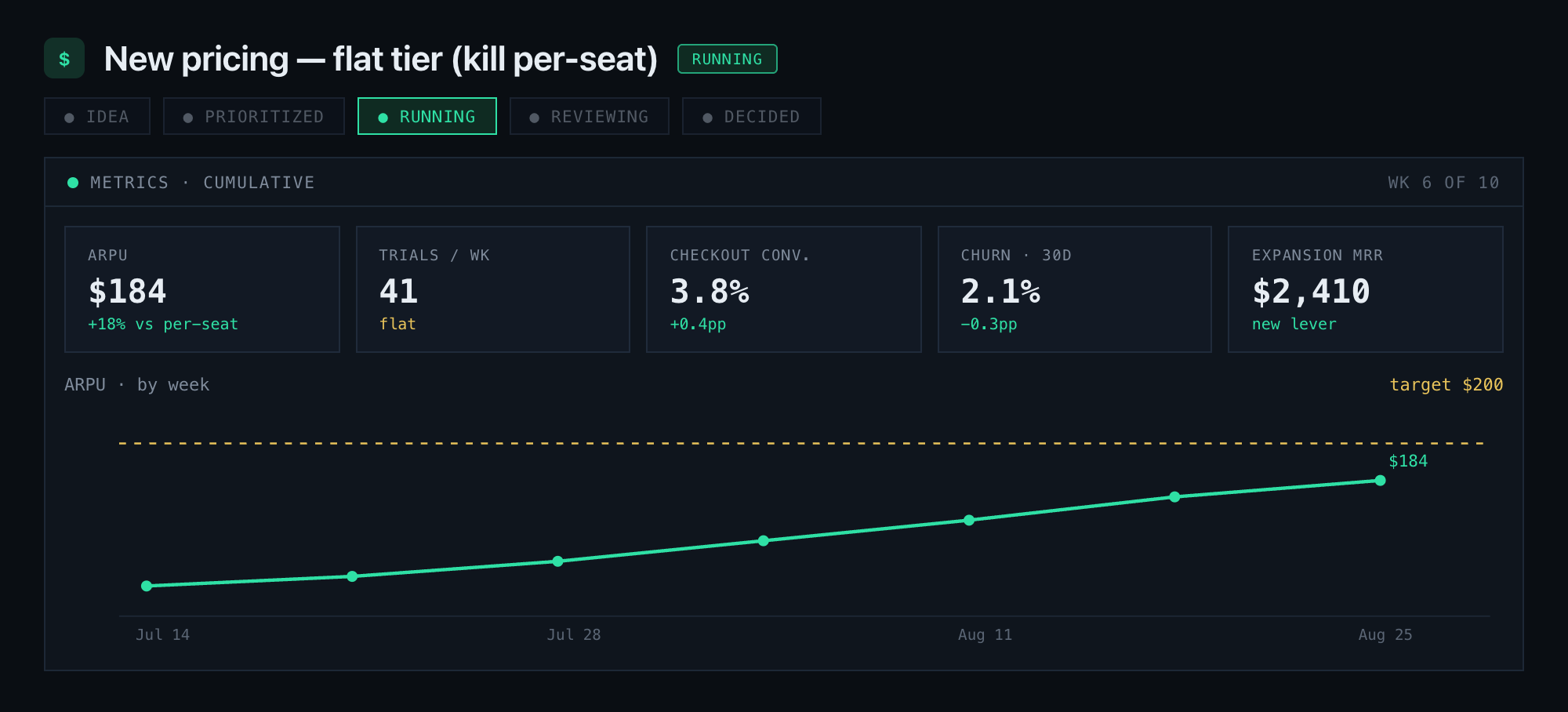
Once a bet closes, Betlog runs the post-mortem step that separates decision quality from luck and rolls it into your team’s calibration history, so you can see whether your 70% confidence bets actually win about 70% of the time. If you’re testing whether premortems and precommitments belong in your own process, a structured team process framework is worth a look for the operational side, while Betlog handles the permanent record. Entries stay immutable once written, by design, so nobody quietly rewrites history after a bet goes sideways.
Betlog runs one plan at $39 per month or $390 per year. Start by logging your next three consequential bets this week, and check the product overview to see how the staged workflow maps onto your team’s current process.
Useful Reading on Decision Journaling and Calibration
- Thinking in Bets — Annie Duke: the foundational case for treating decisions as bets.
- Performing a Project Premortem — HBR: the original premortem framework.
- Premortem technique evaluation — MTU thesis: field and lab validation.
- Revocable precommitment research — PMC: behavioral evidence on reducing impulsive reversals.
Sources
- Performing a project premortem — HBR
- Improving Planning: Quantitative Evaluation of the Premortem Technique in Field and Laboratory Settings — MTU thesis
- The effectiveness of revocable precommitment strategies in reducing decision-making impulsivity — PMC (2024)
FAQ
What Is Business Wargaming in a Decision-Journal Sense?
It’s the practice of logging a consequential business decision, its reasoning, a numeric confidence level, and a fixed review date before you know the result. That written record lets you judge decision quality separately from whatever outcome eventually happens.
How Often Should a Team Review Logged Bets?
Short bets typically get reviewed in 2 to 4 weeks, medium bets in 1 to 3 months, and long, strategic bets on quarterly checkpoints. The review date gets set the moment the bet is logged, not whenever the outcome starts looking clear.
What Is a Premortem and Why Use One?
A premortem asks the team to imagine a decision has already failed and write down why, before the decision is made. HBR’s premortem research shows this surfaces more failure modes than a standard risk discussion, and a short group version can run in 5 to 15 minutes.
Does Betlog Replace a Full Strategy Simulation?
No. Betlog is a decision journal, not a role-play simulation of competitors or markets. It records hypotheses, confidence, trade-offs, and post-mortems for real bets your team is actually making, with pricing at $39 per month or $390 per year.
How Do You Measure Calibration Over Time?
Group closed bets by category, like pricing or hiring, and compare the average confidence you stated against how often those bets actually won. Tracking by category matters because base rates differ sharply between decision types.