Founders: Decision-Making Frameworks to Route Bets and Log Outcomes
Guide for founders and product leads to route choices with a Decision Type Filter, choose fitting frameworks, and log bets to sharpen judgment.
On this page
- What Is a Decision-Making Framework?
- How Do You Route a Decision to the Right Process?
- Which Framework Should You Use for Which Decision?
- How Do You Actually Run a Framework Step by Step?
- What Does a Full Decision Look Like From Hypothesis to Post-Mortem?
- Where Do Teams Get Frameworks Wrong?
- Turn This Workflow Into a Habit, Not a One-Off Exercise
- Sources
- FAQ
Decision-making frameworks improve decision quality when you choose one that matches the decision’s reversibility, stakes, and time available. Pick the wrong one, and you get slow committees on trivial choices or reckless speed on irreversible bets. The rest of this guide gives you a filter for routing decisions, a short catalog of the frameworks worth knowing, and a worked example of running one from hypothesis to post-mortem.
TL;DR:
- Decision-making frameworks are most effective for high-stakes, ambiguous, or irreversible decisions and less useful for trivial or fully reversible choices.
- Classifying decisions by reversibility, stakes, and time helps determine whether to skip, apply a quick process, or use an in-depth framework.
- The most common mistakes are relying on frameworks as trust substitutes or judging decisions solely by outcomes instead of reasoning at the moment.
- Using structured steps such as evidence thresholds, time-boxing, and ownership assignment ensures frameworks promote learning and better decision quality.
- Building a decision journal over time reinforces good judgment and helps teams distinguish skill from luck, turning single decisions into continuous improvement.
What Is a Decision-Making Framework?
A decision-making framework is a repeatable process for organizing information, weighing trade-offs, and reaching a defensible choice, instead of relying on whoever argues loudest in the room. It does not make the decision for you. It structures the inputs so your judgment has less noise to fight through.
The evidence for this is stronger than most leaders assume. Mediated evaluations that convert complex judgments into structured scores measurably reduce bias and noise compared to unstructured discussion. Separately, research applying machine learning to classical decision theories found that constrained, interpretable models often predict human choices better than pure intuition, which is a fairly direct rebuttal to “just trust your gut” thinking for consequential calls.
Frameworks earn their keep on decisions with real stakes, ambiguity, or competing incentives in the room. They start to hurt you in a few specific situations:
- Trivial or fully reversible calls. Running a scoring matrix on which font to use wastes everyone’s time.
- Genuine emergencies. No framework beats trained reflexes when the building is on fire.
- Teams that use process as cover. A framework can become a way to avoid owning a call, which erodes trust faster than a bad decision would.
Use one when the decision is worth the friction. Skip it when it isn’t.
How Do You Route a Decision to the Right Process?
Before picking a framework, classify the decision using three questions, based on the Decision Type Filter that practitioner guides consistently recommend for routing decisions by reversibility, stakes, and time:
- Is it reversible? Can you undo or cheaply adjust this later, or is it a one-way door?
- What’s at stake? Would a wrong call cost you a afternoon, a quarter, or the company?
- How much time do you actually have? Real deadline, or self-imposed urgency?
The answers sort into four rough boxes. Reversible, low-stakes decisions (which vendor to try for a month) deserve almost no process. Just decide and move. Irreversible, high-stakes decisions (a pricing model change that resets customer expectations, a cofounder split) deserve the heaviest process you have, including a formal pre-mortem before you commit. High-stakes but reversible decisions (a risky ad campaign you can pull in a week) get moderate structure with a tight kill window. Low-stakes but irreversible decisions (a company name) get a quick framework mostly to avoid regret, not to optimize.
The most useful move here is often redesigning the decision itself. Instead of “should we sign this 12-month enterprise contract,” ask “can we structure a 60-day pilot first.” Research on decision-making under uncertainty backs this instinct directly: leaders should unbundle large, irreversible decisions into smaller reversible components wherever the choice allows it, rather than treating every big decision as one indivisible bet.

Which Framework Should You Use for Which Decision?
Once you know the decision’s type, the framework choice gets much easier. Here’s the practical catalog, ordered by the kind of situation each one solves.
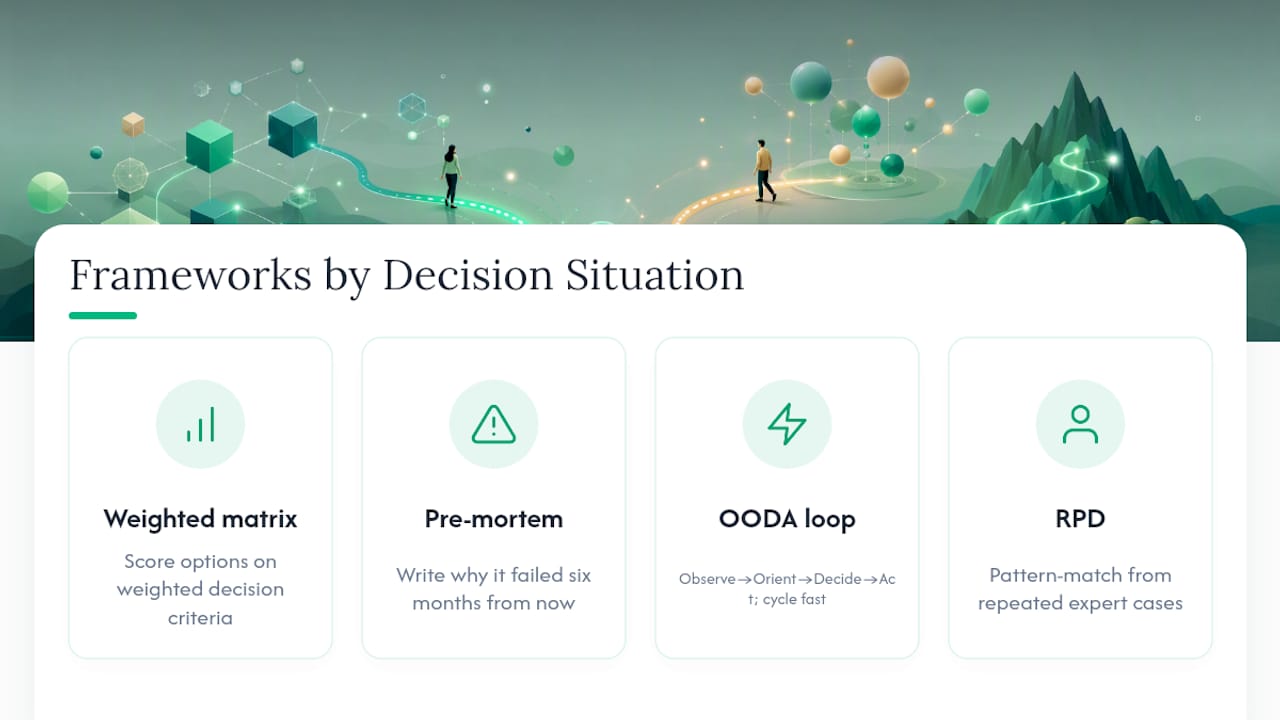
Weighted decision matrix. Best when you have three or more options and can name the criteria that matter (cost, speed, risk, strategic fit). List options as rows, criteria as columns, weight each criterion, and score every option. This is close to the logic behind the Mediating Assessments Protocol: breaking a fuzzy overall judgment into smaller, independently scored components produces more consistent results than ranking options holistically.
Pre-mortem. Before committing to an irreversible or high-stakes decision, gather the team and ask everyone to write down why the decision failed, as if it’s already six months from now and it flopped. This “prospective hindsight” technique produces richer, more specific failure explanations than asking people to simply list risks in the present tense, because it removes the social pressure of predicting failure and reframes it as explaining a fact.
OODA loop. Observe, Orient, Decide, Act. Built for environments where conditions change faster than you can gather complete information: competitive product launches, incident response, fast-moving negotiations. The point isn’t accuracy on any single loop. It’s cycling faster than the situation changes.
Recognition-Primed Decision (RPD). For experienced people making fast calls in familiar territory. A veteran support lead spotting a churn pattern in seconds isn’t skipping analysis. She’s pattern-matching against hundreds of prior cases. RPD works when your team has genuine repetition-based expertise, and it fails badly when a novice mistakes confidence for pattern recognition.
Decision trees. Use these when choices are sequential and each branch depends on an earlier outcome. Hiring decisions with multiple interview stages, or pricing tiers with conditional discounts, map cleanly onto a tree because you can assign rough probabilities to each branch.
Eisenhower matrix. Sorts tasks and small decisions by urgency and importance into four quadrants. It’s a triage tool, not a deliberation tool. Use it to decide what deserves a framework at all, not to resolve the decision itself.
Six Thinking Hats. A group facilitation method that assigns each participant a “hat” (facts, feelings, risks, benefits, creativity, process) so the team stops arguing multiple modes of thinking simultaneously. Genuinely useful for teams where debates spiral because one person is arguing data while another is arguing gut feel.
10-10-10 rule. Ask how you’ll feel about this decision in 10 minutes, 10 months, and 10 years. It’s a cheap, fast counter to present bias, particularly useful for decisions colored by short-term emotion (a heated argument, a tempting shortcut).
Role-based frameworks (RACI, DACI, RAPID). These solve a different problem entirely: not what to decide, but who decides. Clarifying who is Responsible, Accountable, Consulted, and Informed prevents the most common organizational failure mode, which is a decision made twice by two different people who each thought they owned it. Leadership research on decision roles backs this: matching process and authority to context is as important as the analytical method itself.
Lightweight experiments and pretotypes. For reversible bets, the fastest framework is often no framework at all: a landing page, a fake-door test, a manual version of the feature before you build it. These convert an unknowable question into a small, cheap, real answer.
Pro Tip: Don’t reach for a heavyweight framework by default. Start with the Decision Type Filter, and if the decision lands in the reversible, lower-stakes boxes, a 15-minute weighted matrix or a quick pretotype almost always beats a two-hour workshop.
How Do You Actually Run a Framework Step by Step?
Choosing a framework is only half the job. Most decision failures come from skipping the operating rhythm around it, not from picking the wrong model.
- Classify the decision. Run it through the Decision Type Filter: reversibility, stakes, time. This alone determines whether you need five minutes or five days.
- Set your evidence threshold before you look at evidence. Write down what would actually change your mind. Structured decision making processes built for complex resource choices use exactly this move, formalizing objectives and consequence tables before evaluating any option, which prevents the evaluation from bending to whatever answer people already wanted.
- Pick a framework and time-box the deliberation. Decision velocity matters. Frameworks fail in practice when they ignore how long the analysis is allowed to run, letting a matrix session sprawl into a week of second-guessing.
- Set stopping rules and ownership, then record the decision. Name who owns the call, what evidence closes the debate, and write the reasoning down before you know the outcome. This single habit is what separates teams that learn from teams that just accumulate opinions.
- Schedule the review. Put a post-mortem or check-in date on the calendar at the moment you decide, not after results come in. Reviewing only the decisions that turned out badly teaches you nothing about the ones that succeeded by luck.
What Does a Full Decision Look Like From Hypothesis to Post-Mortem?
Here’s a compact, real-world shaped example.
- Hypothesis: Raising the price 20% will cut new signups by less than 15% and increase net revenue within 60 days.
- Confidence: a moderate confidence level, expressed as a number rather than qualitative terms.
- Stakes and reversibility: Moderate stakes, mostly reversible. Price can be rolled back within a billing cycle if signups collapse.
- Metrics that decide it: New trial starts, upgrade rate, and net revenue at day 30 and day 60.
- Kill criteria: If new signups drop more than 25% by day 14, revert immediately.
- What would prove the hypothesis wrong: A drop in signups steep enough that even higher per-user revenue doesn’t offset it.
The post-mortem’s real job is to separate skill from luck: did the team’s model of price elasticity hold, or did a competitor’s outage that same month inflate the numbers?
Calibration comes from doing this repeatedly and comparing predicted probabilities to what actually happened. A pattern across dozens does. Tools built specifically to enforce this kind of record, like Betlog, exist because most teams intend to write hypotheses down and almost never actually do it once things get busy.
Where Do Teams Get Frameworks Wrong?
The biggest mistake I see is treating a framework as a substitute for trust. If your team doesn’t trust each other’s judgment, a scoring matrix won’t fix that. It’ll just give people a more sophisticated way to fight, or a paper trail to hide behind when a decision goes sideways. Frameworks are for decisions that need structure, not for decisions where the real problem is a broken relationship.
The second mistake is “resulting”: judging the decision by the outcome instead of the reasoning at the time. The fix isn’t complicated, but it is uncomfortable. Commit to a review ritual before you know how things turn out, and grade the reasoning, not the scoreboard.
Practically: teach your team the Decision Type Filter before you teach them any specific framework. Run a pre-mortem on every genuine one-way door. And time-box every review meeting, because open-ended retrospectives drift into blame sessions instead of calibration exercises.
— Cesar
Turn This Workflow Into a Habit, Not a One-Off Exercise
Frameworks help you make one good decision. A decision journal is what makes the next fifty better, because it forces the hypothesis, confidence level, and kill criteria onto paper before anyone knows how things turned out. Some decision journal tools build this directly into how a team works: every bet captures the reasoning up front and closes with a real verdict, so results never quietly rewrite what people actually believed at the time.
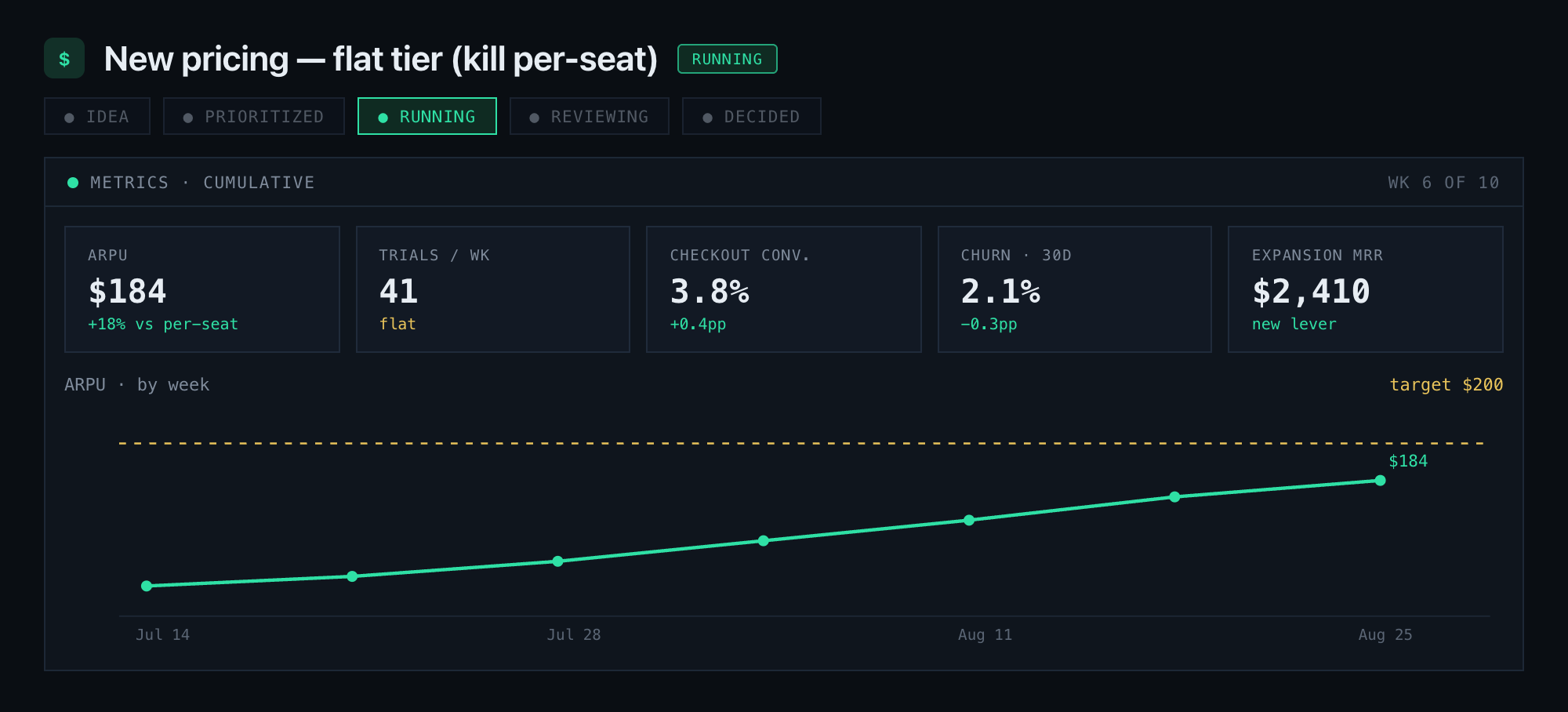
It fits founders, product leads, and small cross-functional teams making the kind of calls this guide covers: pricing changes, roadmap bets, hires, pivots. Instead of a scattered doc or a Slack thread nobody reopens, every bet moves through stages from Idea to Decided, with the post-mortem built into the process instead of left to memory. If the workflow above sounds like something your team should already be doing, start with the Betlog pricing page, where the single plan runs $39 per month or $390 per year.
Sources
For deeper reading on the ideas covered here: MIT Sloan’s piece on the Mediating Assessments Protocol for structured scoring, Structureddecisionmaking for a formal seven-step process, the Science paper on structured models outperforming intuition, and HBR’s leadership-focused framework on matching process to context.
- A structured approach to strategic decisions
- Machine-learning evaluations of classical decision theories (Science)
- Structured decision making steps
- A Leader’s Framework for Decision Making
- Decision Making Frameworks - Which One Fits Your Situation
FAQ
What Is the Best Framework for a Fast Decision?
For time-pressured but familiar situations, Recognition-Primed Decision or the OODA loop work best because they favor speed and iteration over exhaustive analysis. For genuinely novel fast decisions, a time-boxed weighted matrix with just two or three criteria still beats no structure at all.
How Do I Know if a Decision Needs a Heavy Framework?
Run it through the Decision Type Filter first: check reversibility, stakes, and available time. If the decision is a one-way door with real consequences, invest in a full process including a pre-mortem; if it’s cheap to reverse, decide fast and move on.
What’s the Difference Between a Framework and a Decision Journal?
A framework helps you evaluate a specific choice at the moment you’re making it. A decision journal, like Betlog, records the hypothesis, confidence level, and metrics before the outcome is known, so you can separate decision quality from luck later. Frameworks solve one decision; a journal builds judgment over many.
Why Do Decision-Making Frameworks Fail in Practice?
They usually fail because teams skip time-boxing and evidence thresholds, letting deliberation drift indefinitely, a pattern that consistently kills executive output. They also fail when used on decisions too trivial to deserve the process, which trains people to see structure as bureaucracy instead of a tool.
Can Frameworks Be Used for Group and Individual Decisions?
Yes, but the framework shifts with the setting. Individual decisions favor lightweight tools like 10-10-10 or a personal weighted matrix, while group decisions need facilitation methods like Six Thinking Hats or role clarity tools like RACI or DACI to prevent the debate from splitting along personality lines instead of evidence.