8 Step Decision Matrix for Founders: Checklists and a Journal Bridge
Practical 8 step decision matrix workflow for founders and small teams. Includes team-ready checklists, stress tests for weights, and a simple bridge to...

On this page
- What is a decision matrix and when does it help?
- How to build, score, weight, and calculate your matrix
- Weighted matrices, Pugh matrices, and a worked example
- Common mistakes and how to stress-test the result
- Turning the matrix into a team habit worth repeating
- Case studies: decision matrices across industries
- Decision matrix vs. SWOT analysis vs. decision trees
- When a decision matrix helps and when it falls short
- Software tools and templates for building a matrix
- Using matrices responsibly
- Where decision journaling picks up after the matrix closes
- Sources
- FAQ
A decision matrix is a table that scores multiple options against a shared set of criteria, then weights and totals those scores to point toward the strongest choice. It works best when you are comparing several similar options across at least three or four real trade-offs, not when you already know the answer and just want it confirmed. The tool only helps if you are honest about the weights and scores you put into it.
TL;DR:
- Decision matrices are most effective when comparing multiple options with at least four trade-offs, especially for vendor selection or prioritizing projects.
- Building a matrix involves selecting relevant criteria, assigning weights, scoring options, and calculating totals, with hard requirements filtered out beforehand.
- Stress-testing results by adjusting weights and re-evaluating can reveal if the final ranking is fragile or genuinely robust.
- The tool’s main strength is making subjective debates visible and promoting consensus, but it depends heavily on honest scoring and clear criteria.
- Complementing the matrix with decision journaling improves long-term tracking of confidence and accuracy of choices.
What is a decision matrix and when does it help?
A decision matrix, also called a Pugh matrix, selection grid, or criteria rating form, is a structured method for evaluating and prioritizing multiple options against a predefined set of weighted criteria. Instead of debating options in the abstract, you break the decision into its component trade-offs and score each option against each one. The format turns a subjective argument into a comparison everyone can see and challenge.
It earns its place in specific situations:
- Choosing between several vendors, tools, or platforms that all look reasonable on the surface.
- Prioritizing features or projects when you have more good ideas than capacity.
- Narrowing a hiring shortlist where candidates differ across several dimensions at once.
- Picking office space, suppliers, or partners where price, quality, and risk pull in different directions.
It adds little value for one-off decisions with no real alternative, for choices that unfold sequentially rather than all at once, or for calls that hinge on a single, deeply qualitative factor a spreadsheet cannot capture, like whether you trust a cofounder.
How to build, score, weight, and calculate your matrix
Building a matrix is mechanical once you know the sequence. The standard procedure taught in organizational-excellence guides runs through these steps:
- Write down the exact decision you are making, in one sentence.
- List every option seriously under consideration, usually three to six.
- Choose four to eight criteria that actually differentiate the options. More than eight tends to dilute the result.
- Pick a rating scale. A 1 to 3 scale forces sharp distinctions when you are short on data; 1 to 5 works for most business decisions; 1 to 9 suits engineering or technical comparisons where finer gradations matter.
- Assign weights to each criterion, often by distributing 10 points across all of them based on importance.
- Rate every option against every criterion using your chosen scale.
- Multiply each score by its criterion’s weight, then sum the weighted scores for each option to obtain a weighted total.
- Read the totals as a starting point for discussion, not a verdict.
Before you score anything, separate your must-haves from your nice-to-haves. A budget ceiling, a legal requirement, or a non-negotiable feature should disqualify an option outright rather than compete for points against softer criteria.
Pro Tip: Filter out any option that fails a hard requirement before scoring begins. Otherwise a cheap, fast, but non-compliant option can out-score a slower one that actually meets the bar.

Weighted matrices, Pugh matrices, and a worked example
Two variants cover most real use cases. A weighted decision matrix uses numeric scores multiplied by numeric weights, which suits business trade-offs where you need a defensible ranked total. A Pugh matrix compares each option against a baseline using simple qualitative marks (better, same, worse) rather than numbers, which fits early-stage concept selection in engineering or product design where precise scoring would be false confidence.
Here is a compact-worked example for choosing a project management tool:
| Criterion (weight) | Tool A | Tool B | Tool C |
|---|---|---|---|
| Ease of use (3) | 4 (12) | 3 (9) | 5 (15) |
| Price (3) | 5 (15) | 4 (12) | 2 (6) |
| Integrations (2) | 3 (6) | 5 (10) | 4 (8) |
| Support quality (2) | 3 (6) | 3 (6) | 4 (8) |
| Total | 39 | 37 | 37 |
Tool A wins narrowly, but the gap between all three is small enough to warrant a second look before committing.
Common mistakes and how to stress-test the result
The most frequent failure is letting several minor criteria add up to override a single disqualifying flaw. Filter must-haves before you score, not after, so a cheap option cannot out-total a compliant one on volume alone.
A few habits keep the matrix honest:
- Agree on criteria wording and weighting method as a group before anyone scores anything.
- Score with real data wherever it exists instead of gut-feel numbers, and write down the assumption when you cannot.
- Run the matrix again after the first pass, letting the best-scoring option borrow a strength from a competitor, then re-score.
- Treat a narrow final gap as an indeterminate outcome warranting further discussion, not a definitive decision.
Advanced decision-makers treat scores and weights as imprecise estimates rather than exact values, and robustness checks catch conclusions that only hold under one specific set of assumptions. That means adjusting one weight at a time by roughly 10 to 25 percent and watching whether the ranking changes. If the winner flips under a modest weight change, the result is fragile and the group should talk through the disagreement directly rather than trust the total.
Used well, the matrix is a prompt for a better conversation, not a substitute for judgment.
Turning the matrix into a team habit worth repeating
A matrix produces a ranked list. It does not, by itself, capture why you believed what you believed or how confident you actually were. That gap is where most teams lose the lesson a decision could have taught them.
A simple facilitation checklist closes it:
- Assign one person to collect data and one to run the session, so scoring does not turn into a debate about facts.
- Timebox the criteria-setting discussion separately from the scoring discussion.
- Require the group to agree on weights before anyone sees the totals, to avoid reverse-engineering weights to fit a preferred answer.
- Write down the expected outcome and a confidence level, as a probability rather than a feeling, before the decision goes live.
Pro Tip: Record your confidence as a number, like “70% likely this vendor holds up past six months,” so you can check later whether your 70%-confidence calls actually land around 70% of the time.
Recording the reasoning before the outcome is known is what separates a good process from a lucky guess. Research on calibration and hindsight bias shows that writing down pre-decision reasoning and confidence protects teams from rewriting their own history once they know how things turned out.
Case studies: decision matrices across industries
The mechanics stay the same across industries, but the criteria shift with the stakes. In engineering and product design, teams commonly use a Pugh matrix to compare several early-stage concepts against a current baseline design, scoring each on manufacturability, cost, and performance without forcing false numeric precision onto ideas that are still rough.
In software and operations, a weighted matrix suits vendor selection, where price, integrations, security posture, and support quality all pull in different directions and a numeric total helps a team defend its choice to stakeholders who were not in the room.
Hiring committees use the same structure to compare final-round candidates on criteria like domain expertise, culture fit, and availability, which keeps the conversation focused on job-relevant factors rather than whoever interviewed best on a given day.
Facilities and procurement teams lean on it for choosing between office locations or suppliers, where cost, lease terms, and logistics need to be weighed against each other in a way a simple pros-and-cons list cannot capture.
Across all of these, the pattern holds: the matrix works when the options are genuinely comparable and the criteria are agreed on up front. It struggles when the real disagreement is about which criteria matter at all, in which case the argument needs to happen before anyone opens a spreadsheet.
Decision matrix vs. SWOT analysis vs. decision trees

A decision matrix, a SWOT analysis, and a decision tree solve different problems, and confusing them wastes time.
SWOT analysis maps a single option’s strengths, weaknesses, opportunities, and threats. It is a diagnostic tool for understanding one choice or one business in context, not a way to rank several alternatives against each other. Use it before the matrix, to figure out what your criteria should even be.
A decision tree models a sequence of decisions and uncertain events branching over time, often with probabilities attached to each branch. It fits decisions that unfold in stages, like whether to invest in a pilot now and expand later depending on results. A matrix, by contrast, assumes all your options exist at once and evaluates them side by side in a single pass.
A decision matrix is a form of Multiple Criteria Decision Analysis, built specifically for comparing several options against several criteria simultaneously. It is the right tool when you already know your alternatives and your trade-offs, and you need a structured way to compare them, not when you are still exploring what might happen next or trying to understand one option in isolation.
When a decision matrix helps and when it falls short
The advantages are real. A matrix forces criteria onto the table before anyone scores anything, which surfaces disagreements about what actually matters early, when they are cheap to resolve. It turns a subjective debate into something visible and arguable, and it gives a team a paper trail for why it chose what it chose.
The limitations are just as real. A matrix is only as good as the criteria and weights someone chose, and those choices are opinions dressed up as numbers. Two people who disagree about strategy can build two matrices that each produce a clean, confident-looking answer that supports what they already believed. Practitioners note that the most valuable part of the exercise is often not the final score but the alignment the group reaches while agreeing on criteria and weights in the first place.
The tool also struggles with genuinely novel decisions, where you cannot yet name the criteria that will matter, and with decisions where one factor is so dominant it should simply veto the others rather than compete for weighted points. In those contexts, a matrix used mechanically can produce a confident wrong answer faster than no tool at all.
Software tools and templates for building a matrix
You do not need special software to build a decision matrix. A basic spreadsheet in Google Sheets or Excel handles the weighting and multiplication with a couple of formulas, and that is genuinely enough for most individual and small-team decisions.
For teams that want structure without building formulas from scratch, practical templates from guides like Asana and MindTools walk through the same seven or eight steps covered above, typically recommending four to eight criteria and showing sample scoring scales you can copy directly. Untools offers a similar free template aimed at individual decision-makers.
Project management platforms like Asana, Trello, and Notion can host a matrix as a table view directly inside the tool where the decision will eventually get executed, which keeps the reasoning next to the work instead of buried in a separate file nobody opens again.
Whatever tool you pick, the format matters less than the discipline. If you are adapting how you frame trade-offs for a different market or audience, practical guidance on adjusting your value proposition offers useful parallels: the criteria that convince one audience rarely convince another, and a matrix makes that mismatch visible fast.
Using matrices responsibly
A decision matrix is a communication tool that happens to produce a number, not a mechanical oracle. Its real value is forcing a team to agree on what matters before anyone argues about which option wins.
Treat the total as a starting point. Record your confidence in the outcome, stress-test the weights, and write down what you expected to happen before you find out. Then let the next similar decision use different criteria if the last one taught you they were wrong.
— Cesar
Where decision journaling picks up after the matrix closes
A matrix tells you which option scored highest today. It does not tell you, six months from now, whether that score was earned or lucky, because it does not capture your confidence or your reasoning in a form you can check later.
That is the gap Betlog is built for. Once your matrix points to an option, Betlog lets you log the hypothesis behind it, the probability you actually assign to it working out, and the metric that will prove you right or wrong before you find out which one happened.
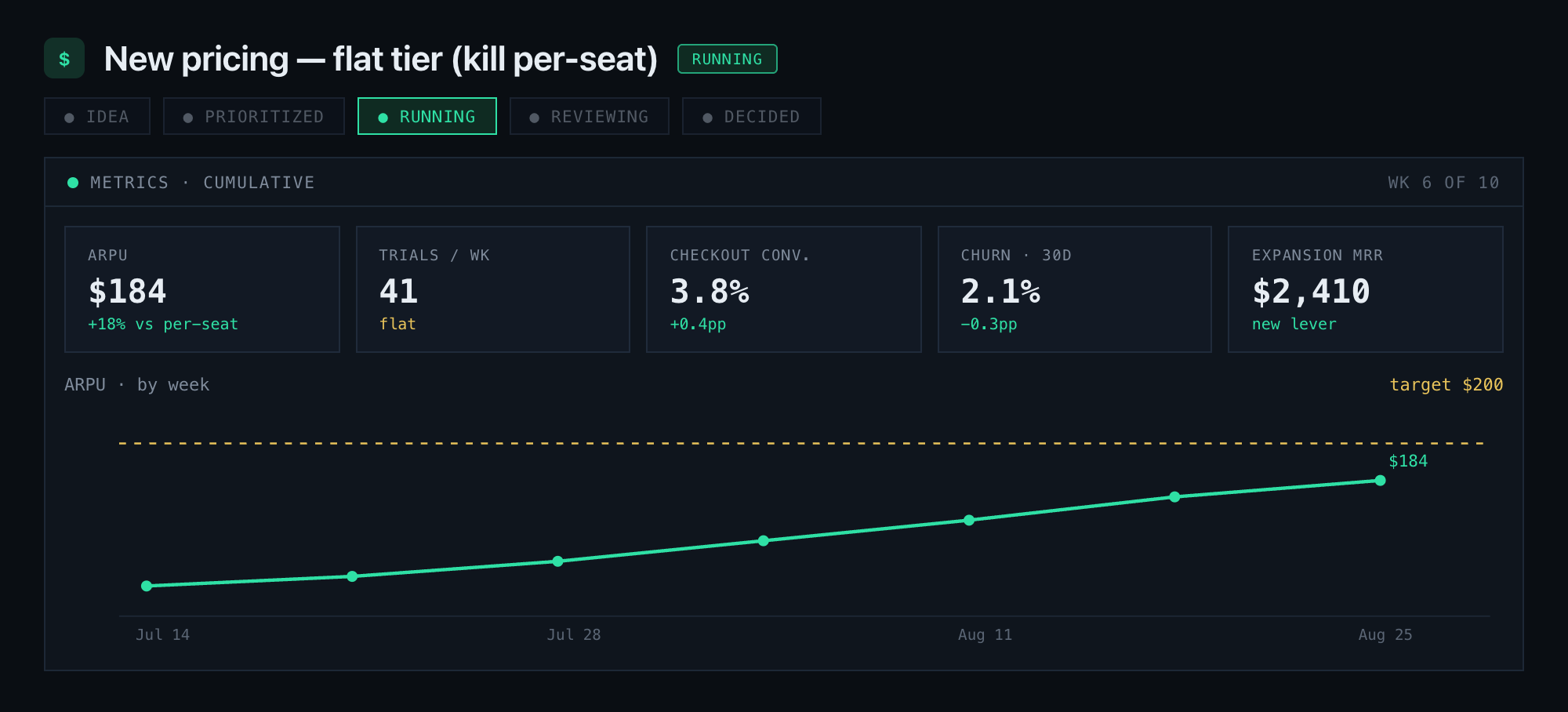
A few things it adds on top of the matrix itself:
- A timestamped record of your confidence, so you can check later whether your 70%-confidence calls actually land around 70% of the time.
- A structured post-mortem that separates whether the decision was sound from whether it simply worked out.
- A running history across every bet your team makes, instead of one matrix per decision that gets forgotten once the choice is made.
Betlog runs one plan at $390 per year or $39 per month. Start a bet on your next matrix-backed decision and see what your confidence looks like once the outcome is in.
Sources
- What is a Decision Matrix? Pugh, Problem, or Selection Grid
- Mathematical/decision support research on uncertainty (MDPI)
- Research on calibration, hindsight bias, and decision recording
FAQ
What is the 10-10-10 rule for decisions?
The 10-10-10 rule asks you to consider how you will feel about a decision in 10 minutes, 10 months, and 10 years, as a way to check whether a short-term reaction is skewing your judgment. It is a mental time-travel exercise rather than a scoring method, and it pairs well with a decision matrix by helping you set criteria that reflect long-term consequences, not just immediate discomfort.
What is another name for a decision matrix?
A decision matrix is also called a Pugh matrix, selection grid, or criteria rating form, depending on the field and the guide you are reading. All three names describe the same basic approach of scoring options against weighted criteria.
What is the most famous decision matrix?
The Pugh matrix, developed for concept selection in engineering, is likely the most widely recognized named variant, since it gave the broader technique one of its alternate names. Beyond that, no single branded matrix dominates outside specific technical fields, and most teams use a generic weighted matrix built in a spreadsheet.
What is a Pugh decision matrix?
A Pugh matrix compares several options against a chosen baseline using simple qualitative marks, typically better, same, or worse, rather than numeric scores. It is particularly useful for early-stage concept selection in engineering and product design, where forcing precise numbers onto rough ideas would create false confidence.


