RAPID Decision Making: 6 Fields, 5–10 Min Bet Journal for Founders
Lean founder playbook for RAPID decision making: six field bet journal in 5–10 minutes, quick premortems, and 30 day to annual calibration.

On this page
- What Is RAPID Decision Making in a Decision Journal?
- A 3-Step Checklist for Your Next Meeting
- How to Write a Bet: A Worked Example
- Run Reviews Fast: Cadence and the Calibration Loop
- Team Rituals That Keep the Habit Alive
- Common Pitfalls and Quick Fixes
- Cesar’s Quick Leadership Checklist
- Try a Structured Decision Journal Instead of a Shared Doc
- Sources
- FAQ
Rapid decision making for founders and small teams means using decision journals and probabilistic bets: write the bet, state a numeric confidence, set a metric and review date, then run brief premortems and calibration reviews. This is not the RAPID® org-chart framework for assigning roles. It’s a practical habit for making consequential calls fast without losing the reasoning behind them. Do this once, on your next real decision, before reading further.
TL;DR:
- Most teams underestimate the importance of writing clear, numeric confidence levels and specific metrics to gauge decision success accurately.
- Regular calibration reviews of past bets reveal overconfidence issues, with high-confidence bets often winning less than 70 percent of the time.
- Quick premortems of eight minutes for high-impact decisions identify multiple failure points, increasing the chances of mitigating risks effectively.
- Restrict decision review to one metric and set a firm review date to maintain focus and ensure timely learning from outcomes.
- Maintaining psychological safety by sharing failures and encouraging dissent supports honest, disciplined decision-making habits.
What Is RAPID Decision Making in a Decision Journal?
Most teams confuse speed with recklessness. They think fast decisions mean skipping analysis. They don’t. Fast, disciplined decision making means compressing the analysis into a format you can fill out in minutes, not skipping it entirely.
This is the core idea behind Annie Duke’s Thinking in Bets: every decision is a bet made under incomplete information, and the outcome depends on both the quality of your reasoning and plain luck. Judge a decision only by how it turned out, and you’ll learn the wrong lesson every time. A well reasoned pricing test can still lose money. A careless hire can still work out.
A 2017 PLOS ONE study on decision-education frameworks found that structured decision training improved decision competence and academic performance by more than 5% on national assessments. Decision quality is a skill you build through repetition, not a trait you either have or don’t. Speedy decision frameworks work precisely because they force the same disciplined thinking every time, compressed into a few minutes instead of a few days.

A 3-Step Checklist for Your Next Meeting
You don’t need a new process. You need three moves layered onto the meeting you’re already having.
- Sort reversible from consequential. Ask one question: can this be undone cheaply within 30 days? If yes, decide on the spot and move on. If no (a hire, a pricing change, a pivot), it earns a full journal entry.
- Force a number and a sentence. Skip “I think this will work.” Require a numeric confidence (55%, 70%, 85%) and one sentence describing the expected outcome. Vague confidence is not confidence.
- Pick one metric and a review date. Not five metrics. One. Attach a date, not “later.”
For anything with real downside, an eight-minute premortem for the highest-impact bets and a two-minute version for everything else.
Pro Tip: If your team can’t agree on a confidence number in under 60 seconds, that disagreement is more valuable than the number itself. Write down both estimates and why they diverge.
How to Write a Bet: A Worked Example
Skip the template debates. Six fields, five to ten minutes, every time.
- Decision: What you’re actually doing.
- Reasoning: Why, in two or three sentences.
- Assumptions: What has to be true for this to work.
- Expected outcome + confidence: A specific prediction with a percentage attached.
- What would change your mind: The disconfirming evidence you’re watching for.
- Review date: A calendar entry, not a vague “check back later.”
Here’s a real shape, using a pricing change:
Decision: Raise the starter plan from $29 to $39 per month for new signups only. Reasoning: Support tickets show price isn’t the top objection; feature gaps are. Current price likely leaves margin on the table. Assumptions: New-signup conversion won’t drop more than 15%; existing customers are grandfathered and won’t churn. Expected outcome + confidence: Net revenue from new cohorts rises within 60 days. What would change your mind: Conversion drops more than 20%, or support tickets citing price double. Review date: Day 45.
A premortem study of software and game teams found that teams identified an average of 17.8 distinct failure reasons and 16.7 mitigations when they ran this exercise before committing. That’s the value of writing the “what would change your mind” field before you’re emotionally invested in being right.
When day 45 arrives, the post-mortem asks two separate questions: did this work, and did we decide well? A decision can lose and still have been the right call given what you knew. Attribute the outcome honestly. If conversion held but a competitor cut prices the same week, that’s luck, not skill, in either direction.
Run Reviews Fast: Cadence and the Calibration Loop
Three review cadences cover almost every consequential bet a small team makes.
| Cadence | What it’s for | What you check |
|---|---|---|
| 30-day quick check | Fast-moving bets (pricing, campaigns, feature flags) | Is the metric trending toward or away from the prediction? |
| substantive review | Hires, roadmap bets, partnerships | Full post-mortem: outcome, skill vs. luck, lesson recorded |
| Annual calibration | Every closed bet from the year | Do your 70% bets actually win about 70% of the time? |
The calibration loop is the part most teams skip, and it’s the part that actually improves judgment over time. Pull every closed bet where you stated a numeric confidence, sort them into buckets (50 to 60%, 60 to 70%, and so on), and check the win rate in each bucket. A spreadsheet with three columns, confidence, outcome, and bucket, does this in under an hour once a year.
If your 80%-confidence bets only win half the time, you’re overconfident and need to either raise your stated numbers to match reality or slow down on high-conviction calls.
Team Rituals That Keep the Habit Alive
None of this works if people won’t write down their real doubts. Google’s re:Work research on team effectiveness identifies psychological safety as the foundation for any practice that depends on people admitting uncertainty out loud.
Three things build that safety fast:
- Leaders share their own low-confidence bets first, including ones that failed.
- Nobody gets penalized for a well reasoned bet that lost. They get penalized for skipping the reasoning.
- Dissent gets a specific invitation: “What’s the strongest reason this fails?” asked directly to the person who’s quietest.
Run the premortem in ten minutes: assume the bet failed six months from now, everyone writes down why, then group the answers and pick one that changes scope or the metric you’re tracking.
Pro Tip: Timebox the decision itself, not just the meeting. If a call needs a full week of debate, it’s probably consequential enough to warrant a real journal entry rather than a hallway decision.
Common Pitfalls and Quick Fixes
Teams usually break this habit in one of three ways.
- Overcomplicating the entry. Six fields, five to ten minutes. If your template has fifteen fields, nobody fills it out after week two.
- Editing the record after the outcome is known. Entries need a timestamp and need to stay locked. Rewriting your confidence number after you see the result is the exact hindsight bias this process exists to prevent.
- Turning reviews into blame sessions. A post-mortem separates decision quality from outcome. Frame it as “what did we learn,” never “whose fault was this.”
Cesar’s Quick Leadership Checklist
Three moves scale this without adding overhead: model your own low-confidence bets publicly, protect the “what would change your mind” field from becoming performative, and review calibration quarterly, not just annually. A tool like Betlog exists because most teams abandon this within a month once it lives in a shared doc nobody opens.
— Cesar
Try a Structured Decision Journal Instead of a Shared Doc
Betlog is built for exactly the process above: structured bets, numeric confidence, review scheduling, and post-mortems that separate skill from luck, all in one place instead of scattered across documents nobody reopens. Teams evaluating decision governance at a strategic level or validating market assumptions before a big bet through external market research often pair that outside input directly into a journal entry as the “assumptions” field.
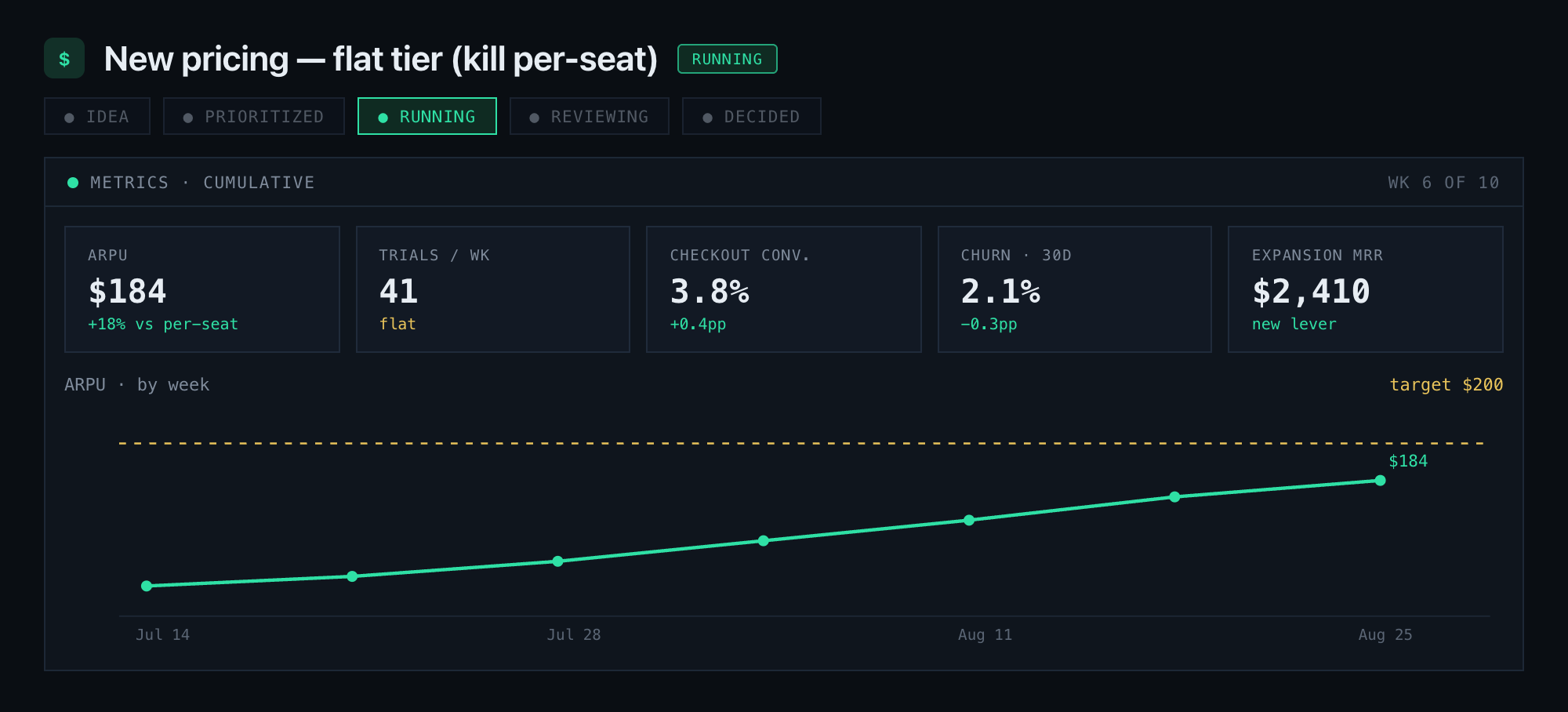
A one-week trial is enough to test fit: log three real decisions you’re already making, set review dates, and see whether the format survives contact with your actual meeting rhythm. Betlog runs one plan at $39 per month or $390 per year. Start by writing your next consequential bet down before you decide, not after.
Sources
- PLOS ONE — decision education study
- Google re:Work — understand team effectiveness
- Premortems in game development teams (HFES Proceedings)
- Thinking in Bets — Annie Duke (book)
FAQ
What Is the Difference Between RAPID Decision Making and the RAPID Framework?
RAPID decision making, as covered here, refers to decision journaling and thinking in bets, writing hypotheses, confidence levels, and reviews to make fast calls under uncertainty. The RAPID® framework (Recommend, Agree, Perform, Input, Decide) is a separate organizational tool for assigning decision roles and isn’t the subject of this method.
How Long Should a Decision Journal Entry Take?
A minimal entry with six fields, decision, reasoning, assumptions, expected outcome with confidence, disconfirming evidence, and review date, takes about 5 to 10 minutes. Entries that take longer usually have too many fields and get abandoned within a few weeks.
How Do I Know if My Confidence Estimates Are Accurate?
Over a year of closed bets, you can see whether your 70%-confidence calls actually win around 70% of the time and adjust from there.
What Should a Premortem Cover for a Fast Decision?
A short premortem asks the team to assume the decision failed and list every reason why, then group those reasons and pick at least one mitigation that changes scope or the metric being tracked. Research on software and game teams found this exercise surfaces many distinct failure reasons per session.
Does Betlog Replace a Shared Spreadsheet for Tracking Bets?
Betlog structures the same fields, decision, confidence, metric, review date, and post-mortem, into a dedicated workflow with stages from idea to decided, rather than a static spreadsheet. Pricing is listed on the Betlog pricing page at $39 per month or $390 per year on a single plan.