Stop 'We Knew It' in Teams: 3 Rituals to Beat Hindsight Bias
Stop hindsight bias in your team with three practical rituals: run pre-mortems, log numeric confidences in a decision journal, and perform monthly...

On this page
- What Is Hindsight Bias? Definition, Forms, and a Quick Example
- Why Hindsight Bias Happens: The Cognitive, Metacognitive, and Motivational Drivers
- How Psychologists Actually Measure Hindsight Bias
- Where Hindsight Bias Shows Up: Medicine, Law, Investing, and Everyday Life
- What Hindsight Bias Actually Breaks in Your Decision Making
- Debiasing Techniques That Actually Work
- How a Decision Journal Closes the Hindsight-Bias Loophole
- What Teams Get Wrong About Fixing This
- Try a Decision Journal Instead of Trusting Your Memory
- Sources
- FAQ
Hindsight bias is the tendency to see past events as more predictable than they actually were once you already know the outcome. It quietly rewrites your memory of what you believed before, which is why it fuels overconfidence and blocks real learning from experience. The good news: it’s measurable, well studied, and correctable with specific habits, which the rest of this piece lays out in detail.
TL;DR:
- Hindsight bias causes individuals to overestimate how predictable an outcome was once it is known, leading to memory distortion, perceived inevitability, and exaggerated foreseeability.
- It most strongly affects decision judgments in medicine, law, investing, and organizational post-mortems, often skewing lessons learned and overconfidence in future decisions.
- Structured techniques such as consider-the-opposite, pre-mortems, and maintaining decision journals with timestamped confidence levels can significantly reduce hindsight bias effects.
- Regular calibration exercises and separating prediction from outcome evaluation help maintain awareness and ensure more accurate reflection on past decisions.
- Most teams mistake hindsight bias for personality flaws rather than understanding it as a memory and cognition issue, so consistent documentation and ritualized review are key to mitigation.
What Is Hindsight Bias? Definition, Forms, and a Quick Example
Psychologists define hindsight bias as the tendency to overestimate, after an outcome is known, how predictable that outcome was beforehand. It’s often called the “knew-it-all-along” effect, and researchers who study it also use the term “creeping determinism” to describe how a sequence of events starts to feel inevitable once you know how the story ends. The concept dates back to foundational work by Baruch Fischhoff in the 1970s, whose experiments showed that simply telling people an outcome changed their memory of the odds they’d assigned to it earlier, and that most of them had no idea the shift had happened, according to Fischhoff’s outcome-knowledge research.
Researchers generally break hindsight bias into three related but distinct forms:
- Memory distortion: you misremember your own prior prediction, recalling it as closer to the actual outcome than it really was.
- Inevitability: you judge the outcome as having been bound to happen, as if there was never a real alternative path.
- Foreseeability: you believe you (or someone else) should have seen it coming, even if the information available at the time didn’t support that.
Here’s the everyday version. A friend’s relationship ends, and within a week she says, “Honestly, I knew we weren’t going to make it.” Maybe she did have doubts. But if you go back and look at what she was actually saying six months earlier, excited about vacation plans, talking about moving in together, the doubts get rewritten into the story after the fact. The breakup didn’t confirm a prediction. It created one, retroactively.
This matters far beyond breakups. The same mental shortcut shapes how doctors recall a diagnosis, how juries judge a defendant’s foresight, and how a product team explains why a launch flopped. Once you know the ending, your brain quietly edits the beginning.
Why Hindsight Bias Happens: The Cognitive, Metacognitive, and Motivational Drivers
Hindsight bias isn’t a single glitch. Researchers Neal Roese and Kathleen Vohs describe it as the product of three separate inputs working together, and understanding each one is what makes the bias possible to catch in the moment rather than just after the fact, according to their review of hindsight bias mechanisms.
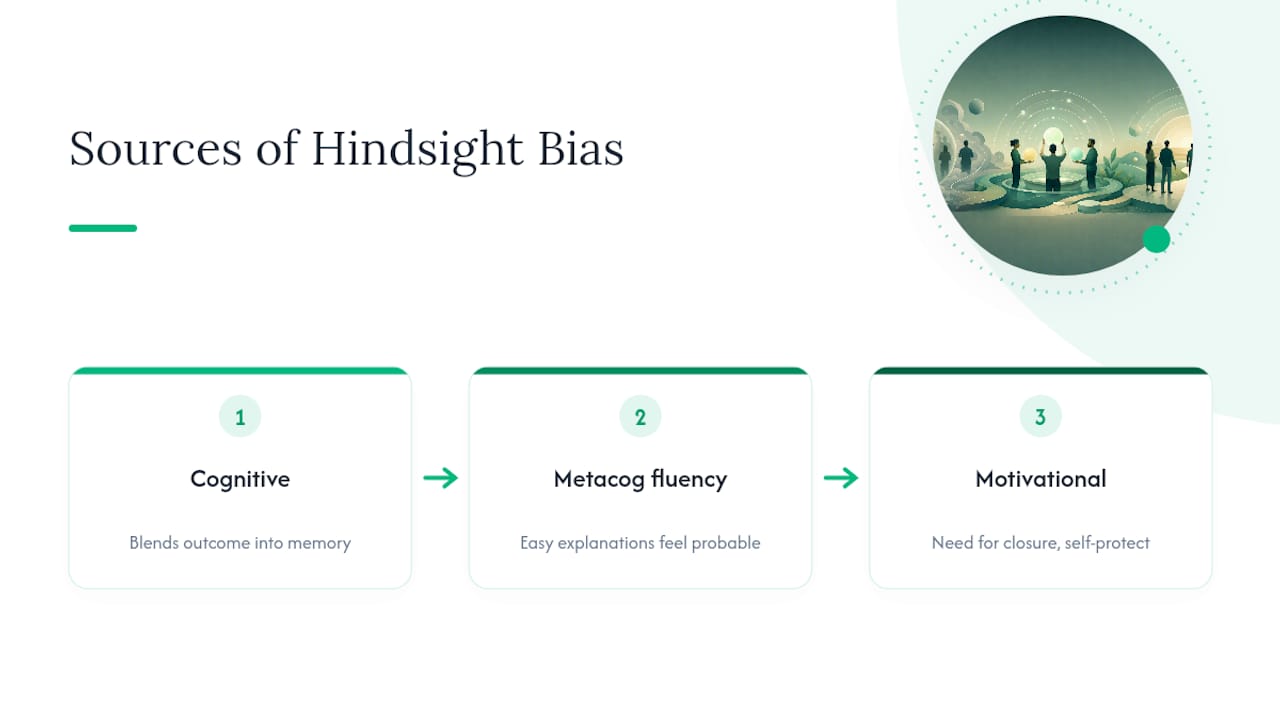
Cognitive input: selective recall and knowledge updating. Once you learn an outcome, your brain doesn’t file it away separately from your prior beliefs. It blends the new information into your memory of what you thought before, and that blend favors whatever is consistent with how things turned out. You’re not lying when you say “I thought so.” You’re remembering a version of your past self that never existed.
Metacognitive input: fluency. After the fact, explanations for an outcome tend to come easily. A startup failed? You can immediately list five reasons. That ease of explanation gets misread as a signal that the outcome was likely all along, when really it just means the story is simple to tell in reverse. Fluency and probability are different things, but your brain treats them as the same signal.
Motivational input: the need for closure and self-protection. People want the world to feel orderly, and admitting “that outcome was genuinely unpredictable” is uncomfortable. Believing you (or an expert, or a system) should have seen it coming restores a sense of control. It also lets you distance yourself from blame: “anyone paying attention would have known,” implies you weren’t the one who missed it.
Counterfactual thinking, imagining how things could have gone differently, cuts both ways here. Sometimes generating alternatives reduces hindsight bias, because it forces you to hold multiple possible outcomes in mind instead of collapsing everything onto the one that happened. Other times, if the counterfactual is easy to imagine but still points toward the same conclusion, it strengthens the feeling of inevitability instead of weakening it. The framing of the exercise, not just doing it, determines which way it swings.
Pro Tip: Before a debrief meeting, ask each person to privately write down what they predicted, and their confidence level, without looking at any notes. Compare that to what they actually wrote down beforehand. The gap is hindsight bias made visible.
How Psychologists Actually Measure Hindsight Bias
Hindsight bias isn’t just a hunch researchers have. It shows up reliably across decades of controlled experiments using a few core designs.
- The memory design. Participants make a prediction or judgment before an event, then later are asked to recall that original judgment after learning the outcome. The gap between their actual original answer and their recalled answer is the bias.
- The hypothetical design. Participants are simply told an outcome occurred (sometimes falsely) and asked how predictable it was in hindsight, without ever having made a real prior prediction. This isolates the “obviousness” judgment from memory distortion.
- Inevitability-curve analysis. Newer methods plot how a person’s judged likelihood of an outcome changes over time, comparing what they said in foresight against what they later recall in hindsight. This work found that hindsight bias often shows up as a temporal shift: people recall reaching high confidence in an outcome earlier than they actually did, even when the overall shape and rate of their belief change stays roughly accurate, according to a 2009 study on inevitability curves.
The findings across these designs are consistent on a few points. Bias severity follows a U-shaped pattern across the lifespan: preschoolers and older adults show more hindsight bias than older children and young adults, a pattern replicated across large samples from age 3 to 95, according to developmental research on hindsight bias. The bias also generalizes across an unusually wide range of domains, from trivia questions to medical diagnoses to political forecasts. And perhaps most unsettling: participants in Fischhoff-style experiments are typically unaware their memory shifted at all. They don’t feel like they’re rationalizing. They feel certain they always knew.
Where Hindsight Bias Shows Up: Medicine, Law, Investing, and Everyday Life
The bias isn’t confined to a psychology lab. It shapes consequential judgments across fields where the stakes of “should have known” are high.
- Medicine. When a diagnosis turns out to be wrong or a treatment fails, physicians reviewing the case after the fact tend to judge the correct diagnosis as having been more obvious from the original symptoms than it actually was. This directly shapes malpractice judgments: reviewers who know the bad outcome rate a doctor’s original decision as more negligent than reviewers presented with only the information available at the time.
- Law. Jurors and judges evaluating whether a defendant or company “should have foreseen” a harm are themselves prone to hindsight bias, since they’re evaluating the decision after already knowing how it turned out. Some legal scholars have proposed deliberately putting jurors in a foresight-only frame, asking them to assess only what a reasonable person could have known before the event, as a partial counterweight.
- Investing. Investors who experience a loss often recall having “known” the market would turn, which reinforces overconfidence in the next bet rather than a more honest read of the odds. Classic heuristics research on judgment under uncertainty shows this overconfidence tracks with worse subsequent decisions, and that keeping structured records of what you actually believed beforehand is one of the few reliable checks on it, according to foundational work on judgment heuristics.
- Organizational post-mortems. When a product launch or a hire doesn’t work out, teams doing the retro already know the ending. That knowledge quietly reshapes how they describe the original decision, turning a reasonable bet made with incomplete information into “we should have seen the warning signs,” even when those signs were only clear in retrospect.
- Everyday reactions. News commentary after an election, a sports upset, or a company collapse is dense with hindsight bias. “Obviously” is one of the most reliable tells that someone is narrating backward from a known ending.
What Hindsight Bias Actually Breaks in Your Decision Making
The practical cost of hindsight bias isn’t abstract. It corrupts four specific things: how you judge past decisions, how confident you feel about future ones, the causal stories you build, and what your organization collectively “learns.”
Resulting is the term Annie Duke uses for judging a decision purely by its outcome instead of by the quality of the reasoning behind it, and hindsight bias is the engine that makes resulting feel justified. A well reasoned bet that loses gets rewritten as “a bad decision,” and a reckless bet that wins gets rewritten as “smart risk taking.” Once the outcome is known, the process that produced it becomes almost invisible.
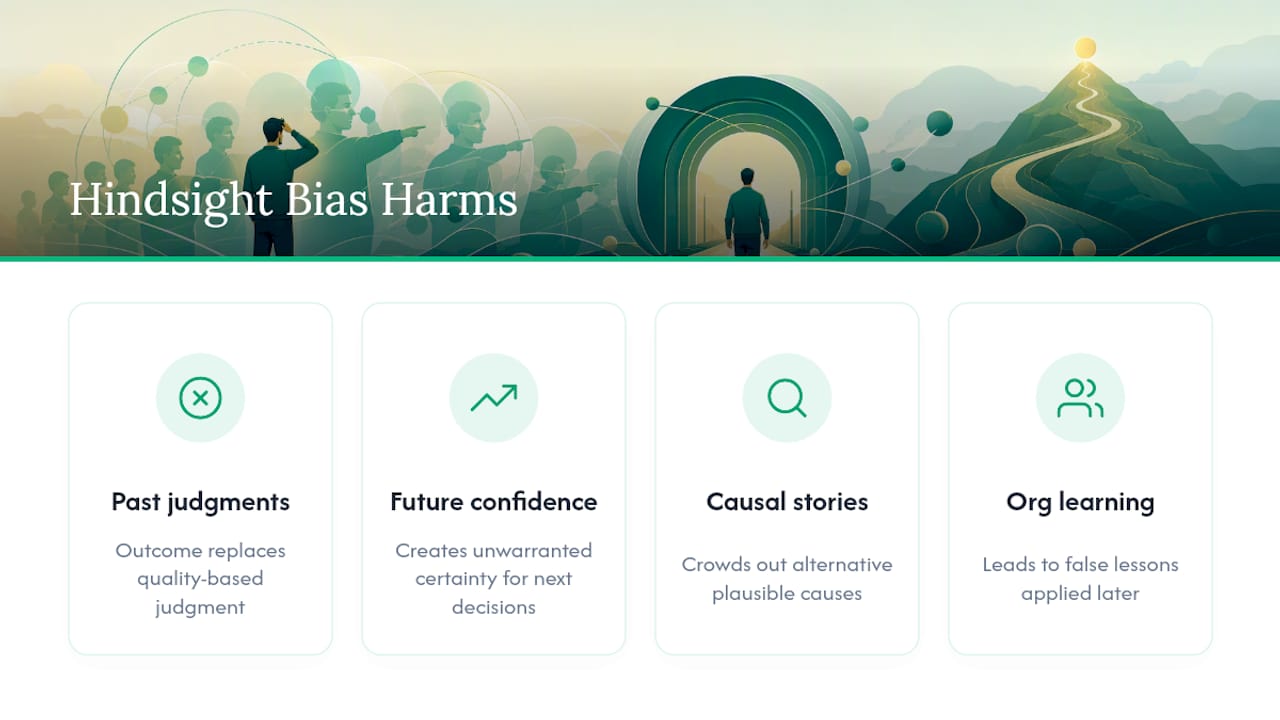
Overconfidence compounds from there. If you believe you “knew” the last outcome all along, you’ll assume your judgment is sharper than it is going into the next uncertain decision. Roese and Vohs describe this overconfidence as one of the clearest downstream harms of hindsight bias, since it directly feeds into riskier choices made with unwarranted certainty, according to their analysis of hindsight bias consequences.
Causal stories get narrower, not clearer. Hindsight bias produces a single, tidy explanation for why something happened, crowding out the alternative causes that were genuinely plausible at the time. That’s myopia: not an absence of a story, but too much confidence in the one story you settled on.
Roese and Vohs identify overconfidence and this narrowed, myopic causal reasoning as two of the primary documented consequences of hindsight bias, distinct from the memory distortion that produces the bias itself.
Organizations suffer a specific version of this: false learning. A team debriefs a failed launch, hindsight bias kicks in, and everyone agrees on a clean lesson (“we should have tested pricing longer”) that feels satisfying but may have nothing to do with what actually happened. That false lesson then gets applied to the next decision, and because it was never checked against the real reasoning at the time, it can quietly make the next call worse, not better.
Debiasing Techniques That Actually Work
None of this means hindsight bias is untreatable. Several specific, testable techniques reduce it, and they’re simple enough to run in a single meeting.
- Consider-the-opposite. Before finalizing a judgment about a past decision, explicitly ask: “What’s a reason this outcome could have gone the other way, given only what was known at the time?” This takes about ten minutes in a group setting: one person states the outcome-driven explanation, another is assigned to argue the counterfactual using only pre-outcome information, and the group compares both. This technique has documented success reducing hindsight-driven judgments across finance, accounting, political analysis, and legal contexts, which makes it one of the more portable debiasing tools available, according to Roese and Vohs’s review.
- Pre-mortems. Before a decision is made, gather the team and ask: “Imagine this failed. What went wrong?” Record every answer before the decision is finalized, not after. This flips the sequence that produces hindsight bias, generating the “obvious” failure reasons in foresight instead of retrofitting them later.
- Decision journals and preregistration. Before you know the outcome, write down your hypothesis, your numeric probability of success (not “I think so,” an actual percentage), the trade-offs you’re accepting, and the specific metrics that will determine success or failure. This is the same logic behind scientific preregistration: locking in your prediction before you can be influenced by the result.
- Calibration practice. Take every prediction you’ve made at, say, 70% confidence over the past quarter, and check what fraction actually came true. If your 70%-confidence bets win 90% of the time, you’re underconfident. If they win 40% of the time, you’re overconfident. Running this exercise monthly, even informally, builds a track record you can’t argue with in hindsight.
- Post-mortems designed to resist resulting. Structure the debrief to force a separate discussion of “was the process sound” versus “did it work,” using only what was documented before the outcome was known as the input for judging the process. Skipping this separation is exactly what lets hindsight bias take over the room.
Pro Tip: Run pre-mortems on wins too, not just losses. Ask “if this succeeds, what would have to be true?” before you launch. It’s the single fastest way to catch a lucky outcome before your team mistakes it for a repeatable strategy.
Awareness alone isn’t enough to make any of this stick. Experts studying hindsight bias note that institutional rituals, standing meeting formats, documentation requirements, recurring calibration checks, are what actually sustain the correction over time, since knowing about a bias intellectually doesn’t stop your memory from quietly rewriting itself the next time an outcome lands, according to research on hindsight bias mitigation.
How a Decision Journal Closes the Hindsight-Bias Loophole
A written prediction beats a remembered one every time, because memory is exactly what hindsight bias corrupts. A structured decision journal works by capturing the reasoning before the outcome exists, which is the only point at which that reasoning is still uncontaminated.
The fields that matter most are specific: the hypothesis being tested, a numeric confidence level (a percentage, not a feeling), the trade-offs knowingly accepted, the metrics that will decide success or failure, and a timestamp. That timestamp is doing more work than it looks like. It’s the piece that makes the entry tamper-evident: once it’s logged, nobody, including the person who wrote it, can quietly edit their prior confidence after seeing how things turned out.
This is the exact workflow Betlog is built around. Consider a product team betting on a price increase:
- Idea stage: hypothesis logged (“raising the mid-tier price by 20% won’t increase churn beyond 3%”), confidence set at 65%, trade-off noted (some short-term signups lost), success metric defined (churn rate after 60 days).
- Running stage: the bet sits untouched while the price change plays out, with no ability to revise the original confidence number.
- Decided stage: the outcome comes in (churn hit 4.5%), and the post-mortem compares the actual number against the 65% confidence and the specific hypothesis, not against a reconstructed memory of what the team “always suspected.”
Do this across enough bets and you get calibration data: whether your team’s 65%-confidence calls actually land around 65% of the time. That’s the number hindsight bias can never give you, because hindsight bias only ever tells you a story about how obvious things were after you already know how they ended.
What Teams Get Wrong About Fixing This
Most teams treat hindsight bias as a personality flaw, something the overconfident engineer or the blame-happy manager does, rather than a structural problem baked into how memory works under uncertainty. That’s the wrong diagnosis, and it leads to the wrong fix (more self-awareness training) instead of the right one (better documentation habits).
Start this week with three moves: write down confidence levels as numbers before any consequential call, run a five-minute pre-mortem before the next launch, and revisit last quarter’s “obvious in hindsight” failures using only the notes from before the outcome was known. Most teams skip that last step because it’s uncomfortable. It’s also the one that actually works.
The most common post-mortem mistake is letting the outcome set the agenda: starting with “this failed, so what caused it” instead of “here’s what we predicted, here’s what we got, where’s the gap.” The first framing invites hindsight bias in the front door. Build calibration into a monthly rhythm, not a one-off exercise, and treat a string of overconfident 90%-confidence bets that only win 60% of the time as a signal worth acting on, not an anomaly worth explaining away.
— Cesar
Try a Decision Journal Instead of Trusting Your Memory
A decision journal tool exists because hindsight bias makes memory an unreliable judge of your own decisions, and no amount of willpower fixes that on its own. Such tools give founders and small product teams a structured place to log the hypothesis, the numeric confidence, the trade-offs, and the metrics for every consequential bet, before the outcome exists to bias the record.
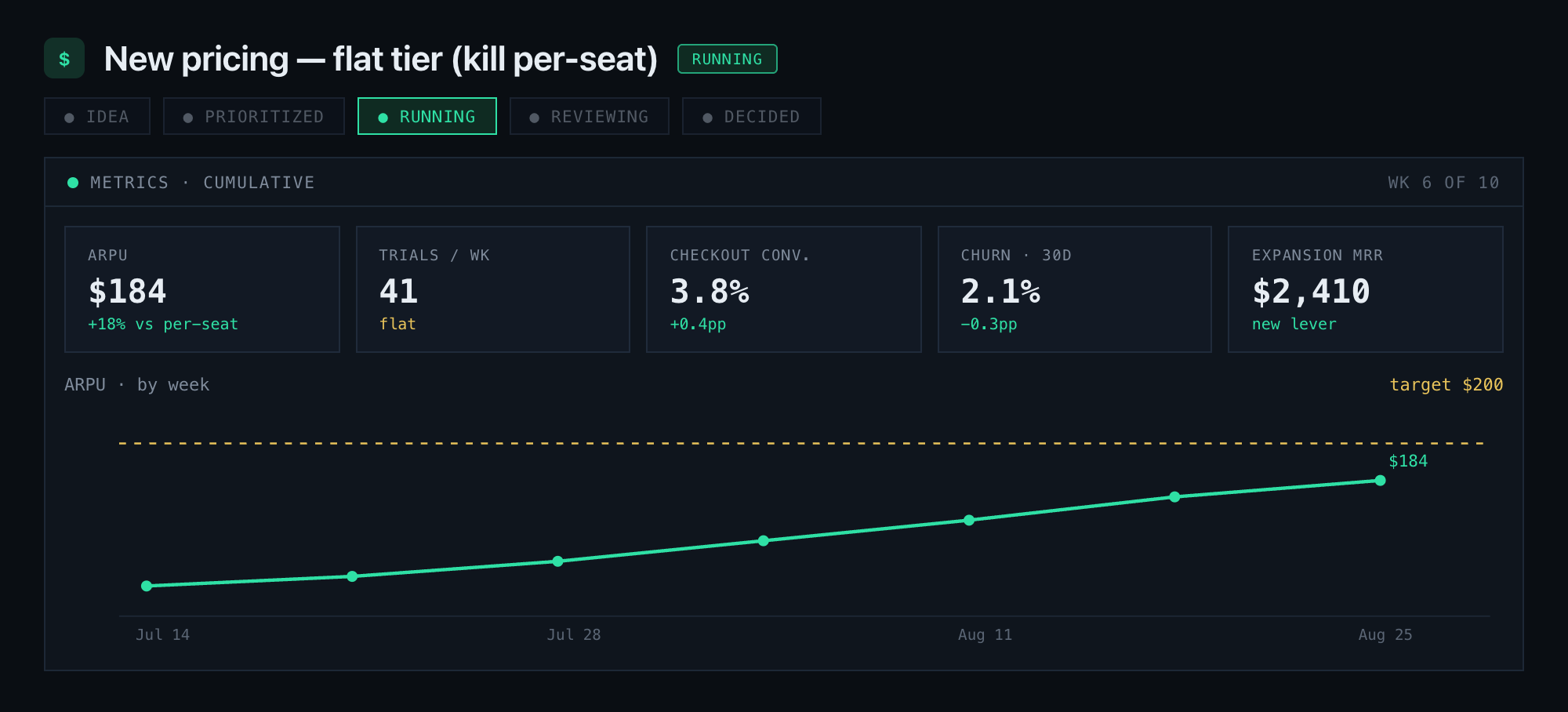
It’s built for teams making calls under real uncertainty, pricing changes, hiring decisions, roadmap bets, where the stakes are high enough that learning the wrong lesson actually costs you. Each bet moves through clear stages and closes with a post-mortem verdict, Won, Killed, or Inconclusive, that separates skill from luck instead of letting the outcome write the story. If you want a low-friction way to see this work, log three real bets you’re currently weighing, note your confidence as a percentage for each, and check back in 30 days to see how your calibration actually holds up. Start with Betlog and put your reasoning on the record before hindsight gets to it.
Sources
For readers who want to go past the summary and into the primary research, a few sources cover the core findings in more depth:
- Hindsight bias — Wikipedia
- Hindsight Bias — Roese & Vohs (2012) PDF
- Hindsight bias from 3 to 95 years of age — PMC article
- Hindsight bias redefined: It’s about time — Journal article (2009)
- Hindsight and foresight: the effect of outcome knowledge on judgment under uncertainty — Fischhoff DOI (2003)
FAQ
What Is Hindsight Bias in Psychology?
Hindsight bias is the tendency to see past events as more predictable than they actually were once the outcome is known, which distorts memory of prior judgments and inflates confidence in future predictions, according to the Wikipedia summary of the effect.
What Is the Difference Between Hindsight Bias and Confirmation Bias?
Hindsight bias distorts your memory of a past prediction after you already know the outcome, while confirmation bias is the tendency to seek out and favor information that confirms a belief you already hold, regardless of outcome. They can overlap, since confirming a belief in hindsight often relies on selectively recalled, outcome-consistent evidence, but confirmation bias operates going forward and hindsight bias operates backward.
What Is Outcome Bias, and How Does It Differ From Hindsight Bias?
Outcome bias is judging the quality of a past decision based on how it turned out rather than on the soundness of the reasoning at the time, which is close to what Annie Duke calls “resulting.” Hindsight bias is the memory distortion that makes outcome bias feel justified, since it convinces you the good or bad result was predictable all along.
Why Is Hindsight Bias Considered Harmful?
It’s harmful because it blocks honest learning: teams and individuals end up crediting skill for lucky wins and blaming bad luck or negligence for reasonable bets that simply lost, which corrupts feedback loops and breeds overconfidence in future decisions, according to Roese and Vohs’s review of documented consequences.
Can Hindsight Bias Actually Be Reduced?
Yes. Structured techniques like consider-the-opposite prompts, pre-mortems, and written decision journals that record confidence levels before an outcome is known have demonstrated reductions in hindsight-driven judgments across finance, law, and organizational settings, according to research on debiasing interventions.