45–60 Min Premortem for Project Teams: Lock Findings in a Decision Log
Run a 45–60 minute premortem to surface concrete failure scenarios, assign owners, and log findings into a decision record your team will actually use.

On this page
- What Is Premortem Analysis?
- What Are the Benefits of Premortem Analysis?
- Premortem vs Postmortem: When to Use Each
- Who Should Participate, and How Do You Set the Tone?
- How to Conduct a Premortem: Step-by-Step
- Turning Failure Scenarios Into Mitigations You’ll Actually Use
- Common Premortem Pitfalls and How to Avoid Them
- A Practical Premortem Template You Can Copy
- Turning Premortem Outputs Into a Decision Record
- Examples of Premortem Analysis Across Industries
- Tools and Software for Running Premortem Sessions
- What Evidence Supports Premortem Analysis?
- How to Integrate Premortems Into Existing Risk Frameworks
- When Should You Skip a Premortem?
- Sources
- FAQ
Premortem analysis is a risk technique where a team imagines a project has already failed and works backward to explain why, surfacing the specific weaknesses a standard risk review tends to miss. The payoff is candor: people who stay quiet in a normal status meeting will name a real problem when the frame is “this already went wrong.” Run one before committing to anything expensive, high-stakes, or hard to reverse.
TL;DR:
- Premortem analysis is most effective when conducted before a project begins, especially for high-stakes or irreversible decisions, to surface hidden risks.
- The method leverages prospective hindsight by asking participants to explain why a future failure occurred, encouraging specific, candid concerns from diverse functions.
- It should be a one-time, structured session with silent brainstorming, clustering, likelihood-impact ratings, and assigning mitigations, to be integrated into project planning.
- Involving skeptics and ensuring a neutral facilitator fosters honest dissent, preventing groupthink and enabling quiet voices to raise objections confidently.
- Follow-up is essential; high-priority risks identified must be transferred into risk registers or project plans and revisited regularly to keep the exercise meaningful.
What Is Premortem Analysis?
Premortem analysis works because of a mental trick called prospective hindsight. Ask someone “what might go wrong?” and they hedge. Tell them “it’s six months from now and this failed, explain why,” and specific, concrete reasons surface fast. Cognitive research by Mitchell, Russo, and Pennington first formalized this shift from speculation to imagined certainty, and it’s the mechanism the entire technique runs on.
Gary Klein packaged the exercise into a repeatable method in 2007, and the Harvard Business Review endorsed it the same year in a piece describing it as a way to surface candid concerns and combat groupthink. A premortem differs from a standard risk register in three ways:
- It happens once, upfront, not as an ongoing tracked list.
- It uses a failure narrative instead of a probability spreadsheet.
- It’s designed to produce dissent, not consensus.
That last point is what makes it useful. Risk registers tend to collect the risks everyone already agrees on. Premortems dig for the ones nobody wants to say out loud.
What Are the Benefits of Premortem Analysis?
The clearest benefit is that premortems break groupthink. When a plan already has momentum and sign-off from leadership, individual doubts get suppressed. Framing the exercise as “the project failed, why?” gives skeptics social cover to speak.
They also counter the planning fallacy, the well-documented tendency to underestimate timelines and overestimate control. Teams that skip this step tend to treat their own optimism as evidence of quality planning, which it usually isn’t.
Premortem analysis benefits, concretely:
- Converts vague unease into specific, ownable failure scenarios.
- Reduces overconfidence baked into the plan before launch, not after the postmortem.
- Gives quiet or junior voices a structured way to raise objections.
- Feeds a calibration loop when paired with a later postmortem.
Premortem vs Postmortem: When to Use Each
The two tools sit on opposite ends of a project’s timeline, and confusing them wastes the exercise. A premortem happens before work starts, when the plan can still change. A postmortem happens after the outcome is known, when the goal shifts to sorting skill from luck.
- Premortem: Runs pre-launch. Output is a list of plausible failure causes and mitigations. Emotional tone is hypothetical, which keeps it low stakes and honest.
- Postmortem: Runs post-outcome. Output is an accounting of what actually happened and why. Emotional tone can get defensive, especially after a loss.
Used together, they close a loop: the premortem predicts specific failure modes, and the postmortem checks which predictions were right. That comparison is where real calibration comes from, according to analysis contrasting the two techniques as complementary rather than redundant tools.
Who Should Participate, and How Do You Set the Tone?
Invite people across functions, not just the core project team. An engineer, a salesperson, and a finance lead will each imagine a different failure, and you want all three.
Deliberately include the person most likely to disagree with the plan. Their dissent is the entire point of the exercise.
The facilitator’s job is to keep it blameless: no names attached to failure causes, no “I told you so” energy. Brief participants beforehand with one instruction: assume the project failed completely and be specific about why.
- Cross-functional mix, including at least one skeptic.
- A neutral facilitator who isn’t the project owner.
- A pre-brief that frames this as prevention, not blame.
Pro Tip: If the project owner facilitates their own premortem, participants self-censor. Bring in someone with no stake in the outcome to run it.
How to Conduct a Premortem: Step-by-Step
Here’s a practical premortem analysis process you can run inside a single meeting.
- Prepare in advance. Send the project brief, timeline, and success metrics well in advance. Book enough time and invite a small cross-functional group of participants.
- Set the frame. The facilitator opens with: “It’s one year from now. This project failed completely. Take five minutes and write down every reason you can think of why.”
- Individual silent brainstorming. Each person writes their reasons alone, on sticky notes or a shared doc, before anyone talks. This step matters more than any other: speaking first anchors the whole room and reintroduces the groupthink you’re trying to avoid. HBR’s original framing treats this silent phase as the mechanism that surfaces candid input.
- Share and cluster. Go around the room, one reason at a time, no discussion yet. Group similar reasons into labeled clusters: “budget overrun,” “key hire falls through,” “vendor delay,” and so on.
- Assess likelihood and impact. For each cluster, rate rough likelihood and impact, high, medium, or low. You’re not building a precise model here. You’re triaging.
- Convert to mitigations with owners. For every high or medium cluster, assign a named owner and a specific action: a monitoring metric, a contingency budget, a contract clause, a backup vendor.
- Document and integrate. Write the failure scenarios, mitigations, and owners into the actual project plan, not a separate file that never gets reopened. This is the step most teams skip, and it’s the one that makes the whole exercise worth the hour.
Turning Failure Scenarios Into Mitigations You’ll Actually Use
A likelihood times impact grid is enough to sort a long list of imagined failures into a short list worth acting on. High-likelihood, high-impact clusters get resources immediately. Low-likelihood, low-impact ones get a note and nothing else.
For anything in between, assign an owner and design a short experiment to shrink the uncertainty rather than debating it in a meeting. That might mean a two-week vendor trial or a customer interview instead of a guess.
- Rank clusters by likelihood and impact, not by how loudly someone argued for them.
- Define early-warning indicators, a specific metric or event that signals the failure is starting to happen.
- Set checkpoints where the team revisits the indicator, not just the original mitigation.
- Decide upfront which scenarios justify a contingency budget or a rollback plan, before the pressure of a real deadline makes that call.
Pro Tip: Write early-warning indicators in specific, measurable terms.
Common Premortem Pitfalls and How to Avoid Them
The most common failure is running a premortem as a checkbox exercise, ten minutes tacked onto a status meeting with no silent brainstorming and no follow-up. That produces generic risks everyone already knew.
Watch for defensive pushback from the project owner, who may treat every raised concern as a personal criticism. A blameless frame, set explicitly at the start, heads this off.
Imagination limited to past failures is another trap. Teams recycle “we ran over budget last time” instead of imagining new failure modes specific to this project. And the biggest waste: generating a strong list of failure scenarios, then never assigning owners or revisiting them, which is the same as not running the premortem at all.
A Practical Premortem Template You Can Copy
Use this as a concise agenda for a premortem session:
- Minutes 0 to 5: Facilitator sets the frame and reads the project brief aloud.
- Minutes 5 to 15: Silent individual brainstorming. Prompt: “Name three specific reasons this project failed.”
- Minutes 15 to 30: Round robin sharing, one reason at a time, clustered live on a board.
- Minutes 30 to 45: Rate clusters by likelihood and impact, assign owners to the top ones.
- Minutes 45 to 60: Draft mitigations and early-warning indicators; assign a note taker to distribute a summary within 24 hours.
Deliverables: a clustered failure list, owned mitigations, and a monitoring checkpoint date, all logged somewhere the team will actually reopen. The PHF premortem tool offers a similar structure built for teams new to the format.
Turning Premortem Outputs Into a Decision Record
A premortem produces failure scenarios that may be forgotten unless someone documents them as testable claims. Log the project’s hypothesis and your confidence in it as a probability before launch, then record each premortem risk as a specific, checkable assumption tied to a mitigation.
- Write the hypothesis and a numeric confidence level before the project starts.
- Log each failure scenario as a testable assumption with an owner.
- Revisit both at the postmortem to see which predictions actually held.
Betlog’s decision journal approach is built around exactly this loop, capturing the bet, the confidence, and the eventual verdict so premortem predictions can be checked against reality instead of forgotten.
Examples of Premortem Analysis Across Industries
Product teams often use a premortem before a major launch, imagining the release flopped and tracing the cause back to unclear onboarding, a missed integration, or a competitor shipping first. That exercise routinely surfaces a dependency nobody flagged in the standard project review.
Construction and infrastructure teams use the technique before breaking ground, imagining a project over budget and behind schedule twelve months out. The failure causes that surface, permitting delays, a subcontractor default, a materials shortage, get built into the contract terms rather than left as vague risks.
In healthcare and public health, PHF frames the premortem as a tool for program rollouts, where imagining total program failure ahead of a launch helps surface access barriers or staffing gaps that a standard logic model misses.
The technique has also moved into policy and technology planning. Brookings applied premortem thinking to generative AI in education, arguing the method is especially valuable in domains with real optimism bias, where enthusiasm for a new technology crowds out attention to second-order effects like unequal access or misuse. That’s a useful pattern for any team evaluating a new tool or platform: run the premortem before the rollout, not after adoption is already underway.
Consulting and advisory teams run premortems on client engagements before signing off on a strategy, a practice that overlaps with how firms like US Market Intelligence approach market entry risk for cross-border projects, anticipating failure points before capital moves.
Tools and Software for Running Premortem Sessions
You don’t need specialized software to run a premortem. The exercise was designed for a whiteboard, sticky notes, and a timer, and that setup still works fine for a single team meeting.
For remote or hybrid teams, a shared digital whiteboard handles the individual brainstorming and clustering steps well: participants add notes silently, then the facilitator groups them live. Any collaborative document or spreadsheet can hold the likelihood and impact ratings afterward.
The harder problem isn’t running the session, it’s keeping the output alive. A premortem generates a list of failure scenarios and mitigations that needs to survive past the meeting, get assigned to owners, and get checked again later. That’s where a structured record beats a one-off doc: a decision journal built for tracking hypotheses, confidence levels, and outcomes gives premortem findings a permanent home instead of a slide that gets archived and forgotten.
Project management platforms with risk registers can also absorb premortem output, as long as someone actually moves the clustered scenarios from the meeting into the tool. The tool matters less than the discipline of transferring findings out of the workshop and into something the team revisits on a schedule.
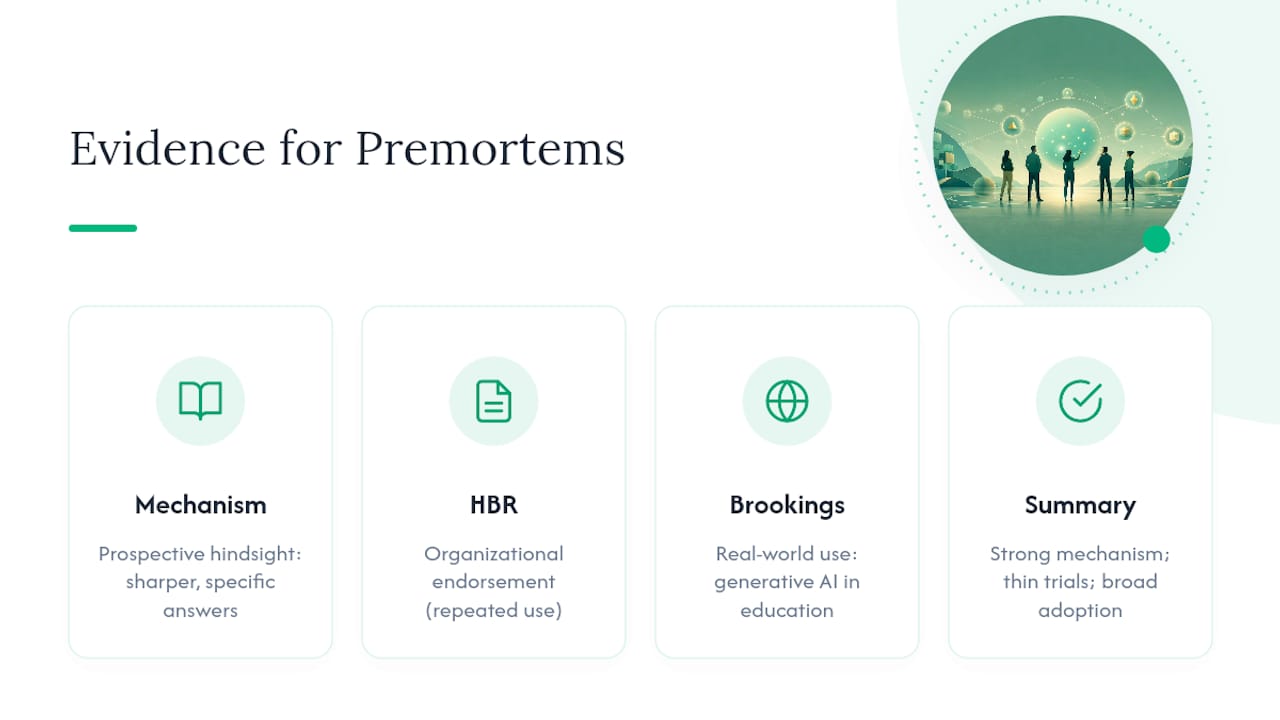
What Evidence Supports Premortem Analysis?
The strongest evidence for premortem analysis is mechanistic rather than statistical: it rests on a well-documented cognitive effect, prospective hindsight, where imagining an outcome as already certain produces more specific reasoning than asking someone to speculate about a hypothetical future. That’s the finding Gary Klein built the premortem method around, and it traces back further to earlier cognitive research on hindsight framing.
Harvard Business Review’s endorsement carries weight because it came from repeated organizational use, not a lab study. HBR described the technique as one that reliably surfaces candid concerns that standard risk reviews miss, precisely because the failure frame gives dissenters cover to speak.
More recent application broadens the case. Brookings’ use of premortems to examine generative AI in education is a real-world case study showing the technique’s value outside traditional project management, in a domain defined by hype and optimism bias. The consistent thread across every source: premortems don’t need a large sample size to work because the mechanism is psychological, not statistical. Ask the same group the same question two different ways, “what could go wrong?” versus “this failed, why?”, and the second version reliably produces sharper, more actionable answers.
That’s a modest but real evidence base: strong on mechanism, thin on large-scale controlled trials, and consistently reinforced by organizational adoption across sectors from tech to public health.
How to Integrate Premortems Into Existing Risk Frameworks
A premortem isn’t a replacement for your existing risk register or project management framework. It’s an input that runs once, early, and feeds the tools you already use.
Slot it in right after project approval and before detailed planning locks in. Run the session, cluster the failure scenarios, then transfer the high and medium priority ones directly into your existing risk register or project charter as tracked line items with owners.
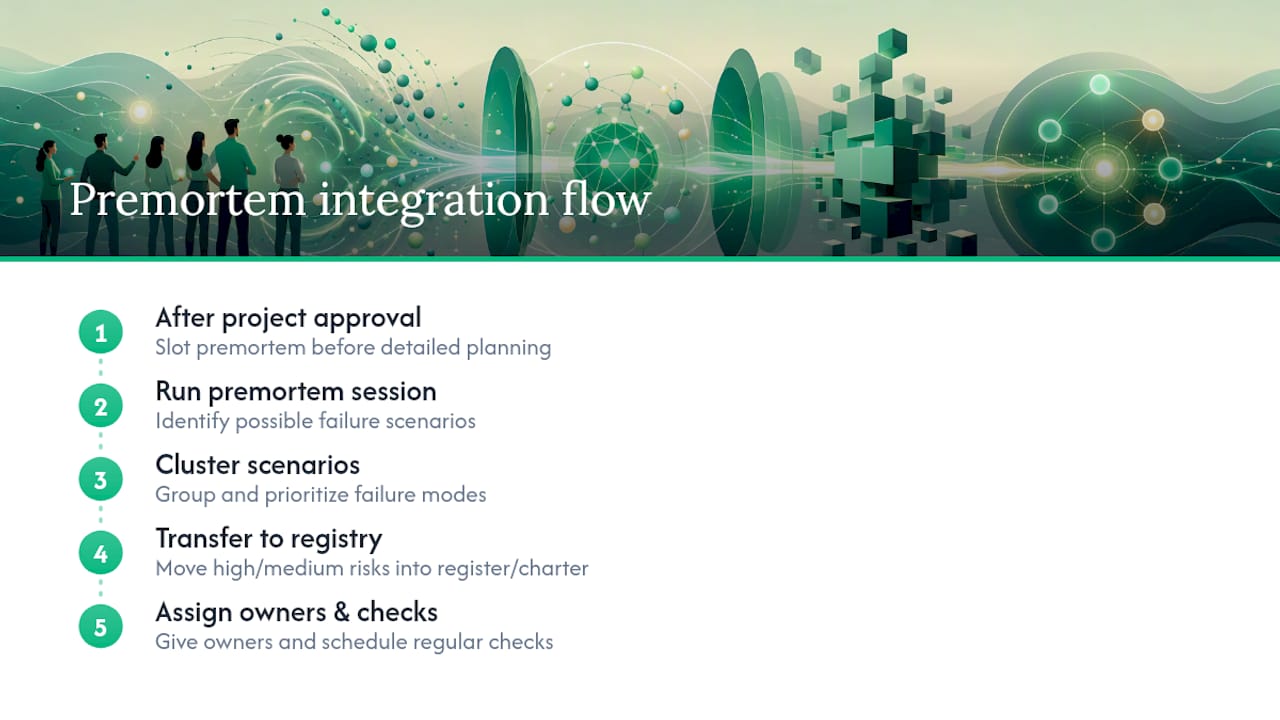
If your organization runs stage gates, make the premortem a required step before the first gate, not an optional add-on that gets skipped under deadline pressure. Pair it with whatever status cadence you already run, weekly check-ins, sprint reviews, steering committee meetings, so the early-warning indicators from the premortem get a home to be checked against.
The connective tissue is the follow-up. A premortem that produces a list nobody revisits is functionally the same as skipping it. Whether that follow-up lives in a risk register, a project management tool, or a dedicated decision record, the requirement is the same: someone owns each risk, and someone checks it on a schedule.
When Should You Skip a Premortem?
Not every decision earns an hour-long session. If the call is cheap to reverse, a small pricing tweak, a minor feature toggle, a premortem is overkill. A five-minute risk checklist or a quick gut-check with one colleague covers it.
Save the full exercise for decisions that are expensive, public, or hard to undo. And always pair it with a postmortem later. Premortems without follow-up calibration are just guesses that never get graded.
— Cesar
Sources
Start with HBR’s original 2007 piece for the technique’s organizational framing, then Gary Klein’s own writeup for the method’s origin. For modern applications in high-uncertainty domains, Brookings’ analysis covers generative AI specifically. PHF’s tool page offers a ready-to-use public-sector template, and Wikipedia’s entry gives a neutral overview of the planning fallacy connection.
- Performing a Project Premortem — HBR
- PRE-MORTEM METHOD OF RISK ASSESSMENT
- The art and science of pre-mortems — Brookings
- Pre-Mortem Analysis | PHF
FAQ
What is the difference between a premortem and a postmortem?
A premortem happens before a project starts and predicts failure causes so they can be mitigated in advance. A postmortem happens after the outcome is known and evaluates what actually caused success or failure, ideally separating skill from luck.
What is postmortem analysis?
Postmortem analysis is a structured review conducted after a project ends, examining what happened, why, and which decisions deserve credit or blame. It’s most useful when compared against predictions made in an earlier premortem.
How do you run a premortem session?
Gather a cross-functional group, have each person silently write down reasons the project “already failed,” then share, cluster, and rate the scenarios by likelihood and impact before assigning owners and mitigations. The whole exercise fits comfortably into a 45 to 60 minute meeting.
Who should facilitate a premortem?
A neutral facilitator who isn’t the project owner works best, since it keeps the discussion blameless and encourages participants to raise concerns they might otherwise soften.
When is a premortem not worth running?
Skip it for low-stakes, easily reversible decisions. A short risk checklist or a quick informal review usually covers those, saving the full premortem for high-stakes or hard-to-undo commitments.