Preserve Institutional Memory: Log the 'Why' in 2 Minutes for Founders
Learn how founders and small teams preserve institutional memory by capturing the decision 'why' with quick decision journals, 2-minute logs, and simple...

On this page
- What Does Institutional Memory Actually Include?
- Why Institutional Memory Matters More Than Most Teams Assume
- Codification or Personalization: Which Strategy Fits Your Team?
- How Can a Small Team Start Preserving Institutional Memory Tomorrow?
- How Decision Journals Capture the Reasoning Behind Every Call
- What Institutional Memory Does for Learning and Innovation
- How Do You Know If Your Institutional Memory Practices Are Working?
- Why This Comes Down to Leadership Choices, Not Tooling
- Turn Decision Records Into a Habit With Betlog
- Where to Learn More About Institutional Memory
- Sources
- FAQ
Institutional memory is the combined explicit records and tacit reasoning an organization builds up over time, the written procedures plus the unwritten judgment calls that never made it into a document. When it’s preserved, teams stop relitigating settled questions and make faster, better calibrated decisions. When it isn’t, every departure quietly drains the organization of context nobody thought to write down.
TL;DR:
- Most knowledge loss occurs from tacit information leaving with departing employees, not from explicit records or documents.
- Relying solely on documentation leads to mistakes, rework, and slower onboarding, as critical context remains unshared or forgotten.
- Combining targeted knowledge codification with active ownership and regular reviews helps preserve valuable institutional memory over time.
- Tracking decision-making habits, like using decision journals, ensures the reasoning behind key choices is captured before outcomes are known.
- Focusing on one high-impact decision area for governance and starting small improves the likelihood of building sustainable knowledge retention practices.
What Does Institutional Memory Actually Include?
Institutional memory splits into two categories that behave very differently once someone leaves the building. Explicit knowledge lives in databases, wikis, contracts, and decision logs. It’s searchable, it survives turnover, and it’s the easy half of the problem. Tacit knowledge is everything else: the sales rep who knows which client always negotiates hardest in Q4, the engineer who remembers why a “temporary” workaround from three years ago can never be removed, the founder who recalls exactly why a pricing test got killed even though the numbers looked fine.
Tacit knowledge is the vulnerable half. It walks out the door with the person who holds it, and nobody notices the gap until a decision gets remade badly. Organizational memory research draws exactly this distinction, and warns that having records alone doesn’t prevent what’s often called corporate amnesia: a company can have an overflowing wiki and still forget why it made a critical choice, because nobody trusted or retrieved the record when it mattered.
A short example makes the split concrete:
- Explicit: a signed vendor contract stating payment terms.
- Tacit: the informal understanding, held only by the person who negotiated it, that the vendor will bend those terms during a slow month if you ask nicely and early.
Lose the second one and you’ll pay full price forever, with no record explaining why you used to pay less.
Why Institutional Memory Matters More Than Most Teams Assume
Losing institutional memory shows up first as rework. Someone re-runs an analysis that was already done, re-debates a decision that was already settled, or repeats a mistake a colleague already made and quietly fixed. Onboarding stretches longer than it should, because new hires have to reconstruct context that used to live in one departed employee’s head. Decision quality erodes gradually, since each new call gets made with less of the accumulated judgment that used to inform it.
The scale of the problem is bigger than most leaders assume. Deloitte’s research on knowledge capture found that A large majority of organizations fail to consistently capture knowledge from employees nearing retirement, even though those employees are the most predictable knowledge loss event a company will ever face. It isn’t a surprise departure. It’s scheduled, and most organizations still let the knowledge walk out anyway.
The downstream costs are measurable where teams bother to track them: longer time-to-productivity for new hires, service metrics that dip after a senior person’s exit, and decisions that quietly regress to worse defaults because nobody remembers why the better default was chosen in the first place.
Codification or Personalization: Which Strategy Fits Your Team?
Knowledge-management strategy comes down to one real choice: codify knowledge into documents and systems, or personalize it by connecting the people who hold it. The KMHelpDesk roadmap frames this as the central fork every KM effort has to navigate, and most organizations need a blend rather than a pure bet on either side.
Codification fits knowledge that’s stable, repeatable, and needed by many people: pricing rules, onboarding steps, compliance procedures. Personalization fits knowledge that’s contextual, judgment-heavy, and rare: why a client relationship needs careful handling, how a founder thinks through a pivot. Lean too hard on codification and you get a wiki nobody trusts. Lean too hard on personalization and you get a company that grinds to a halt whenever three key people are out sick.
Whichever mix you choose, governance is what makes it last:
- A named owner accountable for the knowledge base, not “the whole team” by default.
- A review rhythm on the calendar, monthly or quarterly, not “whenever someone remembers.”
- One authoritative source of truth per topic, so people stop guessing which version is current.
- An incentive that rewards documenting a decision, not just making one.
ISO 30401 and the SECI model (socialization, externalization, combination, internalization) are worth borrowing from as checklists rather than treating them as mandates. Deloitte’s own findings back the governance emphasis directly, arguing that programs succeed when they build a single trusted knowledge source and get real executive sponsorship, not just a tool rollout.
Pro Tip: Pick the one topic where losing institutional knowledge would hurt the most, a key client relationship, a pricing model, a technical decision, and start your governance there instead of trying to codify everything at once.
How Can a Small Team Start Preserving Institutional Memory Tomorrow?
You don’t need a company-wide initiative to start. You need one use case and a habit.
- Pick one high-value use case. Choose the decision area where losing context would cost you the most, and decide upfront whether codification (writing it down) or personalization (pairing people) fits it better.
- Capture the “why,” not just the “what.” For any real decision, write down the hypothesis, your confidence as a percentage, the trade-offs you accepted, the metrics that will judge it, and what outcome you expect.
- Assign an owner and a short review cycle. Someone specific checks the record every few weeks, retires anything stale, and flags gaps.
- Use quick, low-effort tactics. Shadowing a departing employee for a week, a five-minute brain dump before someone’s last day, a running decision log, and a 10-10-10 premortem (how will this look in 10 minutes, 10 months, 10 years) all capture more than a formal audit ever will.
Pro Tip: A decision log entry that takes two minutes to write before you know the outcome is worth more than a polished retrospective written after, because hindsight quietly rewrites the reasoning you actually used.
How Decision Journals Capture the Reasoning Behind Every Call
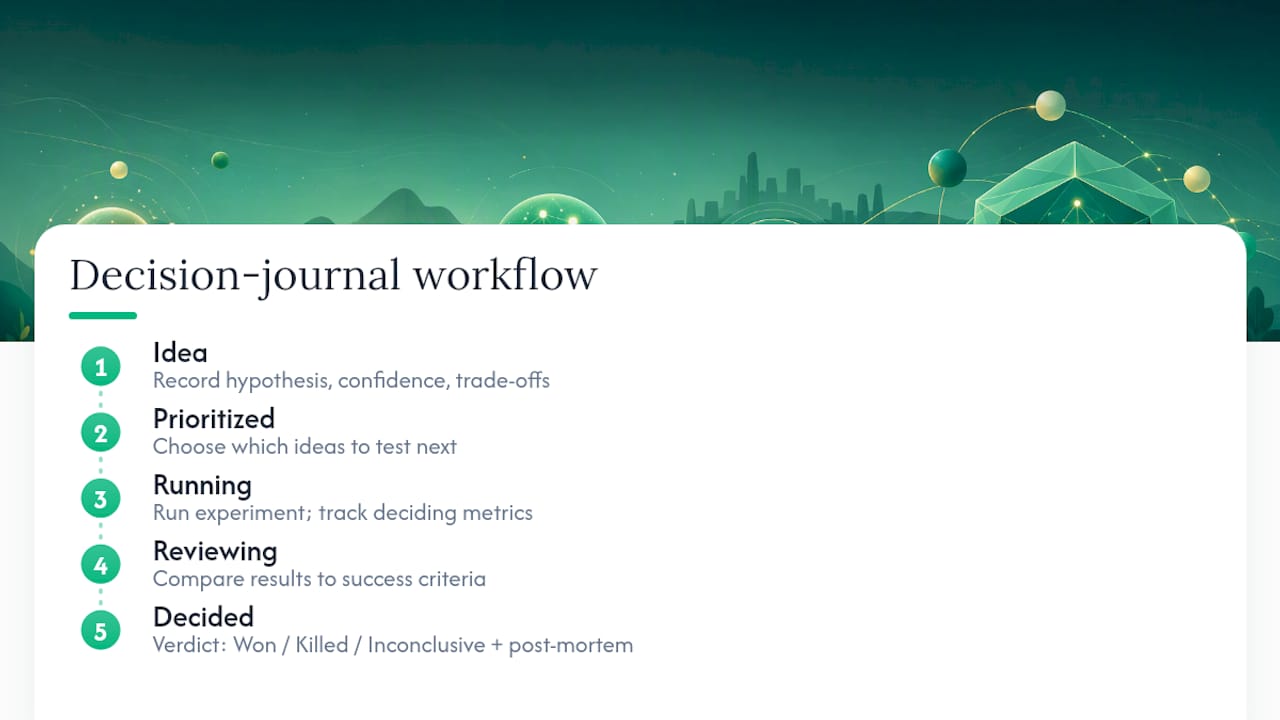
The hardest part of institutional memory to preserve isn’t the decision, it’s the reasoning that led to it. A decision-journal approach solves this by forcing capture before the outcome is known: hypothesis, confidence level, trade-offs accepted, the metrics that will decide it, and what would prove it wrong. This pattern involves moving each entry through explicit stages (Idea, Prioritized, Running, Reviewing, Decided) and closing with a verdict, Won, Killed, or Inconclusive, paired with a post-mortem.
That pre-outcome capture matters because it separates skill from luck. A pricing test that raised revenue 8% might have been a smart call executed well, or a mediocre call that got lucky. Without a record of the original confidence level and reasoning, you can’t tell the difference, and you’ll draw the wrong lesson either way.
The outcome misses the target.
What Institutional Memory Does for Learning and Innovation
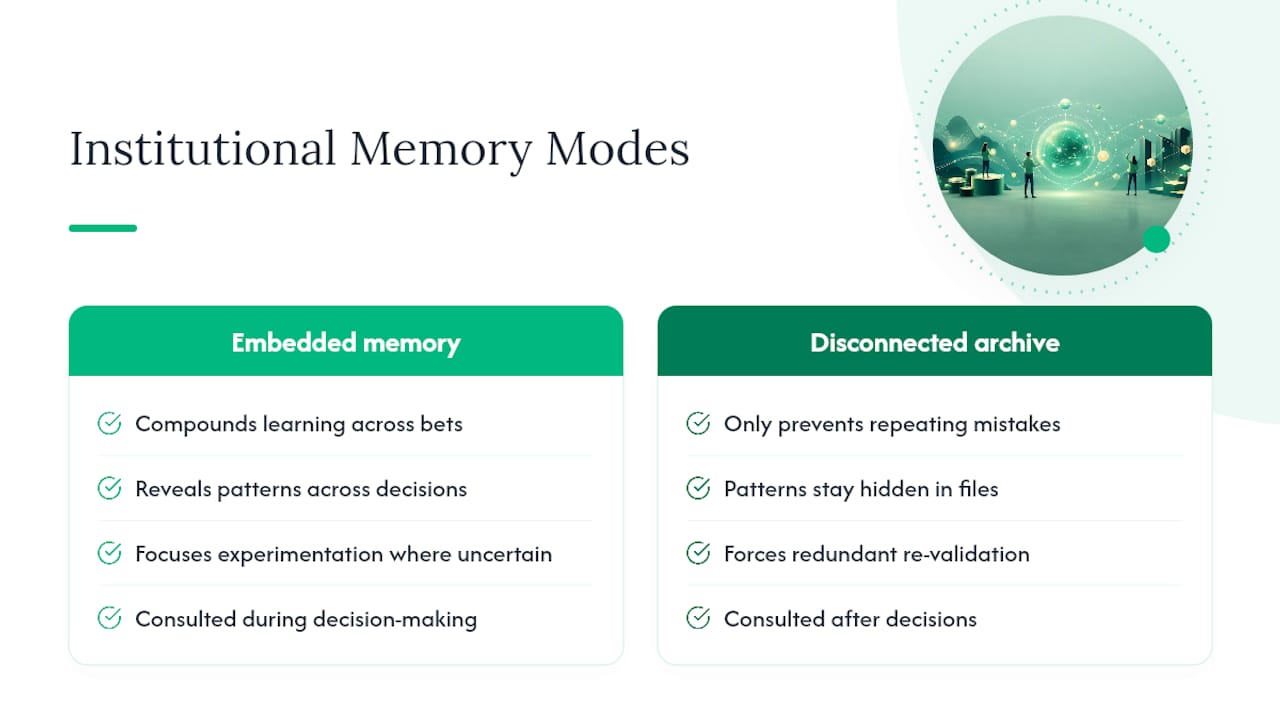
Organizations that preserve institutional memory well don’t just avoid repeating mistakes, they compound learning across every new decision. A team with a searchable record of past bets and their outcomes can spot patterns a single memory never could: which kinds of pricing changes tend to underperform, which product bets consistently overshoot their confidence, which trade-offs keep resurfacing.
That compounding effect is where innovation actually benefits. Teams often assume institutional memory is conservative by nature, a brake that keeps you doing what already worked. In practice it does the opposite when it’s built right: it tells you precisely which assumptions have already been tested, so you stop wasting cycles re-validating settled ground and can point genuine experimentation at the parts that are actually still uncertain.
The dynamic view of institutional memory captures this well: memory isn’t a static archive, it’s the network of practices connecting people to context in real time. That framing explains why some heavily documented companies still innovate slowly. Their memory sits in files nobody consults during actual decision-making, disconnected from the workflow. Organizations that embed capture into where the work happens, rather than as a separate archival task, get compounding returns because the memory is actually consulted before, not after, the next bet gets placed.
How Do You Know If Your Institutional Memory Practices Are Working?
The honest test isn’t whether you have documentation. It’s whether decisions get better over time and whether people actually use what’s been captured.
A few concrete signals are worth tracking. Onboarding time for new hires in a given role, if it’s shrinking as documentation matures, memory is doing its job. Repeat mistakes, the same wrong call made twice in eighteen months is a direct signal that a lesson wasn’t captured or wasn’t retrievable when it was needed.
Usage is the metric most KM programs skip, and it’s the one that matters most. A wiki with thousands of pages and zero weekly visits isn’t institutional memory, it’s a filing cabinet nobody opens. The KMHelpDesk framework makes the same point: documentation without accessibility and trust is close to worthless, and the real KM failure mode is treating capture as a technology rollout instead of a behavior change tied to actual incentives.
Run this evaluation quarterly, not annually. Institutional memory decays fast enough that a once-a-year audit will always be catching problems a few months too late.
Why This Comes Down to Leadership Choices, Not Tooling
Most institutional memory advice treats the problem as a documentation gap, buy a wiki, write more pages, hope people read them. That misses what’s actually broken. The real gap is almost always ownership: nobody is accountable for deciding what’s worth capturing, when it’s stale, and whether anyone trusts it enough to use it before the next decision, not after.
Naming an owner for one decision area this quarter will teach you more about your organization’s actual knowledge gaps than any audit. Start there, capture the reasoning behind your next real bet before you know how it turns out, and let that single habit prove the value before you try to scale it. Teams that want a structured way to do this without building it from scratch have started leaning on tools like Betlog to make the habit stick.
— Cesar
Turn Decision Records Into a Habit With Betlog
Some decision journal platforms operationalize everything this guide just walked through: hypotheses, confidence levels expressed as real percentages, the trade-offs accepted, the metrics that judge the bet, and a structured post-mortem once the verdict is in. Entries often move through clear stages so nothing gets lost between “we discussed this” and “we forgot why.”
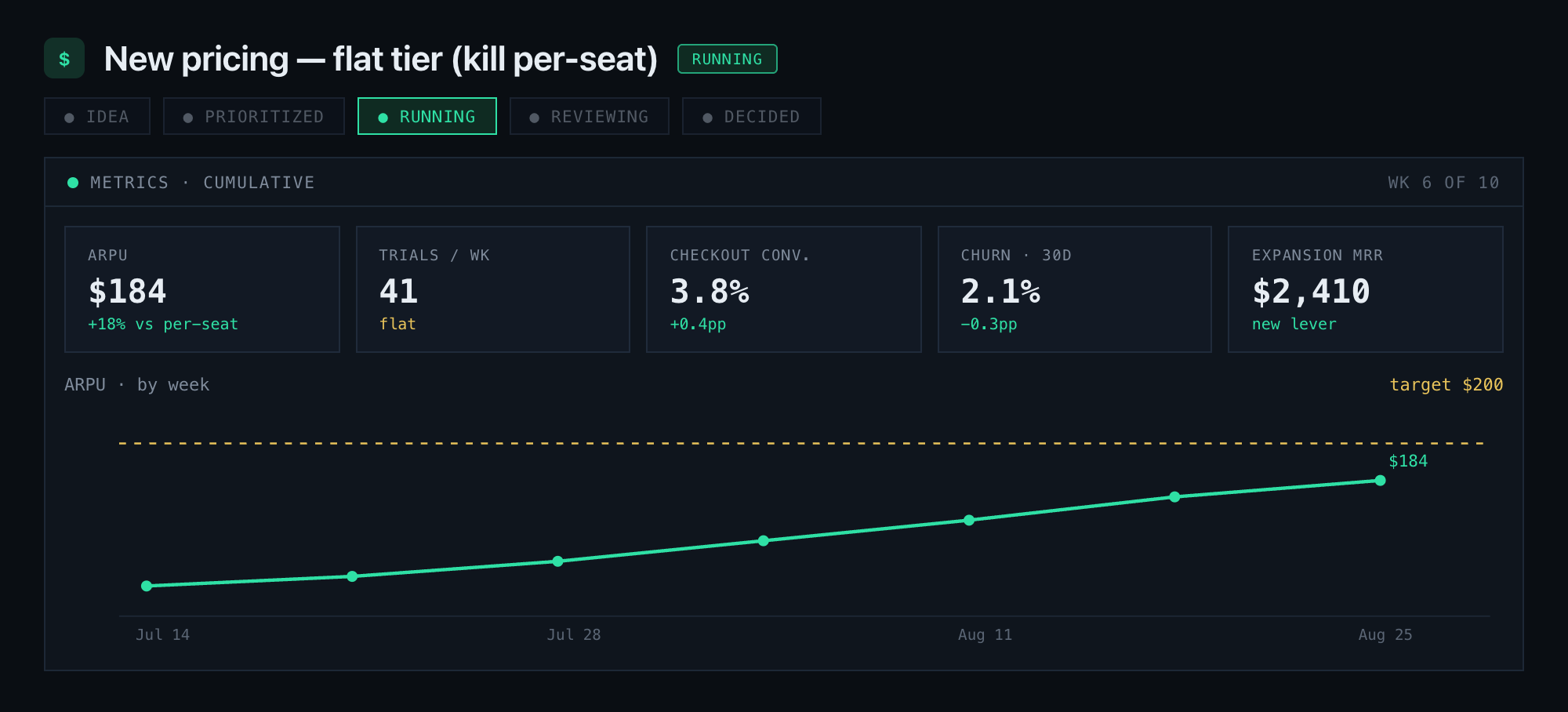
Such tools fit founders, product leads, and small teams who are tired of relitigating decisions because nobody wrote down the reasoning the first time. Instead of a wiki that gets ignored, these tools create a timestamped record that protects against hindsight bias and shows whether the team’s confidence actually matches its results over time. If you’re ready to stop losing the “why” behind your calls, try Betlog and log your next real decision before you know how it turns out.
Where to Learn More About Institutional Memory
- Deloitte’s knowledge-capture guide: the clearest data on retirement-driven knowledge loss.
- KMHelpDesk’s KM roadmap: a practical codification vs. personalization framework.
- Linda Argote’s review: the research case for elaborating knowledge, not just recording it.
- ISO 30401: the standard’s own leadership and lifecycle checklist for knowledge-management systems.
Sources
- Capturing institutional knowledge | Deloitte Insights
- Knowledge Management Strategy — 5-Phase Roadmap | KMHelpDesk
- Annual Review article by Linda Argote (expert perspective)
FAQ
What Is the Meaning of Institutional Memory?
Institutional memory is an organization’s combined explicit records and tacit, person-held knowledge built up over time. It shapes how well a team avoids repeating past mistakes and how quickly it makes sound decisions.
What Are the Four Types of Memory in Organizations?
Knowledge-management literature typically distinguishes explicit, tacit, individual, and collective memory. Explicit and tacit describe the form knowledge takes; individual and collective describe who holds it.
What Is Another Term for Institutional Memory?
“Organizational memory” and “organizational knowledge retention” are the most common alternate terms, used interchangeably in most knowledge-management research.
Can You Give an Example of Institutional Theory in Practice?
A common example is a company that keeps repeating the same failed pricing strategy every few years because the people who learned the original lesson have left and no decision record explained why it failed. Institutional theory studies exactly this pattern: how norms and practices persist, or fail to persist, independent of any one individual.
How Does a Decision Journal Support Institutional Memory?
A decision journal like Betlog captures the hypothesis, confidence level, and trade-offs behind a decision before the outcome is known, then closes the loop with a post-mortem. That combination preserves the reasoning tacit knowledge usually loses, in a format the whole team can retrieve later.