9 Field Decision Audit to Stop Rewarding Luck for Founders
Practical, append-only decision audit founders and product leaders can use. Nine fields, meeting cadence, and a worked pricing-bet example to build...
On this page
- What Is a Decision Audit? (Definition and Scope)
- Why Run Decision Audits: Learning, Calibration, and Accountability
- A Decision Audit Template: What to Record and Why
- How to Run a Decision Audit Meeting: Cadence and Agenda
- The Biases That Quietly Wreck Decision Audits
- Measuring Decision Quality: Calibration and the Decision Quality Matrix
- A Worked Example: Auditing a Founder-Level Pricing Bet
- Making Decision Audits Part of How the Team Actually Works
- Why Leaders Should Make This a Habit, Not a Project
- Sources
- FAQ
A decision audit is a structured, append-only review of a past decision’s process, not its outcome, designed to produce repeatable learning and better calibration. It matters because outcomes are noisy: a smart bet can lose and a reckless one can win, and if you only grade decisions by results, you’ll reward luck and punish good judgment. Leaders and teams making consequential, hard-to-reverse calls are the ones who benefit most.
TL;DR:
- Decision audits focus on reviewing the decision-making process, not the results, requiring documentation of rationale, alternatives, authority, and metrics beforehand.
- Conducting audits quarterly or after high-stakes decisions helps catch process flaws and improves future calibration, rather than relying solely on outcome evaluation.
- A complete decision audit trail includes a clear decision statement, owner, authority, reasoning, rejected options, metrics, and timestamps, stored in an append-only ledger.
- Biases like hindsight, motivated reasoning, planning fallacy, and power dynamics can undermine audits unless actively monitored and countered through structured dissent roles.
- Embedding decision audits into existing routines, with minimal logging effort and dedicated ownership, helps build a repeatable habit that shifts focus from luck-based outcomes to process quality.
What Is a Decision Audit? (Definition and Scope)
A decision audit is a formal review of how a decision got made: what was known, what was assumed, who had authority, and what alternatives got rejected, evaluated on a fixed timeline against the process quality, not the eventual result. The AACE International recommended practice on decision analysis frames this as a structured sequence of framing the problem, analyzing options, and deciding and committing, with decision quality measured by the elements that went into it, not just what happened next.
This is the opposite of “resulting,” the habit of judging a call entirely by its outcome, and it’s also the opposite of relying on anecdote (“last time we raised prices it worked out fine, so let’s do it again”). Not every choice deserves a formal audit. Reversible, low-stakes decisions like a minor UI tweak don’t need one. Pricing changes, key hires, pivots, and irreversible roadmap bets do.
Why Run Decision Audits: Learning, Calibration, and Accountability
Without that feedback loop, confidence is just a feeling dressed up as a number.
Audits also build institutional memory that survives someone quitting or a founder forgetting the actual reasoning six months later. When rationale, rejected alternatives, and named authority are on record, accountability stops being about blame and starts being about pattern recognition, catching the planning fallacy before it repeats. A team that never checks its assumptions against reality tends to make the same optimistic timeline error on every project, and nobody notices until the fourth missed deadline in a row.
A Decision Audit Template: What to Record and Why
A usable decision audit trail doesn’t need to be elaborate. It needs to be complete enough that someone with zero context can reconstruct the reasoning a year later. The minimum fields:
- Decision statement: the exact call being made, written as a single sentence, not a vague topic.
- Owner: who is accountable for the call, by name, not by team.
- Authority: who actually had the power to approve or veto it.
- Rationale: the hypothesis and the evidence behind it at the time, written before the outcome is known.
- Alternatives rejected: what else was on the table and why it lost, which is the single most commonly skipped field and the one that prevents rewritten history.
- Reversibility and stakes: how expensive it would be to undo, which sets how much scrutiny the decision deserves.
- Metrics and timeframe: the specific numbers that will settle whether the bet worked, and by when.
- Timestamp and status: when it was logged and where it sits in its lifecycle.
- Supersedes link: a pointer to any prior entry this decision revises.
Storage should be append-only: corrections create new entries that reference the old one instead of editing history in place, which is exactly how Decision Trace’s ledger design handles it. That single rule is what keeps an audit trail honest. Combine pre-mortem fields (rationale, alternatives, confidence) recorded before the decision runs with post-mortem fields (actual outcome, what proved the hypothesis right or wrong) added only once the metrics window closes.
How to Run a Decision Audit Meeting: Cadence and Agenda
Conducting decision audits periodically, such as quarterly, supplemented by triggered audits when high-stakes or irreversible decisions close out, works well for most small teams. Waiting a full year buries too much context; auditing everything weekly turns into busywork nobody sustains.
- Pull the original record before the meeting starts, unedited, so nobody’s memory quietly reshapes the rationale.
- Assign a dissent role. One person’s job is to argue the process was flawed even if the outcome was good. Groups that skip this step tend to rubber stamp lucky wins.
- Assess the process independent of the outcome. Did the team consider real alternatives? Was the confidence level reasonable given what was knowable at the time?
- Update the calibration log with the predicted probability next to what actually happened.
- Capture one written learning and assign an owner and deadline for any resulting action item.
The output isn’t a verdict on the person who made the call. It’s an update to the team’s calibration and a short list of process fixes for the next bet. Skipping the write-up is the single most common way audits quietly die.
The Biases That Quietly Wreck Decision Audits
Even a well-designed audit falls apart if the room isn’t watching for a few predictable traps.
- Resulting and hindsight bias: once you know how it turned out, the “obvious” signs feel obvious in retrospect even though nobody flagged them beforehand. The fix is grading the decision against only the information available at decision time, which is why the rationale field has to be written before the outcome, not reconstructed after.
- Motivated reasoning: people quietly edit their own story to look smarter after the fact. Requiring the alternatives-rejected field to exist before the outcome is known makes this much harder to fake.
- Planning bias: the gap between what the team assumed would happen and what conditions actually held. Comparing the two directly, line by line, is often more revealing than the outcome itself.
- Power dynamics: junior team members rarely challenge a founder’s pet project out loud. Protecting the dissent role, and rotating who fills it, keeps audits from becoming performance reviews in disguise.
Pro Tip: Write the rationale and confidence level in a sentence that would embarrass you if it turns out wrong. Vague hedging is usually a sign you’re already protecting your future self from a bad outcome.
Measuring Decision Quality: Calibration and the Decision Quality Matrix
The second tool worth adopting is the decision quality matrix: a two-by-two of good process versus bad process, crossed with good outcome versus bad outcome. A team following AACE’s decision-quality framing, which explicitly ties quality to the elements and the process rather than the result, will spend most of its review time on the “bad process” quadrants regardless of how the outcome landed. Teams that track calibration on a lightweight quarterly cadence tend to see the pattern emerge without drowning in review overhead. Don’t chase a dozen metrics. Two or three tracked consistently beat a dashboard nobody opens.
A Worked Example: Auditing a Founder-Level Pricing Bet
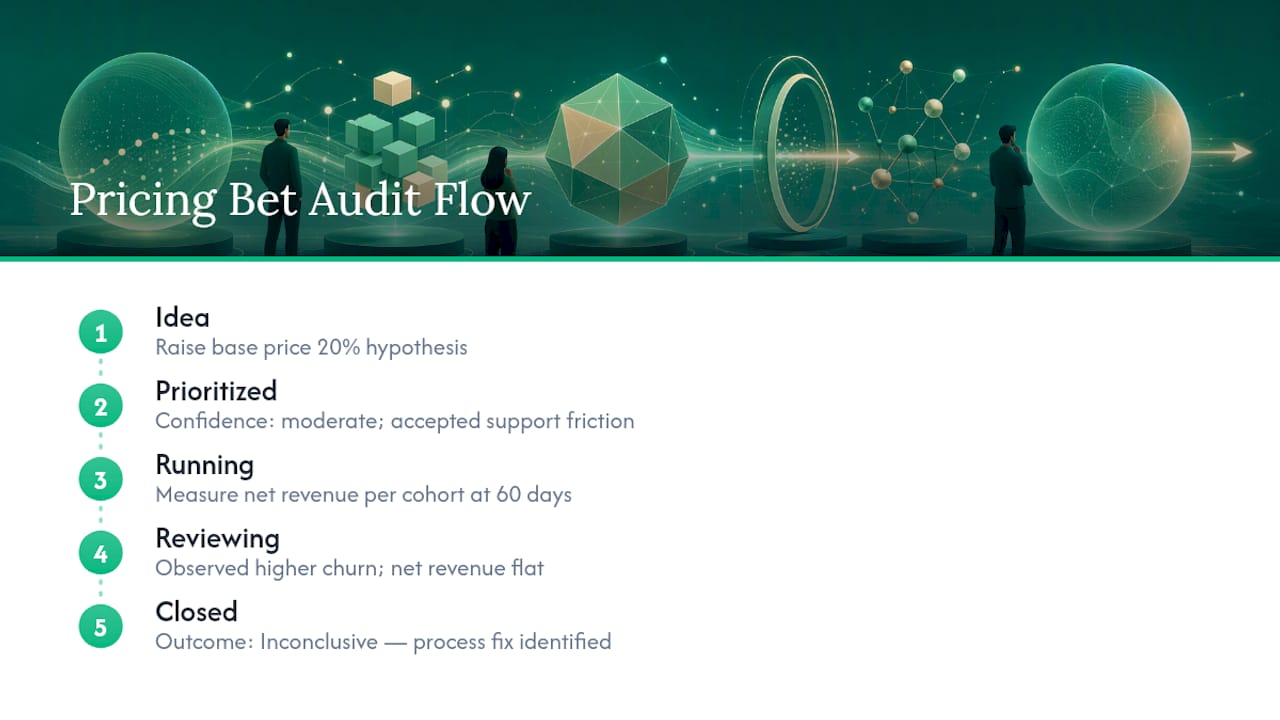
Say a founder raises the base subscription price by 20%, expecting a modest churn bump offset by higher revenue per account. The hypothesis: existing customers are price insensitive below a certain threshold. Confidence, logged before launch, was a moderate estimate, not “pretty sure.” The metric that would decide it: net revenue per cohort at 60 days, with churn tracked separately. The trade-off accepted: some support friction from unhappy long-term customers.
Ninety days later, churn came in higher than modeled and net revenue was flat, not up. The post-mortem separates skill from luck here rather than declaring the whole bet a failure: the pricing logic was reasonable given the data available, but the rollout skipped a segment test that would have caught the churn risk in a smaller group first. That’s a process fix, not a verdict on the founder’s judgment.
Mapped to a template, this looks exactly like an entry moving through Idea, Prioritized, Running, and Reviewing before closing as Inconclusive rather than a clean Won or Killed, because the outcome mixed a real process gap with normal market noise.
Making Decision Audits Part of How the Team Actually Works
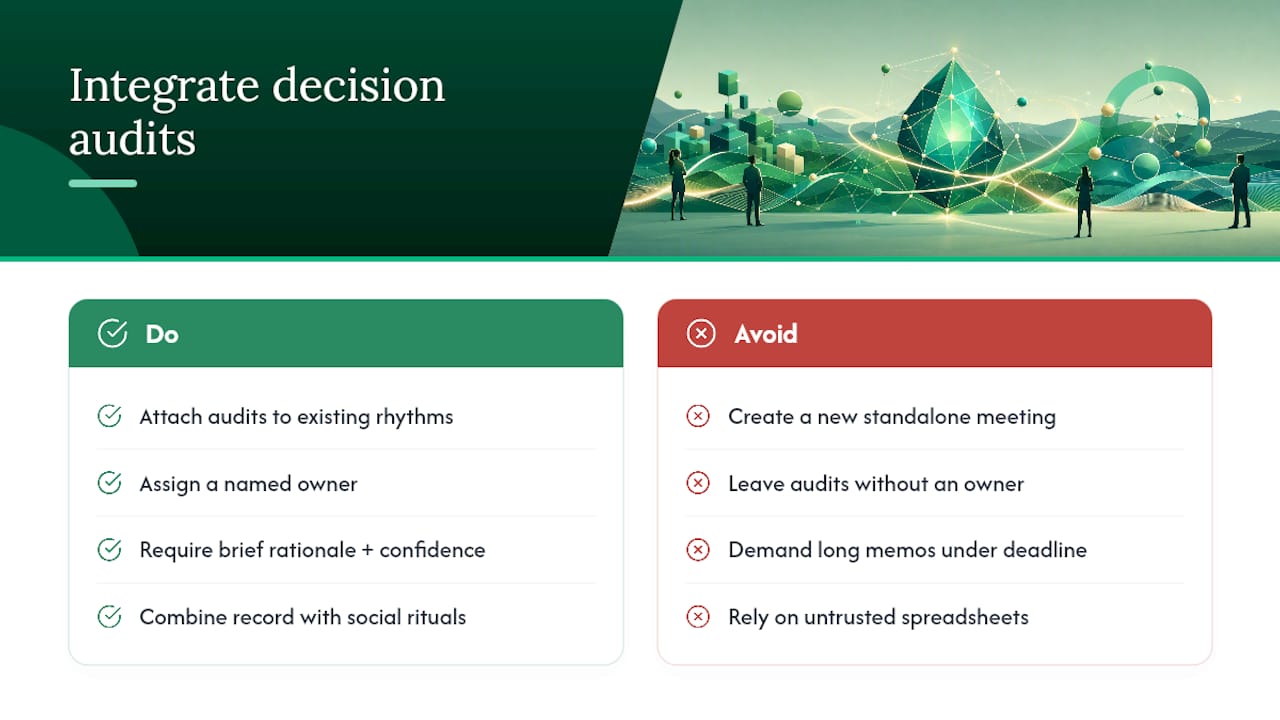
The failure mode isn’t skepticism about audits, it’s enthusiasm that fades after two sessions because nobody built them into an existing rhythm. Attach the audit cadence to something that already happens: quarterly planning, board prep, or a standing leadership sync, rather than inventing a new meeting nobody prioritizes.
Ownership matters more than tooling at first. One person, usually a founder or a senior product lead, needs to be the one who actually opens the record and schedules the review; without a named owner, the ritual quietly disappears the first busy quarter. Decision analysis works best as a sociotechnical process, combining the technical record with social rituals like protected dissent, and that framing from decision-analysis research on practitioner methods applies directly here: a spreadsheet nobody trusts to be honest is worse than no audit at all.
Keep the bar for what gets logged low enough that people actually do it. A one-paragraph rationale and a confidence number take two minutes to write; a five-page decision memo does not get written under deadline pressure, and an audit trail with gaps in it teaches the wrong lesson just as reliably as no audit at all. A tool built around this workflow, like Betlog, keeps the rationale and confidence level attached to the decision from the start instead of relying on someone reconstructing it from memory during the review.
Why Leaders Should Make This a Habit, Not a Project
Most leaders judge decisions the way sports commentators judge coaches: by the scoreboard. That instinct is almost entirely backwards. A coach who goes for it on fourth down with the right math and loses the bet still made the right call, and a team that only rewards scoreboards will eventually punish its best decision makers for bad luck and promote its worst ones for good luck.
The shift from outcome worship to process curiosity is the actual unlock, and it’s uncomfortable at first because it means sitting with an uncertain, honest “we don’t know yet” instead of a tidy story. Start small: pick one decision your team made in the last quarter, high stakes, ambiguous outcome, and run a single thirty-minute audit using nothing but the rationale, the alternatives considered, and the confidence level at the time. Do that once a week for a month before scaling it into a formal cadence. The habit matters more than the format.
— Cesar
Sources
- 133R-23: Using Decision Analysis Methodologies to Enhance Decision Quality (AACE International)
- Building a Decision Audit Trail (and Why You Need One) | StandIn
- logicoflife/decision-trace (GitHub)
- Decision analysis for practitioners (Phillips, LSE Research Online, 2025)
FAQ
What are the four types of audits?
In general business use, the four common audit types are internal, external, compliance, and operational audits, distinguished by who performs them and what standard they check against. A decision audit borrows the same “independent review against a process standard” logic but applies it specifically to how a choice was reasoned through, not to financial statements or regulatory compliance.
What is the 10-10-10 rule for decisions?
The 10-10-10 rule asks how you’ll feel about a decision at various future points, a mental time-travel technique for stress-testing a choice before committing to it. It’s a pre-decision framing tool, distinct from a decision audit, which reviews a choice after the fact.
What are the five steps in decision analysis?
A common decision-analysis structure moves through framing the problem, identifying alternatives, evaluating consequences and uncertainty, deciding and committing, and reviewing the outcome against the original reasoning, closely tracking the frame, analyze, decide-and-commit sequence AACE describes. A decision audit essentially formalizes that final review step into a recurring practice.
What are the seven types of decision-making?
Definitions vary across management literature, but common categories include strategic, tactical, operational, programmed, non-programmed, individual, and group decisions, sorted by scope and how routine the choice is. Decision audits apply most usefully to non-programmed, high-stakes decisions where the reasoning isn’t obvious in hindsight and the lesson is easy to get wrong.