Board Level Risk Appetite: Short Template and Decision Journal
A governance-first explainer for boards: clear definitions, a short template, KPIs and a 4-item decision journal to make risk appetite operational.

On this page
- What Is Risk Appetite in Formal Standards?
- Risk Appetite vs. Risk Tolerance: What’s the Difference?
- Why Does Risk Appetite Matter for Governance?
- How Do You Define and Measure Risk Appetite?
- How Do You Write a Risk Appetite Statement?
- Making Appetite Actionable With Decision Journals
- Risk Appetite and Risk Capacity: What’s the Relationship?
- How Do You Align Risk Appetite With Company Culture?
- What Goes Wrong When Organizations Set Risk Appetite?
- How Do You Monitor Risk Appetite Over Time?
- How Has Risk Appetite Shaped Major Business Decisions?
- Bring Your Decisions Into Alignment With Betlog
- The Governance Gap Nobody Talks About
- Sources
- FAQ
Risk appetite is the amount and type of risk an organization is willing to pursue, retain, or accept while chasing its strategic goals. Standards bodies frame it the same way: broad, board level willingness to accept risk in service of the mission, not a single number pulled from a spreadsheet. It matters because everything downstream, from capital allocation to how fast a team can approve a new product launch, hinges on whether that willingness is written down or just assumed.
TL;DR:
- Risk appetite should be stratified by business line and risk category to reflect different levels of acceptable risk, such as compliance versus experimentation.
- Clear thresholds, triggers, and escalation paths linked to quantitative KPIs are essential for making risk appetite operational and enforceable.
- Regular monitoring with dashboards, quarterly attestation, and decision journals is necessary to prevent drift and ensure decisions stay within defined limits.
- Capacity assessments based on objective measures should determine the hard limits of risk-taking, with appetite adjusting accordingly to avoid overreach during stress events.
- Decision documentation that captures hypotheses and trade-offs before outcomes are known helps close the governance gap and maintains alignment between culture and formal risk policies.
What Is Risk Appetite in Formal Standards?
Practitioners lean on a handful of definitions that all point the same direction. The NIST glossary aligns with COSO guidance and frames appetite as the broad level of risk an organization is prepared to accept in pursuit of value. ISO 31000 uses similar language, treating appetite as a governance input rather than a fixed metric. The Wikipedia summary of risk appetite captures the practical version: the amount and type of risk an organization is willing to pursue, retain, or take on to hit its objectives.
Organizations express that willingness two ways:
- Qualitative statements describe a stance in plain language, such as “we will not compromise customer data security under any growth scenario.”
- Quantitative thresholds attach numbers, such as a maximum acceptable customer churn rate or a capped percentage of revenue exposed to a single vendor.
Most mature organizations do not settle for one enterprise-wide number. They stratify appetite by business line, risk category, or strategic objective, since a fintech’s appetite for compliance risk should look nothing like its appetite for product experimentation.
Risk Appetite vs. Risk Tolerance: What’s the Difference?
Appetite and tolerance get used interchangeably, and that mix-up causes real governance problems. Appetite is strategic willingness, the board-level answer to “how much risk are we comfortable pursuing?” Tolerance is the operational boundary, the acceptable variation around that appetite that management actually enforces day to day. The IRM’s guidance on appetite and tolerance draws this line clearly: appetite is willingness, tolerance is the acceptable range of outcomes within it.
The mapping usually runs in four steps:
- Appetite sets the direction: “We accept moderate credit risk to grow the loan book.”
- Tolerance sets the range: “Default rates can run between 2% and 4%.”
- Thresholds set the trigger: “At 3.5%, notify the risk committee.”
- Escalation sets the action: “At 4%, halt new originations pending board review.”
A single loose sentence about appetite becomes useless without that chain running underneath it.
Why Does Risk Appetite Matter for Governance?
Boards set the appetite; management operationalizes it. That division of labor sounds obvious until you watch it break down, usually because the board approves a vague statement and leaves executives to guess what it means for a specific deal.
A well defined appetite feeds directly into:
- Capital allocation decisions, since risk appetite tells finance teams how much buffer to hold against downside scenarios.
- Innovation trade-offs, where product and engineering need to know how much technical or market risk is acceptable before a launch gets greenlit.
- Stakeholder reporting, where investors and regulators increasingly expect a documented appetite rather than a verbal assurance.
Vague appetite creates three predictable failures: decision paralysis when nobody knows if a move is within bounds, inconsistent risk-taking across business units doing the same job with different comfort levels, and poor capital allocation when resources chase the loudest voice in the room instead of the stated strategy. PwC’s guidance for boards treats appetite as an ongoing, board-engaged process specifically because a static statement stops driving behavior the moment it’s filed away.
Pro Tip: If your board can’t answer “would this decision breach our appetite?” in under thirty seconds during a meeting, your statement is too abstract to be useful. Rewrite it until they can.
How Do You Define and Measure Risk Appetite?
Building a usable appetite framework is a sequence, not a workshop exercise you finish in one afternoon.
- Map strategic objectives to risk categories. List the three to five goals driving the next planning cycle, then identify which risk categories (credit, operational, reputational, technology) each one touches, and who owns that category.
- Assess risk capacity and current profile. Combine short qualitative interviews with department heads and simple quantitative checks, like current exposure levels against balance sheet strength, to understand what the organization can actually absorb.
- Draft appetite statements and translate them into tolerances. Write one headline sentence per risk category, then attach the KPIs and numeric bands that make it enforceable.
- Assign ownership and set a review cadence. Someone specific, not “the risk committee” in the abstract, needs to own each statement and report on it quarterly or at minimum annually.
Sample triggers that work well in practice:
- Customer complaint volume crossing a defined percentage of active accounts
- Days of cash runway dropping below a set floor
- Vendor concentration exceeding a fixed share of total spend
When a threshold breaches, escalation should already be scripted. Nobody should be improvising an escalation path during the incident itself.
How Do You Write a Risk Appetite Statement?
A workable template is short: one headline sentence stating the stance, followed by two or three supporting sentences covering scope, measurable indicators, and what happens at the edge.
Template: “We [accept/avoid/pursue] [type of risk] to [strategic goal]. This applies to [scope]. We measure it through [KPI], and we escalate to [owner] when [threshold] is breached.”
Three examples across different stances:
- Conservative (public safety context): “We have zero appetite for risks that could compromise passenger safety. This applies to all vehicle maintenance and operational protocols. We measure it through incident-free days and mandatory inspection compliance, and any safety-critical near-miss escalates to the safety board within 24 hours.”
- Balanced commercial: “We accept moderate market risk to sustain steady revenue growth. This applies to pricing and inventory decisions across product lines. We measure it through gross margin variance and inventory turnover, and margin drops below 15% escalate to the CFO.”
- Growth-stage startup: “We pursue high product and market risk to capture early-mover advantage. This applies to new feature launches and market expansion. We measure it through burn multiple and customer acquisition cost trends, and a burn multiple above 3 escalates to the founding team for a resourcing review.”
Pro Tip: Avoid words like “significant” or “material” in your statement unless you define them numerically elsewhere. Ambiguous adjectives are where appetite statements quietly stop working.
When drafting language for investor-facing materials that reference strategic risk posture, a structured resource like a pitch deck template can help keep the framing consistent with how you’re describing risk internally.
Making Appetite Actionable With Decision Journals
Appetite statements fail most often not at the drafting stage but at the point of use, when a team makes a call and nobody records why. A decision journal closes that gap by capturing the hypothesis, confidence level, and trade-offs at the moment of decision, before the outcome is known. That timing matters: documenting the rationale up front prevents outcome bias from rewriting history during a board review.
A simple four-item checklist works for most teams:
- Hypothesis: what result do we expect and why?
- Appetite alignment: does this fall inside our stated tolerance for this risk category?
- Threshold: what number or event would trigger escalation?
- Review date: when do we revisit this decision against actual results?
Betlog builds this workflow into a permanent record, so boards reviewing quarterly risk reports see the reasoning behind each call, not just whether it worked out.
Risk Appetite and Risk Capacity: What’s the Relationship?
Appetite is what you want to accept. Capacity is what you can actually absorb without threatening solvency or survival. They’re related but not interchangeable, and confusing them is one of the more expensive mistakes a board can make.
A company might have a strong appetite for aggressive market expansion, fueled by ambition and competitive pressure, while its actual capacity, measured by cash reserves, debt covenants, or regulatory capital requirements, can’t support that ambition without real danger. In that scenario, capacity acts as the hard ceiling and appetite has to bend to fit underneath it, not the other way around.
The relationship works best as a sequence: assess capacity first, using objective measures like liquidity ratios, insurance coverage, and balance sheet strength, then set appetite within that ceiling.
Skipping the capacity assessment is how organizations end up with appetite statements that sound confident on paper but collapse the first time a real stress event hits. Capacity should get revisited whenever the balance sheet changes materially, not just during the annual planning cycle. Appetite, by contrast, can shift more frequently as strategy shifts, provided it never drifts past what capacity actually allows.
How Do You Align Risk Appetite With Company Culture?
A risk appetite statement that contradicts how people actually behave day to day gets ignored within a quarter. Culture is the real appetite; the written statement is just an attempt to describe it accurately, and that ordering matters more than most governance teams admit.
Start by observing actual behavior before writing anything down. If engineering teams routinely ship features without formal sign-off and nobody’s stopped them in two years, your real appetite for technology risk is higher than whatever a conservative-sounding policy document claims. Writing a stricter statement than the culture supports doesn’t lower risk. It just creates a document nobody follows, and a false sense of control for the board.
Alignment works better as an iterative conversation than a top-down mandate. Bring department heads into the drafting process, since they know where the informal appetite already sits, and ask them to flag statements that feel disconnected from how their teams actually operate. The IRM’s guidance treats appetite as an evolving strategic input requiring regular substantive board discussion, not a document drafted once and filed away, precisely because culture itself shifts as the organization grows, hires, and enters new markets.
Reward structures need to match the stated appetite too. A company that claims a conservative appetite for compliance risk but promotes the sales leader who cuts corners fastest is sending a louder signal than any policy document. Incentives, not statements, are what employees actually calibrate their behavior against.
What Goes Wrong When Organizations Set Risk Appetite?
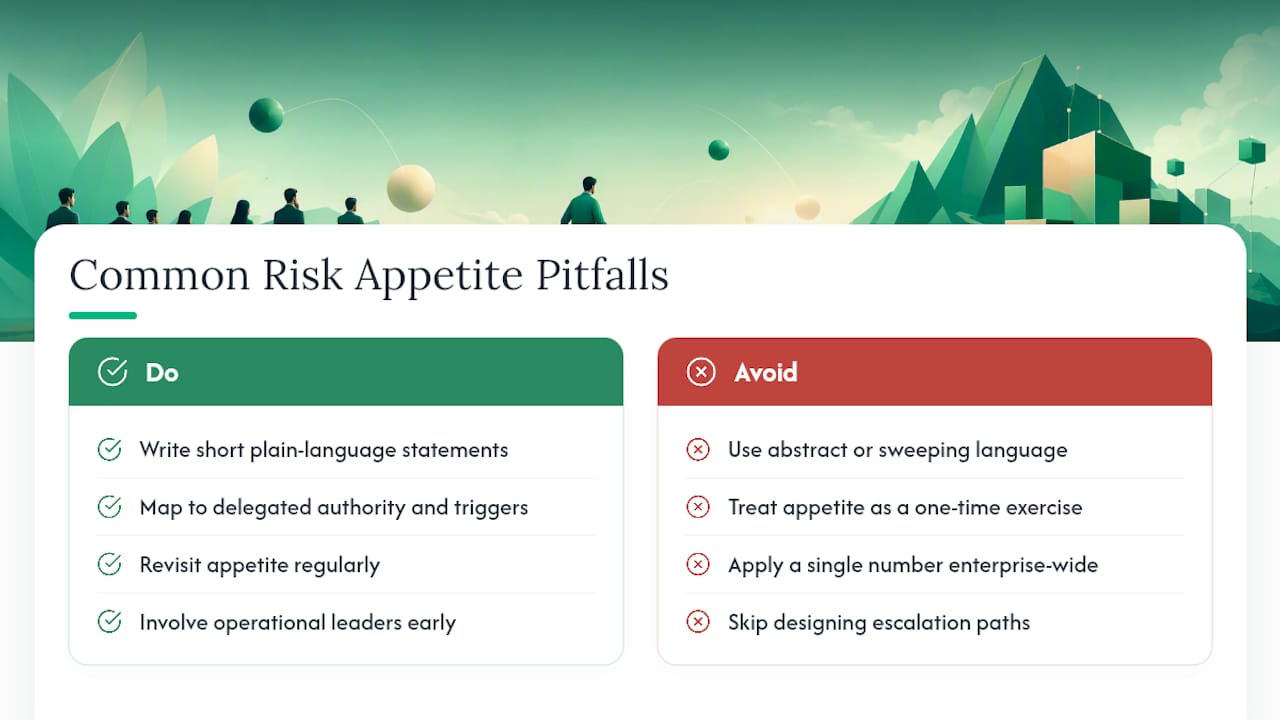
The most common failure is writing appetite as abstract policy language that never maps to a real decision. Statements like “we maintain a moderate risk appetite across our operations” sound reasonable in a board deck and mean nothing to the employee deciding whether to approve a vendor contract. The IRM’s practical guidance points out that the most useful statements are short and plain-language, mapping quickly to delegated authority and measurable triggers, not sweeping abstractions.
A second recurring pitfall is treating appetite as a one-time exercise. Teams draft a statement during annual planning, present it once, then never revisit it until the next cycle, even as market conditions, leadership, or strategy shift underneath it. By the time it’s reviewed again, it no longer reflects reality and nobody’s noticed.
A third problem is setting a single enterprise-wide appetite number and expecting it to work across wildly different business lines. A retail bank’s mortgage division and its trading desk face entirely different risk profiles; forcing both under one blanket appetite statement either constrains one unit unnecessarily or leaves the other dangerously loose.
Fourth, many organizations skip the escalation design entirely. They write a threshold without deciding in advance who gets notified and what happens next, so when a breach actually occurs, the response gets improvised under pressure instead of executed against a plan.
Finally, appetite statements often get drafted without input from the people who’ll actually work within them, which guarantees the culture mismatch problem described above. Involving operational leaders early costs a few extra meetings and saves months of a policy nobody follows.
How Do You Monitor Risk Appetite Over Time?
Appetite isn’t a document you file after the annual board meeting. It needs a monitoring rhythm or it decays into wallpaper.
Dashboards tracking KPIs against tolerance bands are the most common tool, giving risk committees a real-time view of where actual exposure sits relative to the stated ceiling. Effective ones show trend lines, not just current status, since a metric drifting toward a threshold over six months is a different problem than one that spiked yesterday.
Quarterly attestation processes, where business unit leaders formally confirm their operations remain within stated appetite, work well for catching drift before it becomes a crisis. Annual-only reviews tend to miss the gradual creep that causes most breaches; quarterly check-ins catch it while it’s still manageable.
Independent risk function reviews, separate from the business units generating the risk, provide a check against self-reported comfort. A business line that’s slightly over appetite has an incentive to describe its position generously; a second set of eyes corrects for that.
Decision-level records, like structured entries capturing the rationale behind individual calls, give reviewers a granular trail connecting specific decisions back to the appetite statement they were supposed to honor. That level of detail is what turns a quarterly dashboard review from a status check into an actual learning exercise, since the board can see not just whether a threshold was breached but why the decision was made in the first place.

How Has Risk Appetite Shaped Major Business Decisions?
Risk appetite decisions rarely make headlines on their own, but the business outcomes they shape do. A retailer with a conservative appetite for inventory risk that chooses to under-stock ahead of a demand spike will look overly cautious in hindsight, while the same conservative stance looks prescient the following year when demand craters and competitors are stuck writing off excess stock. Appetite decisions get judged by outcome even though the whole point of setting them upfront is that the outcome wasn’t knowable at the time.
Financial institutions offer the clearest large-scale examples. Banks that maintained tighter capital buffers than regulators strictly required, reflecting a lower appetite for capital risk than peers, entered periods of market stress with more room to absorb losses without triggering emergency capital raises. Competitors that ran appetite closer to the regulatory floor had less room to maneuver when conditions turned.
Technology companies show the opposite pattern working in their favor. A firm with a high appetite for product risk that ships an unfinished feature to beat a competitor to market can capture share that’s difficult to win back later, even if the early version needs several rounds of fixes. The appetite decision to launch imperfect and iterate, rather than wait for a polished release, is a direct expression of a risk-seeking stance toward market risk over the safer, slower alternative.
What separates organizations that learn from these moments from those that repeat the same mistakes is whether the original reasoning got written down. A company that documented its confidence level and trade-off assumptions before launching can go back and see exactly which assumption was wrong when results disappoint, rather than reconstructing a plausible story after the fact. That distinction is what decision journaling is built to preserve.
Bring Your Decisions Into Alignment With Betlog
Most of the failure modes covered here, the vague statement, the missing escalation path, the decision nobody can explain six months later, come down to the same root cause: nothing was written down at the moment it mattered. Betlog exists to fix exactly that gap. It gives teams a structured place to record the hypothesis, confidence level, and trade-offs behind a decision before the outcome is known, and to tag that decision against the risk category or appetite statement it’s supposed to respect.
That record turns a quarterly risk review from a guessing exercise into an actual audit trail. When a threshold gets breached, you’re not reconstructing intent from memory. You’re pulling up the entry where someone wrote down what they expected and why. Teams using Betlog build that habit into their normal status calls and post-mortems, which means the organization’s understanding of its own risk appetite gets sharper every quarter instead of staying frozen in whatever the last annual planning document said. Start with a free trial and see how much clearer your next risk committee meeting gets when the reasoning is already on the record.
The Governance Gap Nobody Talks About
Most risk appetite advice stops at the statement. Write it, get board sign off, distribute the PDF, done. That’s the part that’s easy to consult on and hard to screw up visibly, so it’s where most frameworks spend their energy. The actual failure point is almost always downstream of the statement, at the moment an employee is deciding whether a specific move falls inside or outside the line the board approved.
Conventional guidance underrates how much appetite work is really change management, not documentation. A statement that contradicts existing incentive structures or team habits will lose to those habits every time, no matter how well it’s worded. I’d rather see a company spend its energy interviewing department heads about how decisions actually get made than polishing a headline sentence for the board deck.
If you take one thing from this and act on it this quarter, make it this: build the habit of writing down the reasoning behind a decision before you know how it turns out. Not the outcome, the reasoning. That single habit does more to keep appetite statements honest over time than any amount of statement drafting, because it’s the only mechanism that catches the gap between what leadership says it wants and what the organization is actually doing.
— Phil
Sources
A few resources are worth bookmarking for your next board packet or training session:
- Risk Appetite - Glossary | CSRC
- Risk appetite and tolerance — IRM
- Risk appetite: management and board considerations — PwC
FAQ
What Is Meant by Risk Appetite?
Risk appetite is the amount and type of risk an organization is willing to pursue, retain, or accept in pursuit of its strategic objectives, as defined in standards like the NIST glossary. It’s a governance level decision, not an operational limit.
What Are the Three Types of Risk Appetite?
Organizations generally describe their stance as risk-averse, risk-neutral, or risk-seeking, a spectrum reflected in common risk appetite frameworks. Most organizations sit at different points on that spectrum for different risk categories rather than picking one stance for everything.
What Is Another Word for Risk Appetite?
“Risk tolerance” is sometimes used interchangeably in casual conversation, though the IRM distinguishes the two precisely: appetite is willingness at the strategic level, while tolerance is the operational range beneath it. “Risk capacity” is a related but separate term describing what the organization can actually absorb.
What Is the Difference Between Risk Tolerance and Risk Appetite?
Risk appetite is the strategic willingness to accept a type of risk to meet a goal; risk tolerance is the specific operational range or limit that puts that willingness into practice. A company might have an appetite for market expansion risk, with tolerance expressed as a specific acceptable range for customer acquisition cost or burn rate.