Founders: 5 Stage Blameless Postmortem to Beat Hindsight Bias
Founders: run a 5 stage blameless postmortem with a ready template, 3–6 week timing, falsification thresholds, and named owners.

On this page
- What Is a Blameless Postmortem for a Strategic Bet?
- The Minimal Framework: From Pre-Decision Record to Postmortem
- A Postmortem Template You Can Copy Today
- When to Run It and Who Needs to Be in the Room
- The Traps That Turn “Blameless” Into “Toothless”
- Where Founder Conviction Helps, and Where It Hurts
- A Faster Way to Run This Discipline Every Time
- Sources
- FAQ
A blameless postmortem for strategic decisions is a structured review that compares the reasoning you had before a bet against what actually happened, without punishing the people who made the call. The goal is calibration, not blame: you’re sorting how much of the result came from a sound decision and how much came from luck. Run it a few weeks after a pricing change, a hire, or a pivot produces real signal, using a timestamped record of your original hypothesis and confidence level as the anchor.
TL;DR:
- Writing down the decision statement, hypothesis, confidence level, and falsification threshold before committing is essential to measure decision defensibility objectively.
- Tracking bets through explicit stages and setting triggers for review in advance ensures accountability and prevents lingering or unreviewed commitments.
- Conducting reviews 3 to 6 weeks after outcome signals balance timely learning with memory accuracy, involving decision owners, an executive, and front-line team members.
- Sequencing the review to first judge the decision based solely on time-relevant information avoids outcome bias and results from judging decisions by success alone.
- Using a structured template or tools like Betlog helps preserve timestamped records, stage progress, and actionable outcomes, fostering continuous improvement in strategic decision-making.
What Is a Blameless Postmortem for a Strategic Bet?
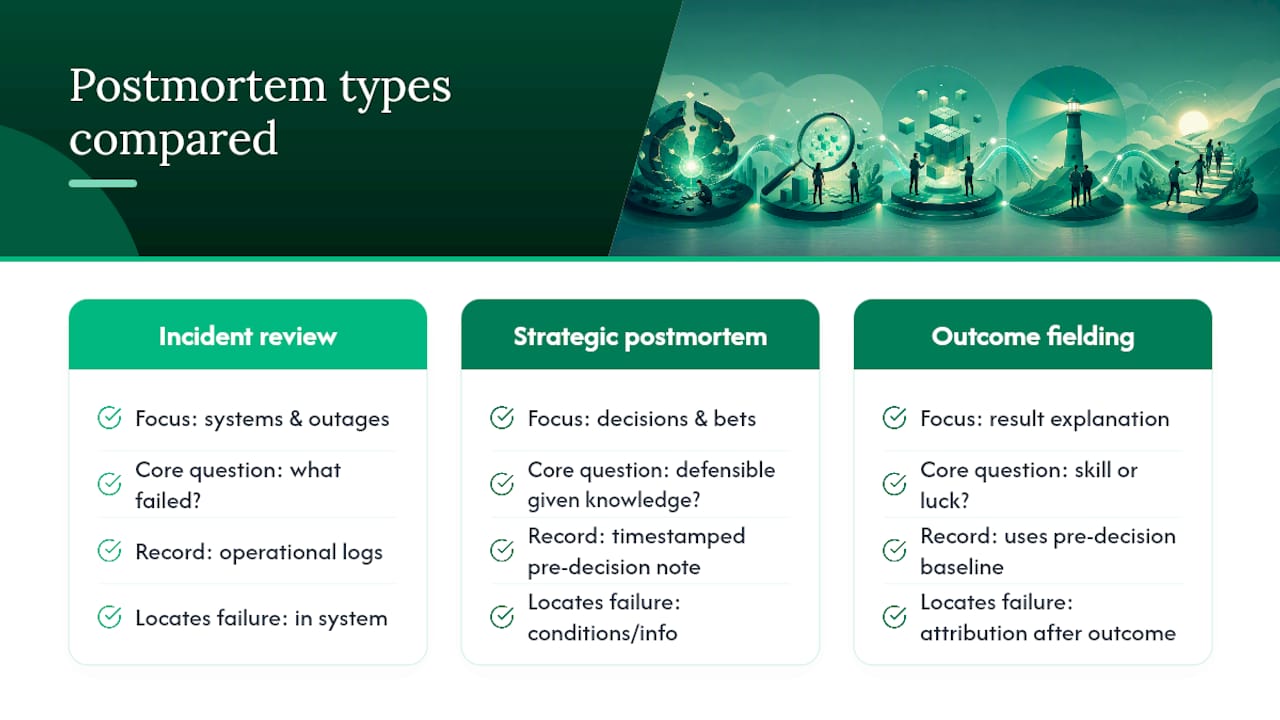
Most founders already know the incident-review version of this idea from engineering teams. The strategic version works differently, and it’s more useful for anyone making product, growth, or pricing calls under uncertainty.
A blameless postmortem, in this sense, is a review of a decision, not a system. It asks one core question: given what you knew before you committed, was the decision defensible? That question only works if you wrote down what you knew before the outcome arrived. Without a timestamped pre-decision record, every postmortem degrades into a story that flatters whoever is telling it.
This is also where the term “blameless” gets misread. People hear it as immunity from accountability. It isn’t. A blameless review locates the failure in the conditions and the information available at decision time, not in a person’s character. That distinction lets you fix the process instead of scapegoating the person who happened to be closest to a bad-luck outcome. Some writers call this a no-blame review or a blameless retrospective; the mechanics are the same whether you’re reviewing a pricing bet, a hire, or a market pivot.
The related discipline is outcome fielding, a term from decision science that means sorting a result into “skill” or “luck” after you know how it turned out, using the pre-decision record as your baseline. Skip that step and you’ll fall into what researchers call resulting, judging a decision purely by whether it worked, which teaches the wrong lesson almost every time. A good decision can lose. A reckless one can win. Neither tells you what to do next unless you separate the two.
The Minimal Framework: From Pre-Decision Record to Postmortem
You need three things before a postmortem can work: a written record before the bet, a lifecycle that tracks the bet honestly, and a trigger that forces the review instead of letting it drift.
1. Write the pre-decision record before you commit. Capture these fields the moment you decide, not after:
- Decision statement (what you’re actually committing to)
- Hypothesis (why you believe this will work)
- Confidence, stated as a percentage, not a phrase like “pretty sure”
- Success metrics and the specific falsification threshold that would prove you wrong
- Trade-offs you’re knowingly accepting
- Owner and who holds the authority to kill the bet
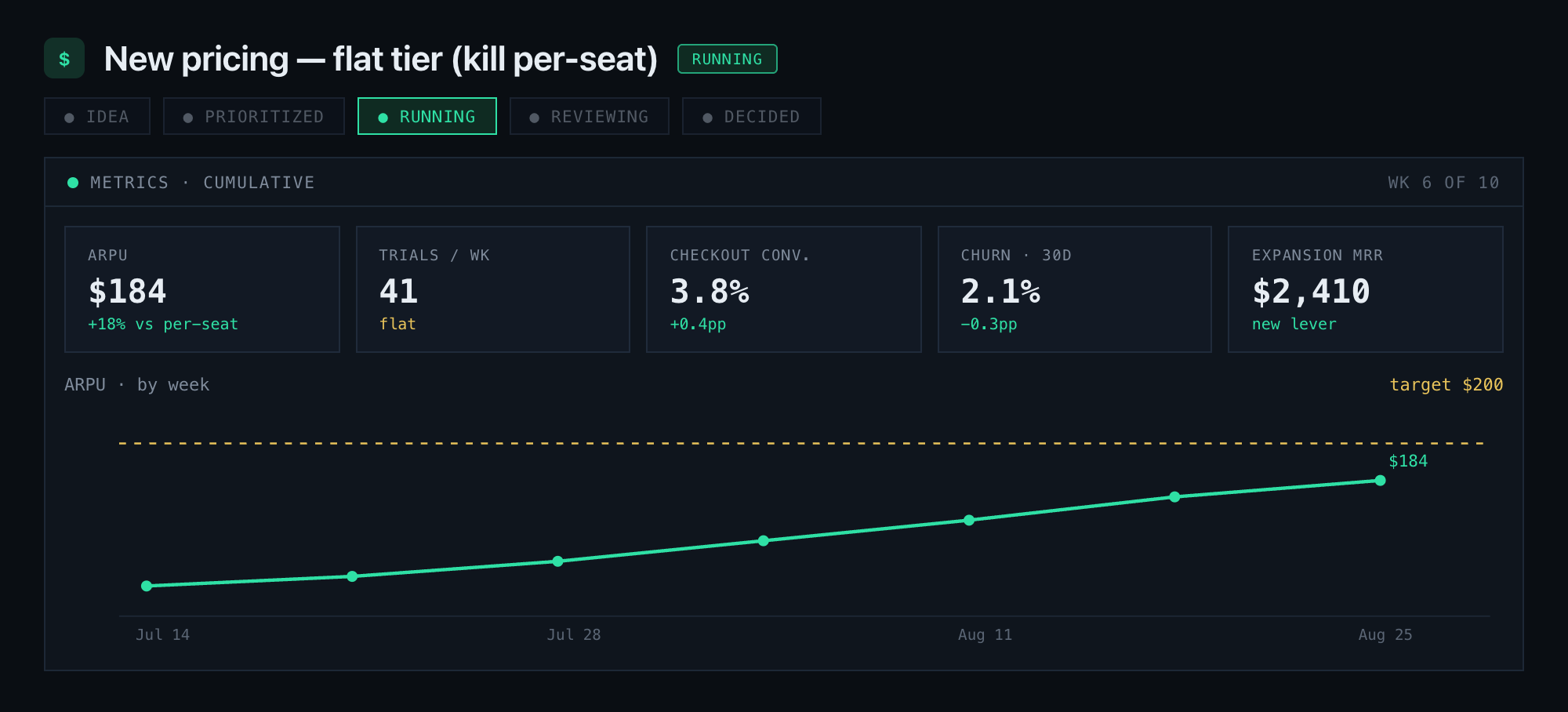
2. Move the bet through explicit stages. Track it as Idea, Prioritized, Running, Reviewing, and Decided. Each stage forces a decision point instead of letting a half-committed bet linger in limbo for two quarters.
3. Set your triggers before you need them. Agree on the metric thresholds that force a formal review in advance. Monitoring designed after a failure is archaeology. Monitoring designed before commitment is governance, and it’s the difference between a team that learns and a team that just narrates.
4. Sequence the postmortem itself. Judge the decision first using only what was knowable at the time it was made. Only after that’s settled do you bring in outcome knowledge to update your assumptions going forward. This two-step sequencing is the single biggest fix for outcome bias in leadership reviews, because it stops the outcome from contaminating the judgment of the decision itself.
Pro Tip: If you can’t state your falsification threshold before you launch a bet, you don’t have a real hypothesis, you have a hope. Write the number that would kill the bet before you write the number you’re hoping for.
A Postmortem Template You Can Copy Today
Here’s the field list. Drop it into a doc, a spreadsheet, or a dedicated decision journal, and fill it out for every bet worth reviewing.
- Decision statement
- Timestamp of the original commitment
- Hypothesis
- Confidence (%)
- Accepted trade-offs
- Success metrics
- Falsification thresholds
- Timeline of key signals as they arrived
- Verdict: Won, Killed, or Inconclusive
- Lessons learned
- Actions, each with an owner and a date
Falsification threshold: if trial-to-paid conversion drops more than 15% within six weeks, kill the price change and roll it back.
Revenue per customer rises. Was that skill or luck?
| Factor | Skill or luck | Why |
|---|---|---|
| Correct hypothesis about low-tier price sensitivity | Skill | Held under the threshold as predicted |
| Competitor’s pricing move | Luck | Unrelated to the founder’s decision, outside their information set |
| Setting a falsification threshold in advance | Skill | Prevented a sunk-cost hold if conversion had cratered |
The verdict here is Won, but the lesson isn’t “raise prices more.” It’s that the threshold worked as designed. That’s a process win independent of the competitor’s move, and it’s exactly the kind of finding you’d lose if you only asked “did revenue go up?”
When to Run It and Who Needs to Be in the Room
Timing and attendance decide whether a postmortem produces real learning or just a meeting.
- Wait 3 to 6 weeks after enough outcome signal exists. Too early and people get defensive because the wound is fresh; too late and memory of the actual decision-time reasoning degrades. That window is a practical trade-off many teams land on for product and growth bets specifically.
- Include the decision owner. They hold the pre-decision record and need to defend or revise it.
- Include an executive sponsor. Someone with authority to approve action items, or the findings stall.
- Include the people doing the day-to-day work. They notice early warning signals leadership missed, and leaving them out produces a partial analysis every time.
- Assign a facilitator. Someone whose job is to keep the conversation on systemic conditions, not personalities.
Before the session, circulate the pre-decision record so nobody reconstructs it from memory in the room. Agree out loud, at the start, that you’ll judge the decision using only decision-time information first, then bring in outcome data second. End with actions mapped to an owner and a date. Skip that last step and your findings sit in a doc nobody reopens.
Pro Tip: If your postmortem produces zero named owners with zero dates, you didn’t run a postmortem. You ran a therapy session.
The Traps That Turn “Blameless” Into “Toothless”
Two biases wreck most reviews before they start. Resulting judges the decision by the outcome alone. Hindsight bias convinces the room that the failure was obvious all along, when it wasn’t obvious to anyone at the time with the information they actually had.
Governance fixes that work:
- Reconstruct the information set first, before anyone mentions the outcome.
- Force an “assumption box” exercise: what did you expect to be true, and what signal would have falsified it? Reviews that skip this step usually stall at timeline reconstruction and never produce anything implementable.
- Set escalation triggers before the next bet launches, not during the postmortem for this one.
- Keep performance reviews and learning reviews in separate meetings entirely, so nobody self-censors to avoid a bad review.
Strategic postmortems rarely get demanded by boards or investors, which is exactly why so few teams do them well, and why the ones that do build a real edge. A facilitator who redirects every tangent back to systemic conditions and closes with named owners and dates is the difference between a review that changes behavior and one that just airs grievances.
Where Founder Conviction Helps, and Where It Hurts
Betlog exists because most teams skip step one: writing the hypothesis down before they know the answer. When you record a decision statement, a confidence percentage, and a falsification threshold at the moment you commit, a pricing change, a senior hire, a pivot, the postmortem practically writes itself later. You’re comparing the record to reality, not reconstructing a story that flatters the outcome.
The mistake I see most often in early-stage teams is founder mode outliving its usefulness. Conviction is an asset during a crisis, when there’s no time to gather evidence. It becomes a liability during expansion bets, when there’s plenty of time to check assumptions and the founder just doesn’t want to. An honest postmortem will tell you which one you’re in. That’s worth more than being right on any single call.
— Cesar
A Faster Way to Run This Discipline Every Time
Betlog is built specifically for the framework above: you record the decision statement, hypothesis, and confidence as a percentage the moment you commit, before anyone knows how it turns out. Bets move through explicit stages, Idea, Prioritized, Running, Reviewing, Decided, so nothing lingers in limbo, and every closed bet ends with a postmortem verdict of Won, Killed, or Inconclusive that gets archived permanently. Nobody can quietly rewrite the reasoning after the fact.
You don’t have to use Betlog to run this process; a shared doc or spreadsheet with the template above works too. But if you want the lifecycle, the confidence tracking, and the archive handled for you instead of rebuilt from scratch every quarter, the full plan is $39 per month or $390 per year. Set up your first bet before your next pricing test or hire, and you’ll have a real record to review in six weeks instead of a memory to argue about.
Sources
For deeper reading on the mechanics behind this framework: the DEV Community piece on strategic postmortems covers resulting and structural analysis in depth. The European Business Review breaks down outcome bias sequencing. OnPlana covers facilitation and timing specifics.
- Running Effective Postmortems on Failed Strategic Initiatives, Not Just Incidents - DEV Community
- Outcome bias in leadership decisions: build a post-mortem that learns - European Business Review
- What a Post-Mortem for Strategic Decisions Would Look Like — Notes
- Running a Project Postmortem That Doesn’t Devolve Into Blame - OnPlana
FAQ
What Makes a Postmortem “Blameless” Instead of Just Polite?
A blameless postmortem locates the cause of a failed bet in the information and conditions available at decision time, not in a person’s judgment or character. It stays rigorous by pairing that framing with action-mapping, so findings get an owner and a date instead of dissolving into vague reassurance.
How Is This Different From an Incident Postmortem?
An incident postmortem reviews a technical outage or system failure. A strategic blameless postmortem reviews a business decision, a pricing change, a hire, a pivot, comparing the original hypothesis and confidence level to what actually happened.
How Do I Avoid Resulting When Reviewing a Failed Bet?
Judge the decision first using only what was knowable at the time it was made, before anyone brings the outcome into the conversation. This sequencing is the core fix recommended for outcome bias in leadership reviews, and it’s the single habit that prevents good decisions with bad outcomes from getting punished.
Who Should Attend a Strategic Postmortem?
Include the decision owner, an executive sponsor with authority to approve changes, the people who did the day-to-day work, and a facilitator to keep the conversation on systemic conditions. Skipping front-line contributors is a common reason reviews miss the early warning signals that were actually visible at the time.
Does Betlog Replace a Manual Postmortem Process?
Betlog operationalizes the same template, timestamped hypotheses, confidence as a percentage, staged bet tracking, and a closing verdict, so you don’t have to rebuild it in a doc each time. The full plan runs $39 per month or $390 per year, and the underlying discipline works whether or not you use the tool.