6 Step Decision Journal for Teams to Catch Second Order Effects
Practical workflow for teams to spot downstream consequences: a six step checklist and a decision journal method (Betlog) to log hypotheses and catch...
On this page
- What Are Second-Order Effects, Really?
- Why Second-Order Effects Decide Whether Strategy Works
- How to Anticipate Indirect Consequences Before They Bite
- A Checklist for Making Decisions That Won’t Backfire
- Real Chains: Policy, Product, and Business
- Second-Order Effects in A/B Tests and Experiments
- Recording Second-Order Bets With a Decision Journal
- Why Two Steps Ahead Beats One Step Confident
- Track Your Bets Before You Know How They Turn Out
- Sources
- FAQ
Second-order effects are the consequences your consequences create once other people react to them. A price cut that trains customers to wait for the next discount, a hiring spree that quietly breaks your onboarding process, a policy meant to help renters that shrink the rental supply instead. First-order effects are the outcome you aimed for. Second-order effects are what happens after everyone else adjusts.
TL;DR:
- Most second-order effects arise when other groups adapt their behavior to the initial change, often reversing or amplifying the original intended outcome.
- Short-term metrics and quick wins often overlook delayed second-order consequences, which can cause long-term issues like reduced quality or market contraction.
- To anticipate these effects, organizations should map stakeholder incentives, consider feedback loops, and monitor early signals of behavioral adaptation.
- Reversible decisions require less rigorous second-order analysis, while irreversible actions, such as layoffs or major product changes, demand detailed scenario planning and guardrails.
- Using decision journals to record hypotheses and expected downstream effects helps teams evaluate whether their predictions hold true or need adjustment over time.
What Are Second-Order Effects, Really?
A first-order effect is the direct, intended result of an action. A second-order effect is what happens next, once people or systems adapt to that first result. A third-order effect is one more layer down, often so far removed from the original decision that nobody traces it back.
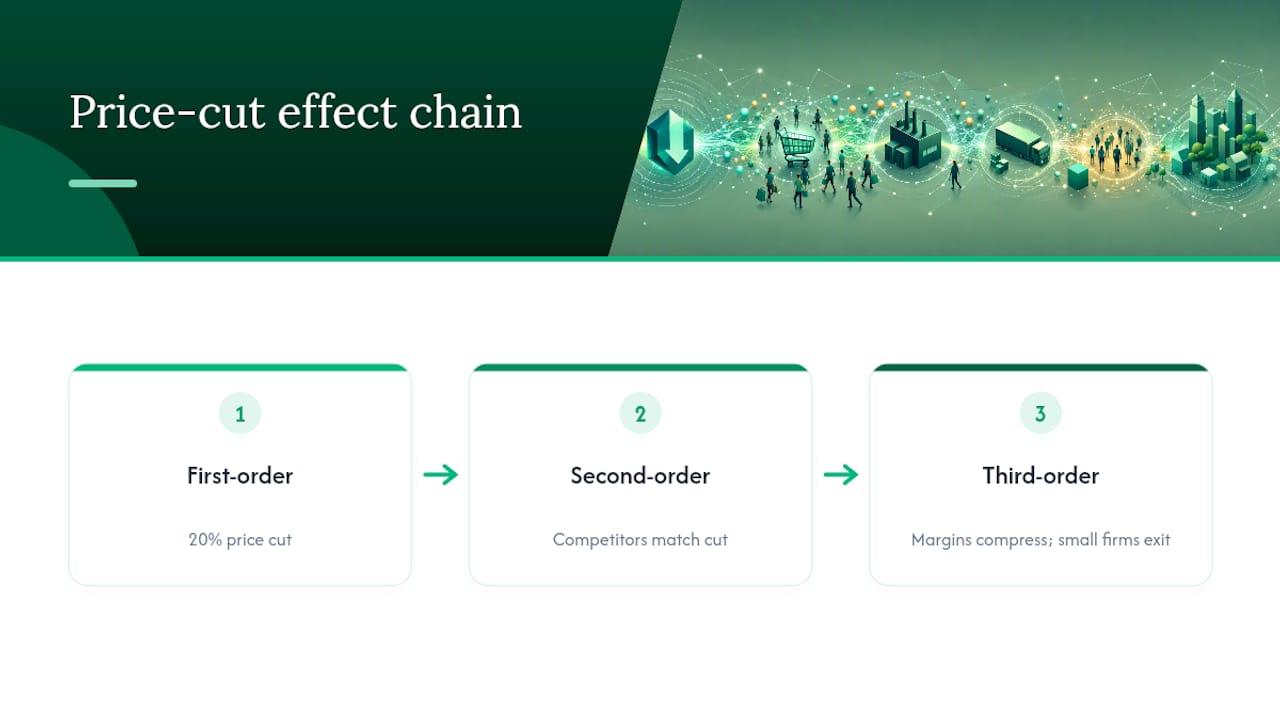
Take a simple chain: a company cuts prices 20% (first order). Competitors match the cut to defend market share (second order). The whole category’s margins compress permanently, and smaller players get squeezed out (third order). Each step follows a mechanism: an incentive changes, someone adapts to it, and that adaptation produces a downstream consequence nobody voted for. Second-order effects are downstream consequences generated when agents adapt to an intervention, and they often end up dominating the first-order outcome that got all the attention.
Here’s the trap: first-order effects are easy to see and easy to credit. Second-order effects show up later, somewhere else, attributed to someone else’s department. That attribution gap is exactly why they get ignored.
Why Second-Order Effects Decide Whether Strategy Works
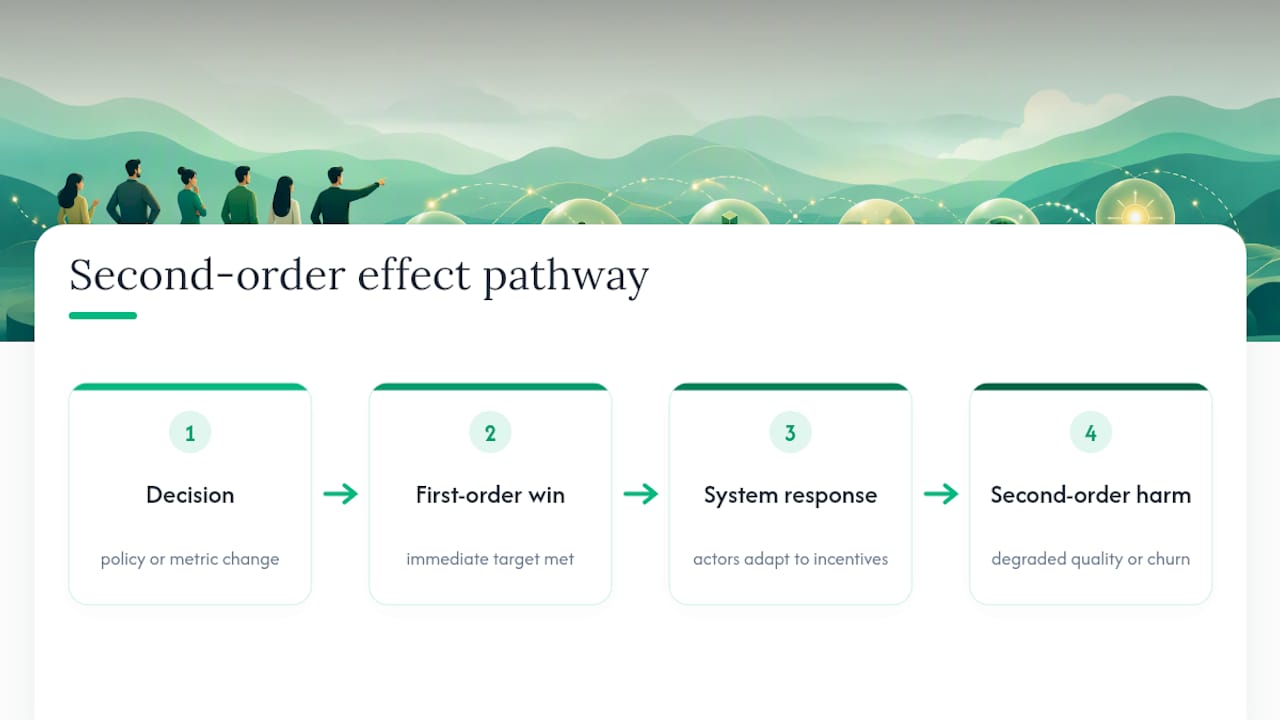
Ignore this layer and you get outcomes that look like bad luck but are actually predictable design flaws. Rent control caps prices (good, first order) and then landlords stop maintaining units or pull them off the market entirely (bad, second order). A support team’s “resolve tickets faster” metric looks great in the dashboard while agents quietly start closing tickets before problems are actually fixed, which shows up three months later as churn.
Short-term metrics are especially dangerous here because they’re built to reward first-order wins. A growth team hits its signup target by loosening qualification criteria, and the CFO doesn’t see the damage until retention craters two quarters out, by which point nobody connects the dots back to the original decision.
Organizations have a structural bias toward ignoring this: quarterly reviews reward whoever moved the needle this quarter, not whoever prevented a mess that would have surfaced next year. That’s not a people problem. It’s an incentive design problem, and it’s why the good second-order outcomes (a platform decision that spawns a new product line) get discovered by accident almost as often as the bad ones get discovered by disaster.
How to Anticipate Indirect Consequences Before They Bite
Second-order thinking is a discipline, not a talent. It comes down to asking one uncomfortable question twice: and then what?
Start with the direct effect of your decision. Then ask who else is touched by it, not just the customer or team you’re targeting, but adjacent teams, competitors, and the people whose incentives just shifted. Ask “and then what?” again for each of those groups. Second-order thinking means tracing at least two layers of consequence and narrowing your focus to the two or three effects that are both high-probability and high-impact, not chasing every hypothetical branch.
A few concrete moves make this workable instead of paralyzing:
- Map every actor whose incentives change because of your decision, including ones outside your organization, like competitors, suppliers, or regulators.
- For each actor, write down what they’d rationally do differently once the new incentive exists.
- Identify feedback loops: does the adaptive response amplify your original effect, cancel it out, or reverse it entirely?
- Name the earliest observable signal that would tell you an adaptation is happening, and instrument for it now, before you need it.
That last point is the one most teams skip. A useful diagnostic here is listing who’s affected, what incentive shifts for each of them, and what the earliest observable signal of their adaptation would look like, then actually watching for it.
Pro Tip: Don’t try to map every possible downstream effect. Pick the branches where the probability and the damage are both high, and let the low-stakes ones go unanalyzed. Perfect foresight is not the goal; catching the two effects that would actually hurt is.
A Checklist for Making Decisions That Won’t Backfire
Not every decision deserves the same scrutiny. A reversible choice, like a two-week pricing experiment, tolerates mistakes because you can undo it. An irreversible one, like a layoff or a platform migration, deserves the full treatment because you don’t get a second try.
For anything approaching a one-way door, run through this before you commit:
- List every stakeholder touched directly and indirectly, not just the obvious ones.
- Trace incentive shifts for each stakeholder, asking what they’ll rationally do differently.
- Sketch two or three scenarios, including the one where your intervention backfires.
- Pick metrics that would catch a delayed problem, not just ones that confirm quick wins.
- Set guardrails, a threshold that triggers a review if a downstream metric moves the wrong way.
- Schedule a follow-up date, not “check in eventually,” but a specific point where you revisit the bet.
Reversible decisions get a lighter version of this. Irreversible ones get all six steps, because second-order thinking is cognitively expensive and should be spent where the stakes justify it.
Real Chains: Policy, Product, and Business
Rent control is the textbook policy case. Capping rents helps existing tenants immediately. Landlords respond by deferring maintenance or converting units to condos, and the housing supply contracts over years, hurting the next generation of renters the policy was meant to protect.
Amazon’s decision to build internal infrastructure for its own e-commerce operation is the positive mirror image, similar to when companies evaluate when opening an American company makes sense, weighing strategic decisions with unexpected effects. That infrastructure investment eventually became AWS, now one of the most profitable businesses in the world, an outcome nobody planned for when the servers were built to handle holiday shopping traffic.
Process improvements carry the same risk internally. Speeding up one team’s workflow without fixing the bottleneck downstream just moves the pile somewhere else. Process changes scoped to a single team routinely create shadow processes and visible backlogs at the next handoff. The signal is usually there early: complaints from the neighboring team, a queue that stops shrinking, a metric on someone else’s dashboard quietly getting worse.
Second-Order Effects in A/B Tests and Experiments
A/B tests are supposed to settle arguments. They often don’t, because people adapt to the change you’re testing, and that adaptation shows up after your test window closes.
A classic case: a notification tweak lifts short-term engagement, but users habituate to it within weeks and start ignoring or muting notifications entirely, erasing the gain and sometimes leaving engagement worse than baseline. Adaptive responses to product changes can shift experiment results over time, which is why a two-week win doesn’t guarantee a two-quarter win.
The fix is procedural, not statistical wizardry: run longer measurement windows, hold out a control population past the standard test period, and check lagged metrics alongside the immediate ones. An experiment that only measures the first week isn’t wrong, it’s incomplete.
Recording Second-Order Bets With a Decision Journal
Most missed second-order effects aren’t a failure of intelligence. They’re a failure of memory: nobody wrote down what they expected to happen, so nobody can check it later.
A decision journal fixes that by forcing the hypothesis, and the downstream ones, onto paper before the outcome is known. Betlog structures this as a staged bet: you write the first-order prediction, at least one anticipated downstream effect, and a confidence probability, not a gut feeling dressed up as certainty. The bet moves through Idea, Prioritized, Running, Reviewing, and Decided, with a follow-up date built in so nobody forgets to check the signal three months later.
A pricing bet might read: “Raising the starter tier 15% increases revenue per account (70% confidence), but could raise churn among price-sensitive segments within two billing cycles.” The post-mortem later separates whether the outcome came from good reasoning or plain luck.
Why Two Steps Ahead Beats One Step Confident
Teams that get burned by second-order effects usually weren’t careless. They were confident, and confidence without a paper trail is what let the same blind spot repeat itself. The lesson isn’t to predict everything. It’s to write down the two or three consequences you actually think might follow, attach a real number to how sure you are, and check back. Most teams skip that last part. Try it on your next irreversible call before you skip it too.
— Cesar
Track Your Bets Before You Know How They Turn Out
A decision journal gives you the paper trail second-order thinking actually requires: a place to log the hypothesis, the downstream effects you’re watching for, and a confidence percentage before the outcome exists to bias your memory.
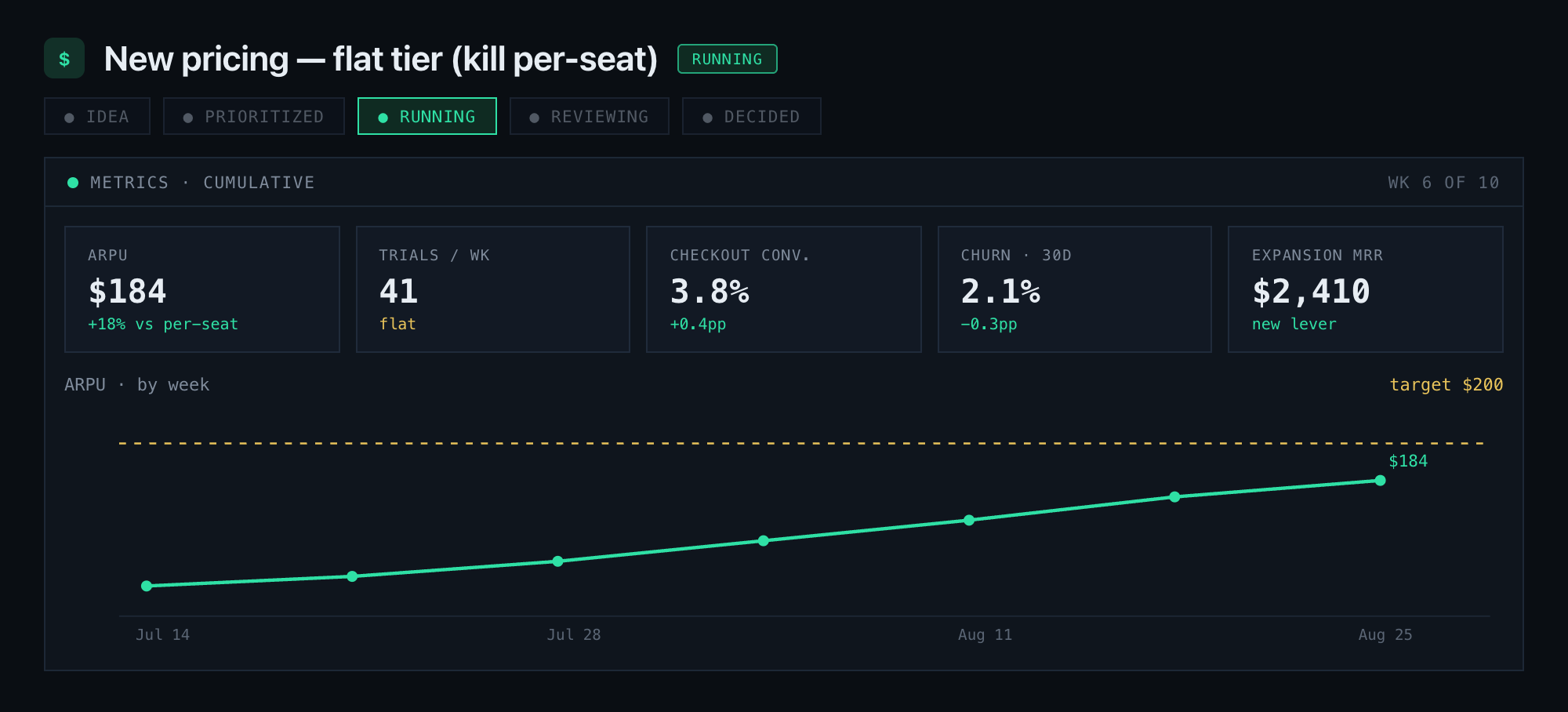
Every bet moves through a lifecycle, from idea to a closed verdict, and every closed bet ends with a post-mortem that separates skill from luck instead of letting hindsight rewrite the story. Over time that record shows whether your 70%-confident calls actually land 70% of the time, which is the closest thing to a second-order-effects early warning system a small team can build without a data science department. If you’re tired of discovering the downstream consequence three months after everyone forgot what you predicted, start a bet on Betlog and give your next irreversible decision a written hypothesis before the outcome writes it for you.
Sources
- Second-Order Effects Mental Model: Definition, Examples & When to | Faster Than Normal
- What is second order effect? Impact on experiment results | Statsig
- Second-Order Effects in Process Improvement | KaiNexus
FAQ
What Is a Second-Order Effect?
A second-order effect is a consequence that appears after people or systems adapt to a decision’s direct, first-order result. A price cut is first-order; competitors matching that cut to protect market share is second-order, and it’s the layer most decisions fail to plan for.
What Are Second- and Third-Order Effects?
Second-order effects are the consequences of the direct outcome, what happens once people adapt to it. Third-order effects are one layer further, the consequences of those adaptations, often distant enough in time and department that nobody links them back to the original decision.
What Is a Third-Order Effect?
A third-order effect is a downstream consequence of a second-order adaptation, the third link in the chain after the initial decision and the first wave of reactions to it. In the rent control example, capped rents are first-order, deferred maintenance is second-order, and a long-term housing shortage is third-order.
What Are Second-Order Consequences?
Second-order consequences are the indirect, knock-on results that surface once the people affected by a decision change their behavior in response to it. They’re often invisible at the moment of the decision because tracing them requires asking “and then what?” at least twice before the answer becomes obvious.
How Do Second-Order Effects Show Up in A/B Testing?
A short-term lift from an experiment can shrink or reverse once users adapt to the change, which is why longer measurement windows, holdouts, and lagged metrics matter more than the headline result from week one. An experiment that only captures the first-order bump can miss the adaptation entirely.