Product Teams: 6 Elements of the Decision Quality Framework and DICE
Team guide to the Decision Quality Framework: apply its six elements, add DICE for complex or AI decisions, and operationalize each choice with a decision...

On this page
- The Six Elements of Decision Quality Explained
- How Do You Apply the Framework as a Team?
- How Do You Measure Decision Quality Over Time?
- What Are the Most Common Decision Quality Failures?
- Advanced: DICE Theory and When to Use It Alongside DQ
- A Worked Example: Running a Decision Through a Decision Journal
- Where Did the Decision Quality Framework Come From?
- How Does Decision Quality Compare to Other Decision-Making Models?
- What Do Successful and Failed Applications Look Like?
- How Should You Adapt the Framework to Your Organization?
- Why Does Leadership Culture Determine Decision Quality?
- What Software Supports Decision Quality in Practice?
- Author perspective: prioritize framing before rigor
- How Betlog Turns Decision Quality Into a Daily Habit
- Sources
- FAQ
The decision quality framework defines a good decision as one that clears six specific bars, not one that happens to work out. Miss any single element and the whole decision is weaker for it, since decision quality is only as strong as its weakest link. Decision quality and outcome quality are separate things: a well-framed, well-reasoned bet can still lose to bad luck, and a sloppy one can still win.
TL;DR:
- Failing to properly frame the decision or choosing a narrow problem scope can lock in ineffective options before analysis begins.
- Generating fewer than three alternatives or neglecting to include the status quo increases the risk of biased or incomplete decision-making.
- Relying on vague confidence estimates, such as “pretty sure,” undermines the ability to measure decision quality and track calibration over time.
- Most common decision failures stem from an inappropriate frame or the absence of real trade-off analysis, not from a lack of resources or intelligence.
- Implementing structured decision processes suited to decision complexity and reversibility, along with a strong decision culture, significantly improves outcome quality.
The Six Elements of Decision Quality Explained
A decision earns high quality when it satisfies all six elements at once. Skip one and the whole chain weakens, no matter how strong the others are.
- Appropriate frame. Ask: are we solving the right problem, at the right scope, with the right decision maker in the room? A wrong frame (say, “should we hire a salesperson?” instead of “how do we grow revenue?”) locks in bad options before anyone opens a spreadsheet.
- Creative and doable alternatives. Teams that land on one option usually stopped looking too soon. Force a set of multiple real paths, including a “do nothing” baseline, before debating merits.
- Relevant, reliable information. The goal is evidence good enough to decide, not evidence that eliminates all doubt. Set a deadline for research and stop when marginal information stops changing your view.
- Clear values and trade-offs. Build a simple values matrix, three or four criteria (revenue, risk, speed, team morale) scored per alternative, so trade-offs are visible instead of implied.
- Sound reasoning. Test the logic connecting evidence to conclusion. Would a skeptical colleague accept the chain of “if this, then that”?
- Commitment to action. Name one owner and confirm the people who must execute actually agree with the call, not just tolerate it.
The canonical framework treats these six as jointly necessary. A brilliant analysis with no committed owner is just an interesting memo.
How Do You Apply the Framework as a Team?
Running Decision Quality as a team ritual works better as a fixed sequence than as a vague discussion. A repeatable meeting flow turns the six elements into artifacts people can actually check.
- Frame check (15 minutes). Write a one-sentence frame statement and confirm the right decision maker is present. If the room disagrees on what’s being decided, stop here.
- Alternative generation (30 minutes). Produce an alternatives table with at least three distinct options, including the status quo. Ban single-option proposals outright.
- Information gathering (timeboxed, up to several weeks depending on stakes). Assign an information plan: who checks what, by when, and what “good enough” looks like.
- Values and trade-offs (20 minutes). Score each alternative against three or four agreed criteria in a shared matrix.
- Reasoning memo (asynchronous, before the final meeting). One page: assumptions, logic, and what would prove the choice wrong.
- Decision gate (30 minutes). Walk the frame, alternatives, matrix, and memo together, then name an owner and record the decision.
The structured decision making approach used in environmental and public policy work follows a similar seven-step logic, with consequence tables playing the same role as the values matrix here. For low-stakes, reversible calls, compress steps 1 through 5 into a single 30-minute huddle. For irreversible or expensive ones, spread them across a week and require a written reasoning memo before the gate.
How Do You Measure Decision Quality Over Time?
Decision quality metrics fall into two buckets: calibration (are your confidence numbers honest?) and operational KPIs (is the process actually running?).
Calibration means tracking whether your 70%-confidence bets win about 70% of the time. Measurement instruments built for this, including decision quality instruments originally developed in medical decision research, combine knowledge checks with concordance scoring, and their use is linked to less regret and more confidence in the final call. Calibration only becomes statistically meaningful after several dozen tracked decisions, so don’t judge your batting average after five bets.
Pro Tip: Log every confidence estimate as a specific percentage, not a phrase like “pretty sure.” Vague confidence can’t be scored later, and it can’t be corrected.
Track these operational KPIs alongside calibration:
- Cycle time: days from frame statement to committed decision.
- Reversal rate: percentage of decisions undone within 90 days.
- Documentation rate: percentage of decisions with a written frame, alternatives, and reasoning memo.
- Post-mortem rate: percentage of closed decisions with a completed after-action review.
A lightweight scorecard mapping each of the six DQ elements to its evidence (frame statement, alternatives table, info plan, values matrix, reasoning memo, named owner) and an owner per row keeps the framework from becoming an abstraction.
What Are the Most Common Decision Quality Failures?
Most bad decisions trace back to a handful of repeatable failure modes, not bad luck.
- Wrong frame. Mitigation: restate the problem in three different ways before choosing which one to solve.
- Single-solution bias. Mitigation: require a minimum of three alternatives before any discussion of merit.
- Risk theater. Compliance checklists and risk registers that create the appearance of rigor without real dialogue are what one Forbes analysis calls risk management theater. Mitigation: replace the checklist with a live pre-mortem where someone argues the decision failed and explains why.
- Resulting: judging the decision by the outcome instead of the process. A good bet can still lose. Mitigation: write the reasoning and confidence level before the outcome is known, then grade the process separately from the result during the post-mortem.
- Motivated reasoning. Mitigation: assign a designated dissenter in every decision gate.
Advanced: DICE Theory and When to Use It Alongside DQ
DICE Theory adds a second evaluative layer for decisions that are unusually complex or involve AI-assisted analysis. It scores decision integrity across four dimensions:
- Depth: how far past the surface the analysis went.
- Integration: whether inputs from different sources or functions were actually combined, not just collected.
- Coherence: whether the pieces of reasoning agree with each other.
- Exhaustiveness: whether the full space of relevant factors was covered.
Depth and Exhaustiveness overlap heavily with the DQ elements of information and alternatives; Integration and Coherence map closest to sound reasoning. The difference is that DICE was built for volatile, uncertain contexts and for decisions where an AI model generated part of the analysis, since structural completeness and interpretability matter more when a human didn’t write every line of reasoning themselves. Use it on top of DQ, not instead of it, when a decision involves machine-generated forecasts, multiple merging data sources, or genuine novelty with no comparable precedent.
A Worked Example: Running a Decision Through a Decision Journal
Here’s what a single decision looks like inside a structured journal, field by field. A product team debating a pricing change logs the frame (“should we raise the starter tier price?”), a hypothesis about the impact on signups, the expected outcome, and a confidence probability instead of a gut feeling.
They record trade-offs accepted (slower signup growth for higher margin), the metrics that will decide it (30-day conversion rate, churn), and what would prove the hypothesis wrong. The bet moves through five stages: Idea, Prioritized, Running, Reviewing, Decided. At close, it gets a verdict, Won, Killed, or Inconclusive, and a post-mortem that separates what was skill from what was luck.
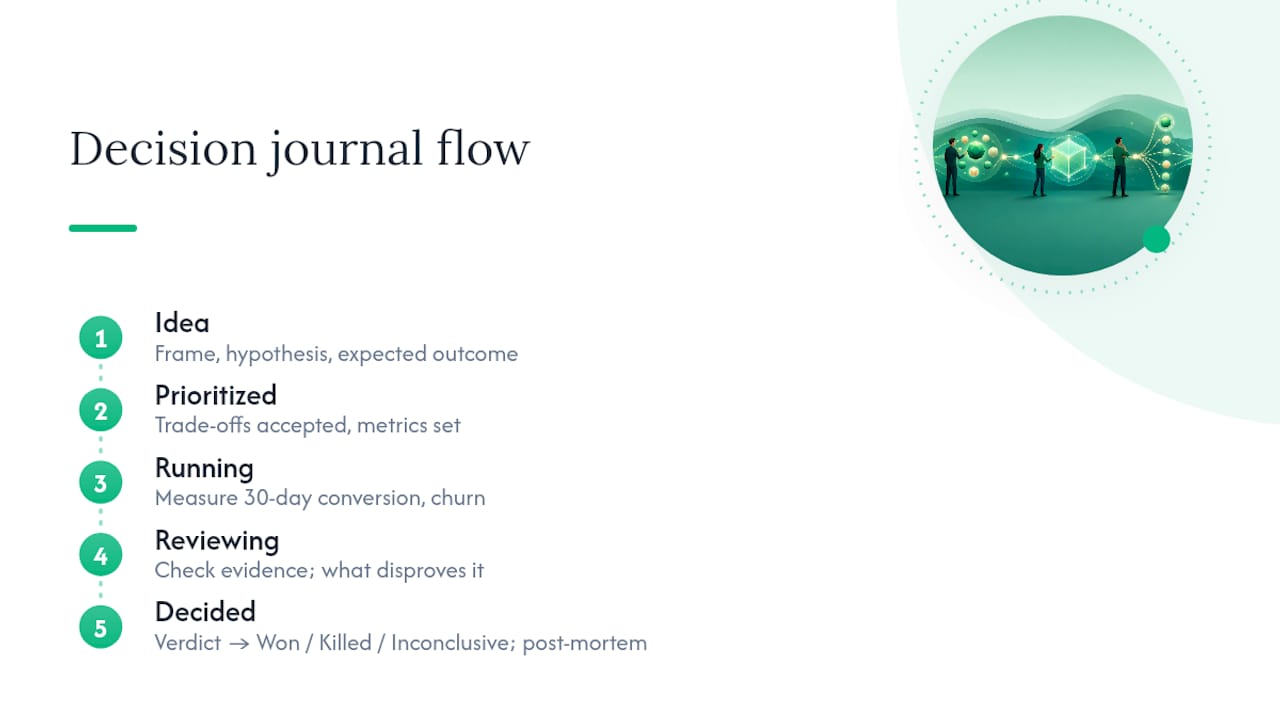
This is exactly the structure an operational decision journal is built to enforce, and it’s why calibration only starts to mean something after a few dozen closed bets accumulate in the record.
Where Did the Decision Quality Framework Come From?
Decision Quality traces its roots to decision analysis, the applied branch of decision theory that emerged from Stanford’s engineering and management science programs in the 1960s. Early decision analysts worked mostly with oil and gas and pharmaceutical companies, industries where a single capital allocation call could run into the hundreds of millions of dollars and take a decade to play out.
Consulting practices built around decision analysis, most visibly the group now known as the Decision Quality Center, formalized the six-element structure sometime in the following decades as a way to audit how a big decision got made, separate from whether it later succeeded. The insight driving that formalization was uncomfortable for a lot of executives: companies were routinely promoting people for lucky outcomes and firing people for unlucky ones, while the actual quality of their reasoning went unmeasured either way.
That framing spread from oil majors into pharma, then into general corporate strategy work, then eventually into product and startup circles, where the pace of decisions is faster but the stakes per decision are often just as real for a small team. The core insight never changed: decision quality and outcome quality are two different variables, and treating them as one variable is how organizations end up rewarding recklessness and punishing good judgment. The six-element checklist was simply the tool built to keep those two variables from getting confused in a room full of people with incentives to confuse them.
How Does Decision Quality Compare to Other Decision-Making Models?
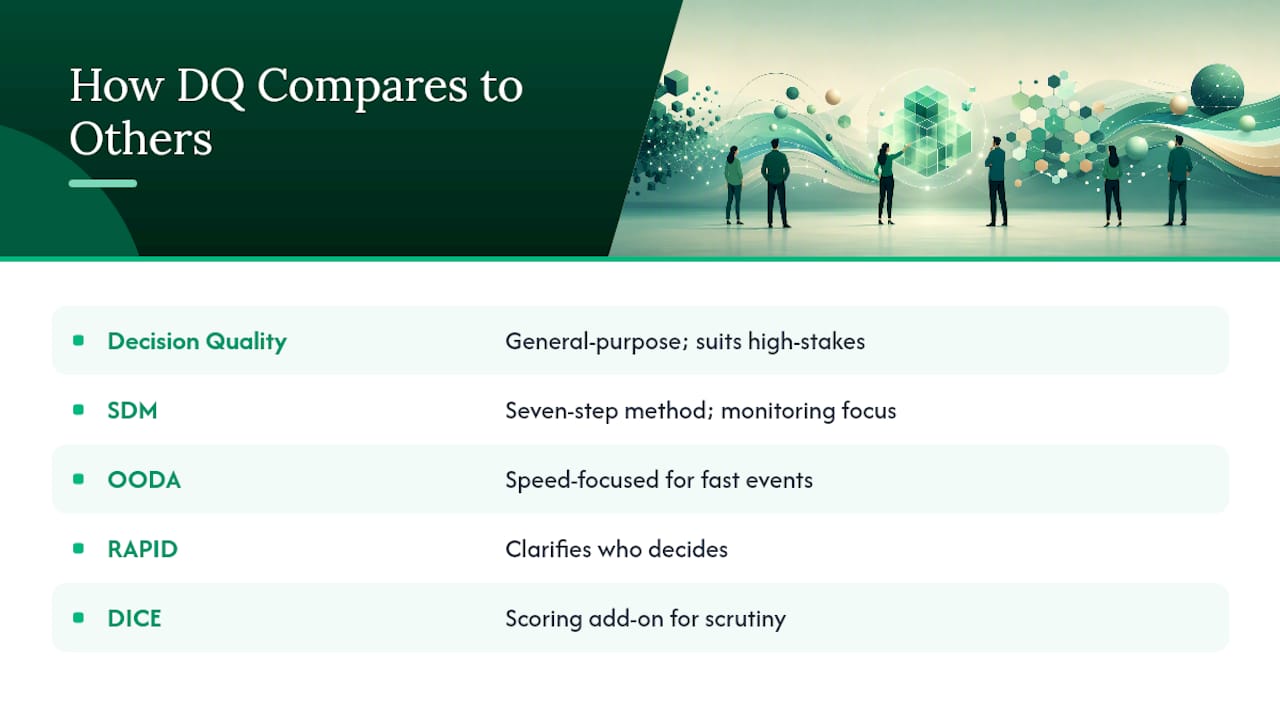
Decision Quality is not the only structured approach to hard choices, and it’s worth knowing where it sits relative to the others.
Structured Decision Making (SDM), used heavily in environmental and natural-resource policy, follows a comparable seven-step sequence built around explicit objectives, measurable criteria, and consequence tables that lay out how each alternative performs against each objective. SDM and DQ overlap almost completely on alternatives and trade-offs; SDM leans harder into formal monitoring and adaptive learning after the decision is made, since it was built for multi-year natural resource management.
OODA loops (Observe, Orient, Decide, Act), developed for military aviation, optimize for speed under fast-changing conditions rather than for the depth DQ demands. OODA fits a live product incident or a fast-moving competitive response; DQ fits a decision with enough weight to justify a week of framing work.
RAPID and other decision-rights frameworks (Recommend, Agree, Perform, Input, Decide) solve a different problem entirely: they clarify who gets to decide, not whether the decision itself was well-reasoned. A team can have perfect role clarity and still make a badly framed call.
DICE Theory, covered above, isn’t a competing framework so much as an add-on scoring layer for decisions where completeness and interpretability need extra scrutiny.
The practical takeaway: DQ is the strongest general-purpose framework for decisions with real stakes and enough time to do them properly. Pair it with OODA-style speed rules for anything reversible and cheap, and layer DICE on top for anything involving AI-generated analysis or genuine novelty.
What Do Successful and Failed Applications Look Like?
Capital-intensive industries offer the clearest before-and-after picture of Decision Quality in practice. Oil and gas companies that adopted formal DQ gates for major capital projects, requiring an explicit frame, a real alternatives set, and a documented trade-off discussion before sign-off, reduced costly project mistakes tied to skipped framing and single-option proposals reaching the board.
A recognizable failure pattern shows up just as often in software and product teams, even without a formal name attached to it: a roadmap decision gets framed narrowly (“should we build feature X?” instead of “how do we address the underlying churn driver?”), one alternative gets presented as a fait accompli, and the reasoning behind it lives only in someone’s head. When the feature underperforms, the postmortem, if one happens at all, focuses on execution rather than on the fact that the frame was wrong from the start and no real alternative was ever built.
The pattern that separates the successful cases from the failed ones isn’t intelligence or resources. It’s whether the frame and alternatives got real scrutiny in the first fraction of the process, before anyone invested in a specific answer. Teams that skip straight to evaluating “the plan” instead of first asking whether they’ve got the right question rarely notice the gap until the outcome forces them to.
How Should You Adapt the Framework to Your Organization?
Decision Quality doesn’t need to run the same way for every decision or every team, and forcing a heavyweight process onto a lightweight choice is its own failure mode.
By decision reversibility. Reversible, cheap decisions (a marketing test, a minor feature toggle) deserve a compressed version: a 15 minute frame check and a quick alternatives list, skip the formal reasoning memo. Irreversible, expensive decisions (a pricing overhaul, a key hire, a pivot) deserve the full six-step sequence with written artifacts at each stage.
By organization size. A five-person startup can run the entire decision gate in one meeting with one facilitator wearing every hat. A 200-person company needs named roles: someone owns the frame, someone owns the alternatives table, someone owns the final commitment, because diffusion of ownership is exactly what kills the sixth element.
By decision type. Hiring decisions benefit from a heavier weighting on values and trade-offs (culture fit versus skill versus speed to hire). Technical architecture decisions benefit from a heavier weighting on information and alternatives, since the cost of the wrong stack choice compounds for years. Pricing decisions benefit from tight calibration tracking, since they’re repeatable enough to build a real confidence track record.
By industry regulation. Regulated industries, healthcare, finance, aviation, often need the reasoning memo formalized into a compliance artifact regardless of decision size, since auditors will ask for it later whether the team wanted to write it or not.
Why Does Leadership Culture Determine Decision Quality?
A framework is only as good as the incentives surrounding it, and this is where most Decision Quality efforts quietly fail. Leaders who publicly credit lucky outcomes as skill, and quietly punish unlucky ones as incompetence, teach their teams to optimize for outcomes that look good in hindsight rather than for reasoning that holds up under scrutiny. That’s the exact dynamic separating decision quality from outcome quality is designed to prevent, and no checklist survives a culture working against it.
The leaders who get this right do a few specific things differently. They ask “what was your confidence level going in?” before asking “how did it turn out?” They protect the person who raised the dissenting alternative in a pre-mortem, even when that alternative wasn’t chosen, because punishing dissent guarantees you stop hearing it. And they treat a documented reasoning memo as a sign of rigor, not a bureaucratic tax, which is the difference between real structured dialogue and the risk theater that shows up when compliance checkboxes replace actual debate.
None of this requires a large organization. A three-person founding team that agrees to write down its reasoning before knowing the outcome, and reviews it honestly afterward, has more decision quality culture than a 500-person company running risk committees that nobody argues in.
What Software Supports Decision Quality in Practice?
Most teams trying to run Decision Quality by memory lose the thread within a few decisions, since the whole point of the framework depends on writing things down before the outcome is known. A handful of tool categories support the different pieces.
Documentation and knowledge-base tools (the kind consultancies use to present frameworks and findings back to clients) handle the frame statement and reasoning memo well when a team already has a workflow built around them. If you’re building out client-facing documentation for decision outputs, a specialized website built for consultancy work can help present that structured reasoning credibly to stakeholders who weren’t in the room.
Spreadsheet-based consequence tables and values matrices remain the default for the alternatives and trade-offs steps, mostly because they’re fast to set up and everyone already knows how to use them, even though they rarely capture confidence levels or get revisited after the decision closes.
Purpose-built decision journals fill the gap those two leave open: they capture the confidence probability, the trade-offs, and the metrics at the moment of commitment, then force a post-mortem before the record can close. That’s the category dedicated decision journals operate in, filling the gap most spreadsheets and wikis were never designed to hold onto.
Author perspective: prioritize framing before rigor
If you take one thing from this, spend the first slice of your time, not the whole project, nailing the frame and alternatives. A wrong frame poisons everything downstream, and no amount of later rigor fixes it. Use reversibility as your speed dial: cheap and undoable calls deserve a fast pass; expensive, permanent ones earn the full sequence.
— Cesar
How Betlog Turns Decision Quality Into a Daily Habit
Betlog is the practical way to run Decision Quality without a separate process nobody maintains. Every bet you log captures the frame, the confidence probability instead of a vague gut feeling, the trade-offs you’re accepting, the metrics that will decide it, and what would prove you wrong, which covers four of the six DQ elements before you’ve even committed.
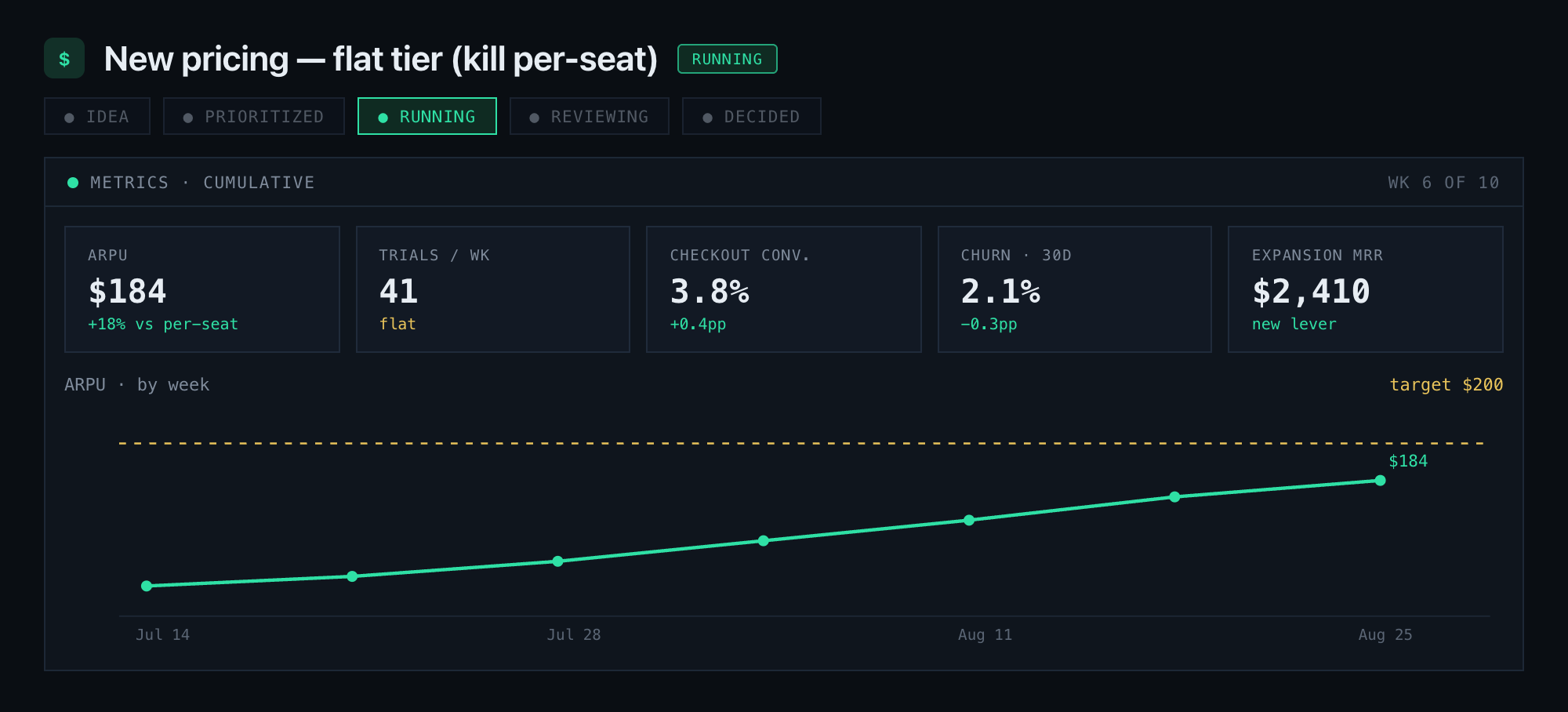
Bets move through Idea, Prioritized, Running, Reviewing, and Decided, and every closed bet ends with a post-mortem that separates skill from luck instead of letting hindsight rewrite the story. That’s how the sixth element, commitment, stays honest: there’s a named owner and a timestamped record nobody can quietly edit after the fact.
This decision journal fits founders, product leads, and small cross-functional teams making pricing, roadmap, and hiring calls under real uncertainty, not individuals casually jotting notes. If your team is ready to see whether its 70%-confidence bets actually win 70% of the time, start a Betlog trial and log your next real decision before you know how it turns out.
Sources
- Decision Quality (TEE Blog, McCombs)
- Measuring ‘decision quality’: Irresolvable difficulties and an alternative proposal (PMC)
- DICE Theory: A Decision Integrity and Completeness Evaluation Framework (Zenodo)
- Risk management theater: Unmasking the illusion for true business success (Forbes)
FAQ
What Are the Six Elements of Decision Quality?
The six elements are appropriate frame, creative and doable alternatives, relevant and reliable information, clear values and trade-offs, sound reasoning, and commitment to action, and overall quality is capped by the weakest one.
What Is the 5-5-5 Rule in Decision-Making?
Definitions of the “5-5-5 rule” vary across sources, so treat any specific version cautiously; the more established practice for weighing consequence over time is a mental time check for near, medium, and long-term consequences, described below.
What Is the 10-10-10 Rule for Decisions?
The a mental time check for near, medium, and long-term consequences asks how you’ll feel about a decision in 10 minutes, 10 months, and 10 years, a mental time-travel check that separates short-term emotional reaction from long-term consequence.
What Are the Five Stages of Decision-Making?
In a decision journal workflow, decisions typically move through five stages: Idea, Prioritized, Running, Reviewing, and Decided, closing with a verdict of Won, Killed, or Inconclusive.
How Do You Separate Decision Quality From Outcome Quality?
Grade the process (frame, alternatives, reasoning, confidence stated in advance) separately from the result, since a well-reasoned decision can still lose to bad luck and a careless one can still win.