Founders: Write a 2 Minute Decision Brief That Prevents Hindsight Bias
Write a decision brief in 2 minutes. One screen template, probability mapping, pre registered kill criteria, and a worked example from idea to post mortem.

On this page
- Decision brief template: fields, examples, and why each matters
- Worked example: a realistic founder decision from brief to post-mortem
- How to convert intuition into a probability and pick reliable metrics
- Team rituals: short premortems, status reviews, and post-mortems
- Calibration, common pitfalls, and quick fixes for small teams
- A founder’s short reflection on using decision briefs
- How Betlog turns this template into a daily habit
- Sources
- FAQ
A decision brief is a short, timestamped decision journal entry that records the hypothesis, probability, trade-offs, key metrics, and a planned review date. Write it in under two minutes with five fields: title, timestamp, hypothesis with confidence as a probability, the metric that will decide it, and a review date. This structure protects the reasoning behind a call, so later you judge the decision, not just how it turned out.
TL;DR:
- Teams should establish and calibrate a clear probability scale, with confidence levels mapped to specific percentages, to improve decision accuracy.
- Using one leading indicator and one lagging metric, both set before the decision, helps objectively evaluate success or failure.
- Regularly conducting premortems and review stages fosters early risk identification, psychological safety, and dissent to improve decision quality.
- Enforcing strict pre-registration of hypotheses, probabilities, and kill criteria reduces bias and prevents indefinite testing of poor bets.
- Tracking calibration over multiple bets reveals whether team judgments align with actual outcomes, helping refine prediction skills over time.
Decision brief template: fields, examples, and why each matters
A usable template has to be short enough that people actually fill it out before acting, not after. The fields below cover the reasoning a team needs to judge a decision on its merits later, independent of the outcome.
- Title and timestamp: names the bet and locks in the exact date the reasoning was written, so nothing gets edited in hindsight.
- Hypothesis: the specific claim being tested, stated so it can be proven wrong.
- Confidence: a probability, not a phrase like “pretty confident,” attached to the hypothesis.
- Trade-offs accepted: what you are giving up or risking by choosing this path over the alternative.
- Key metric and kill criteria: the one or two numbers that will decide the bet, and the threshold that ends it early.
- Review date: a specific date to check the metric, set before the bet starts.
The kill criteria matter most. Without a stated “what must be true” for the bet to succeed, and a threshold for calling it early, teams tend to let losing bets run indefinitely and call it patience.
Worked example: a realistic founder decision from brief to post-mortem
Imagine a team is deciding whether to raise its entry plan price from a lower amount to a higher amount. Here is how the brief looks at each stage.
- Idea stage: hypothesis written as “Raising the entry price to $39 will not increase 30-day churn by more than 2 percentage points, and will grow monthly recurring revenue.” Confidence set at 65%.
- Prioritized stage: team lists trade-offs: slower signup growth versus higher revenue per customer, and the risk of losing price-sensitive early adopters.
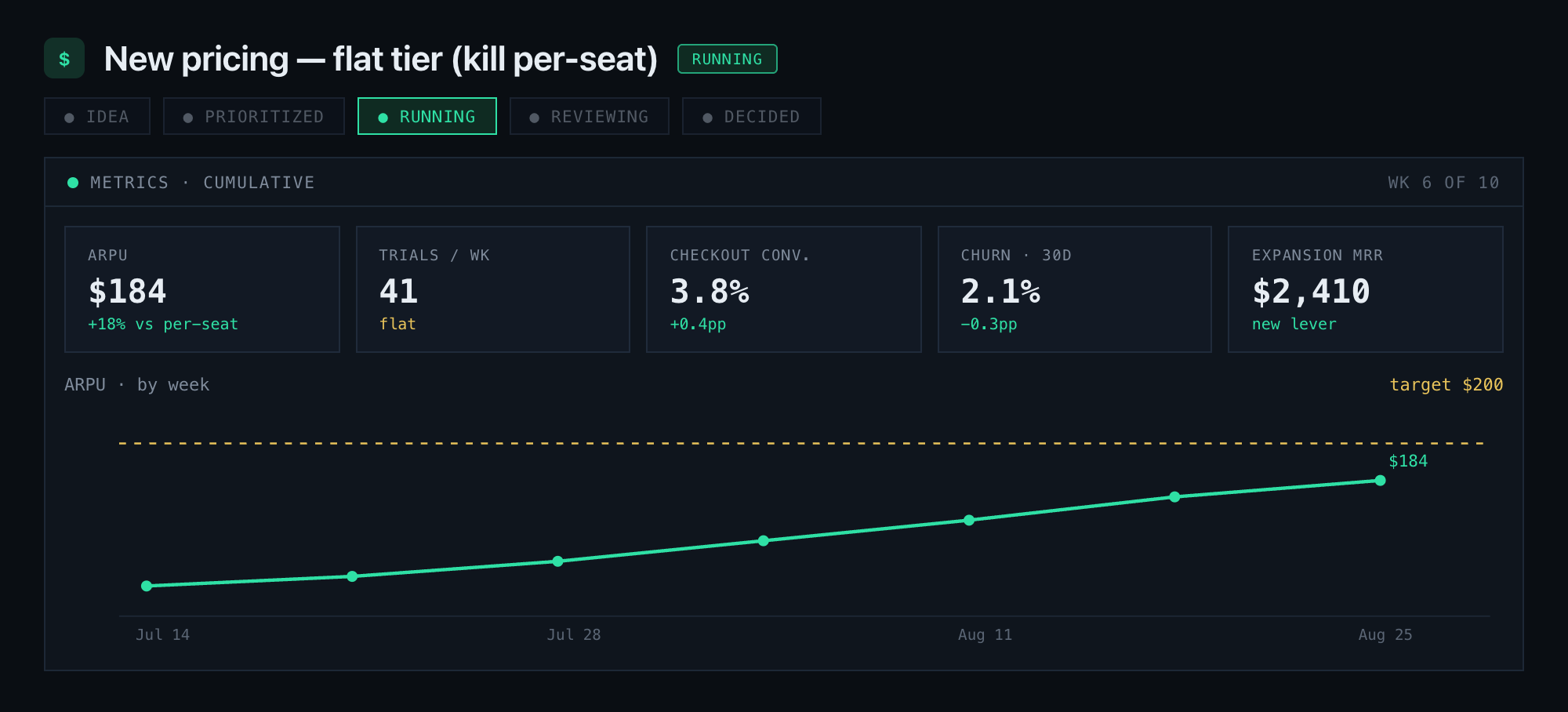
- Running stage: leading indicator tracked weekly is signup conversion rate on the pricing page; lagging indicator is 30-day churn among new signups.
- Reviewing stage: on the pre-set review date, 30 days after launch, the team pulls both metrics against the kill criteria set at the start.
- Decided stage: the bet closes as Won, Killed, or Inconclusive, and the team writes a short post-mortem.
The post-mortem is where the real learning happens. Instead of asking “did revenue go up,” which invites resulting, the team asks two separate questions: was the reasoning sound given what was known at the time, and how much of the outcome was luck versus the decision itself? A price increase that worked because a competitor raised prices the same week is not the same win as one that worked because the value proposition genuinely supported it. Thinking in Bets calls this separation “resulting,” the mistake of judging a decision purely by how it turned out rather than by the quality of the reasoning behind it.
Pro Tip: Write the post-mortem before checking whether the team feels good or bad about the result. Reading the metric first colors the analysis.
How to convert intuition into a probability and pick reliable metrics
Most people are not used to stating confidence as a number, so give the team a rough conversion scale and let it get more precise with practice.
- “Very unlikely” maps to roughly 10-20%.
- “Somewhat unlikely” maps to roughly 25-40%.
- “Coin flip” maps to 50%.
- “Somewhat likely” maps to roughly 60-75%.
- “Very likely” maps to roughly 80-90%.
Once the probability is set, pick exactly one leading indicator, something you can observe within days or weeks, and one lagging metric that reflects the real outcome. A pricing bet’s leading indicator might be conversion rate on the pricing page, while the lagging metric is 30-day revenue retention. Decide both before the bet starts, along with who owns pulling the numbers, so nobody goes metric shopping after the fact to justify a result.
A pre-registered kill criterion also does double duty as a discipline check. Practitioner guidance on decision journaling recommends stating the “what must be true” threshold up front specifically so a team cannot quietly redefine success once the numbers come in.

Team rituals: short premortems, status reviews, and post-mortems
A premortem takes 15 to 30 minutes before a bet starts. The team imagines the decision has already failed and works backward to list the most plausible causes, then adds the strongest ones to the brief as risks to watch. Research on this technique, known as prospective hindsight, found it can make a team notably better at spotting plausible failure causes than standard risk discussion, because imagining failure as already real removes the social cost of raising doubts. Harvard Business Review describes premortems as a way to make it safe for people with real reservations to speak up before a decision is locked in, and the Uncertainty Project’s summary of the underlying research points to a meaningful lift in identifying failure modes compared with traditional planning discussions.
- Run the premortem before the bet moves past Idea, and log the top risks directly in the brief.
- Move the bet through Prioritized, Running, and Reviewing on a fixed cadence, weekly for fast bets, monthly for slower ones.
- Close every bet as Won, Killed, or Inconclusive, with the post-mortem attached the same day.
Invite at least one person likely to disagree into the review. Google re:Work’s research on team effectiveness lists psychological safety and clarity as two of the strongest predictors of a team’s performance, both of which depend on dissent being welcome rather than punished.
Pro Tip: Assign someone the explicit job of arguing the opposite case in every review. It is easier to disagree when disagreement is the assignment.

Calibration, common pitfalls, and quick fixes for small teams
The most common failure is resulting: crediting a win to skill and blaming a loss on bad luck, without checking the reasoning either way. Close behind it are motivated reasoning, skipping kill criteria so a bad bet just runs forever, and making the call while emotionally invested, sometimes called tilt.
- Enforce pre-registration: no bet starts without a written hypothesis and probability.
- Force an actual number: reject “I think it’ll work” until it becomes “I’d put this at 70%.”
- Track calibration over time: compare the average stated probability across closed bets to the actual share that won.
- Review in batches: judging one bet in isolation hides patterns that twenty or thirty bets reveal.
A well-calibrated team’s 70%-confidence bets win close to 70% of the time, not 95% and not 40%. Tracking that gap across a rolling window of 20 to 50 bets, and reporting it every quarter, turns a vague sense of “we’re pretty good at this” into an actual number worth trusting or fixing.
A founder’s short reflection on using decision briefs
It failed. The post-mortem was uncomfortable, but separating the decision from the outcome showed the reasoning had been sound. The market had simply moved. That distinction changed how I judge every call since, and it is the difference between learning from a loss and just feeling bad about one.
— Cesar
How Betlog turns this template into a daily habit
Betlog builds the exact fields above into a single workflow, so a bet moves from Idea to Prioritized, Running, Reviewing, and Decided without a spreadsheet or a stale document nobody opens again. Hypotheses, probabilities, trade-offs, metrics, and kill criteria live in one record, and every closed bet gets a post-mortem that separates skill from luck instead of letting the outcome write the story.
- Permanent, timestamped records that cannot be quietly edited once the outcome is known.
- Calibration tracking across closed bets, so a team can see whether its 70% calls actually land 70% of the time.
- Built-in review stages that make premortems and status reviews part of the workflow instead of an extra meeting nobody schedules.
Teams that want the discipline of a decision brief without building the tracker themselves can check the Betlog pricing page and start logging bets today.
Sources
- Performing a Project Premortem — Harvard Business Review
- Pre-mortem (prospective hindsight) — The Uncertainty Project
- Thinking in Bets — key lessons and ‘resulting’ explained (Shortform summary)
- Understand team effectiveness — Google re:Work
FAQ
What is the purpose of a decision brief?
A decision brief records the reasoning behind a choice, including the hypothesis, probability, and metrics, before the outcome is known. Its purpose is to let you judge the quality of the decision later instead of judging it by how things turned out, a mistake Thinking in Bets calls resulting.
How long should a decision brief be?
A decision brief should take under two minutes to write and fit on one screen: a title, timestamp, hypothesis, probability, one or two metrics with kill criteria, and a review date. Length is a warning sign; if a brief needs paragraphs of context, the bet is probably not falsifiable yet.
How do I run a pre-brief meeting or premortem?
A premortem takes 15 to 30 minutes before the bet begins: the team imagines the decision has already failed and lists the most plausible reasons why. Harvard Business Review notes this format makes it easier for people with real concerns to raise them before commitments are locked in.
What is the difference between a decision brief and a post-mortem?
The decision brief is written before the outcome, capturing the hypothesis and probability, while the post-mortem is written after the review date to judge what happened. A good post-mortem separates how much of the result came from the decision itself versus luck, rather than crediting or blaming the outcome alone.
What does a well-calibrated team’s track record look like?
Teams can check this by comparing average stated probability to actual win rate across a rolling window of 20 to 50 closed bets.


