Self-Serving Bias: Founders Catch Blame Shifts With a Journal
Self-serving bias makes founders credit wins to skill and losses to luck. See how decision journals and team accountability reveal the pattern.

On this page
- What Self-Serving Bias Actually Means
- Why We Do It: Motivation and Mental Shortcuts
- What the Research Shows: Size and Limits of the Effect
- Self-Serving Bias in Everyday Life and at Work
- The Double-Edged Nature of Self-Serving Bias
- How to Spot Self-Serving Bias Before It Hardens
- How to Reduce Self-Serving Bias: Evidence-Backed Strategies
- A Decision Journal in Practice: From Hypothesis to Post-Mortem
- Treat Bias Mitigation as a Skill, Not a Character Flaw
- Put This Into Practice with a Decision Journal
- FAQ
- Sources
Self-serving bias is the habit of crediting our successes to our own skill while blaming our failures on bad luck or outside forces. It matters because it blocks honest learning: if every win proves we’re smart and every loss was unlucky, we never update what we actually know. The good news is that research points to specific, practical ways to catch and correct it.
TL;DR:
- The bias appears when people credit skill for success, blame outside forces for failure, and shift explanations when an outcome threatens their competence.
- Across 266 studies, the average effect was d = 0.96; it was smaller in Asian samples (0.30) and people with depression (0.21).
- Before a consequential decision, record the hypothesis, expected result, confidence percentage, and disconfirming evidence, then compare that record with the outcome during review.
- Team reviews should assess decisions using information available then, separately from results, so lucky wins do not excuse poor choices or losses condemn sound ones.
What Self-Serving Bias Actually Means
Self-serving bias describes the pattern of explaining good outcomes with internal causes (talent, effort, judgment) and bad outcomes with external causes (bad luck, unfair competitors, market timing). Psychologists call this an attributional asymmetry: the explanation shifts depending on whether the result flatters us, not on what actually happened.
It’s easy to confuse with a few neighboring concepts. Hindsight bias is the feeling, after an outcome is known, that we “knew it all along.” Self-serving bias is narrower: it’s specifically about who or what gets the credit or blame. The better-than-average effect, where most people rate themselves above the median on favorable traits, is a cousin bias built on the same ego-protective instinct but applied to self-comparison rather than outcome explanation. Confirmation bias overlaps too, since once we’ve decided a loss was “just bad luck,” we tend to notice evidence that supports that story and ignore evidence that doesn’t.
The bias isn’t constant across every person or situation. The 2004 meta-analysis that remains the most cited reference on this topic found the effect attenuated in people with depression and anxiety, groups who, if anything, tend to under-credit themselves for success. That variation matters: it tells us self-serving bias isn’t a fixed personality flaw, it’s a motivated pattern that shows up more strongly when our ego has something to protect and less strongly when our self-view is already fragile.
Three features define a genuine case of self-serving bias:
- Asymmetry: success gets an internal explanation, failure gets an external one, for the same category of event.
- Consistency: the pattern repeats across multiple outcomes rather than appearing once.
- Self-relevance: the explanation changes specifically because the outcome touches our own competence or identity, not someone else’s.
Once you see the asymmetry clearly, the next question is why it happens at all, and that has both an emotional answer and a mechanical one.
Why We Do It: Motivation and Mental Shortcuts
Two separate engines drive self-serving bias, and they usually run at the same time.
The first is motivational. We want to protect self-esteem, especially when an outcome threatens our identity as competent, capable, or in-control. A missed sales target feels less threatening if “the market shifted” than if “I misjudged the pitch.” There’s also a simple hedonic motive: external attributions for failure just feel better in the moment, so we reach for them the way we reach for any mood repair.
The second engine is cognitive, not emotional. Several ordinary mental shortcuts push us toward self-serving explanations even without any conscious ego defense:
- Selective attention: we notice and remember details that support a flattering account and skim past details that don’t.
- Availability: whatever explanation comes to mind fastest (often “the competitor undercut us” rather than “we mispriced it”) gets used, regardless of accuracy.
- Anchoring: our first guess at a cause sticks, and later evidence gets bent to fit it rather than genuinely reconsidered.
- Memory reconstruction: we don’t recall decisions as they were made, we reconstruct them in light of what we now know happened, quietly editing out the uncertainty we actually felt at the time.
These shortcuts trace back to the foundational heuristics-and-biases research describing how people systematically substitute easy mental operations for harder, more accurate ones when judging probability and cause. Self-serving bias is one of the predictable outputs of that substitution, applied to explanations of our own outcomes.
A few factors turn up the volume on both engines. Self-threat is the biggest one: when a failure directly challenges our competence or status, the attributional distortion gets larger, not smaller. Task importance works the same way, a trivial decision rarely triggers much defensiveness, but a decision tied to our identity as “the person who makes good calls” does. Interestingly, laboratory experiments on managerial decision-making found that people with high self-leadership and strong core self-evaluations, traits usually associated with better performance, showed stronger self-serving attributions, not weaker ones. Confidence in yourself, in other words, doesn’t automatically protect you from this bias. It can feed it.
Cultural background moderates the effect as well, a pattern the research literature returns to repeatedly and that the next section quantifies.
What the Research Shows: Size and Limits of the Effect
A 2004 meta-analysis of 266 studies found a large average self-serving attributional effect of d = 0.96, one of the more robust findings in social psychology, but the size of the effect varies sharply by population. Across cultures and clinical groups, the same meta-analysis reported the bias was much smaller in Asian samples (d = 0.30) than in U.S. samples (d = 1.05), and attenuated in people with depression (d = 0.21) and anxiety (d = 0.46) compared with the general population.

That spread is the headline result as much as the average itself. An effect size near 1.0 is large by the standards of social psychology, meaning the tendency to favor self-serving explanations is not a subtle statistical whisper, it shows up reliably and strongly in most adult samples studied. But the gap between U.S. and Asian samples, more than three times smaller in the latter, suggests the bias is shaped heavily by cultural norms around individual achievement versus collective explanation, not just by universal human wiring.
The clinical pattern tells a related story from a different angle. People experiencing depression or anxiety attribute outcomes more evenly between internal and external causes, sometimes even over-blaming themselves for failures. That’s consistent with the idea that self-serving bias is, in part, a mood-protective mechanism: when the mechanism that normally inflates self-regard is disrupted, the attributional asymmetry shrinks along with it.
Beyond the meta-analysis, individual experiments fill in how the bias plays out in applied settings. The managerial decision-making study mentioned earlier put participants through simulated business decisions and found that managers with stronger self-leadership traits were more likely to internalize credit for favorable results while externalizing blame for unfavorable ones, a finding that complicates the common assumption that confident, high-performing people are immune to this distortion. Other theoretical work on multi-dimensional uncertainty suggests that when an outcome could plausibly be explained by several different causes at once, people have more “room” to pick the explanation that flatters them, because no single cause is forced by the evidence.
What remains open is how durable these effects are inside real organizations over long stretches of time, and how much structured accountability can close the cultural and clinical gaps the meta-analysis found. Those are exactly the questions that mitigation strategies, covered later, are designed to address.
Self-Serving Bias in Everyday Life and at Work
The pattern shows up almost everywhere outcomes are judged.
- Relationships: after an argument, it’s common to recall our own words as reasonable and our partner’s as the problem, rather than examining what each side actually contributed to the conflict.
- Workplace reviews: a product launch that hits its numbers gets credited to strategy and execution in the retro; a launch that misses gets blamed on timing, budget, or a dependency from another team, even when the underlying decision quality was identical.
- Sports and media: athletes and commentators tend to credit wins to preparation and skill, while losses get attributed to referee calls, injuries, or weather, a pattern visible in how post-game interviews are framed almost every week.
- Politics: a party in power points to its own policies when the economy improves and to global conditions, the opposition, or external shocks when it worsens, often using nearly identical language for both.
What makes these examples useful isn’t just that they’re relatable, it’s that they share the same structure every time: success gets a story about competence, failure gets a story about circumstance. Once you see that symmetry breaking, in a one-on-one conversation or in a team’s quarterly review, you’re looking at self-serving bias in real time, not a one-off excuse.
The workplace version deserves special attention because it compounds. A single biased explanation in a performance review is a minor distortion. Repeated across every sprint retro, every postmortem, and every hiring decision, it becomes an organizational habit, one that applied research on accountability in hiring suggests can quietly skew who gets credit, who gets blamed, and ultimately who gets promoted.
The Double-Edged Nature of Self-Serving Bias
Self-serving bias isn’t purely destructive, but its costs tend to outlast its benefits, especially for teams.
The learning harms are the most serious. When success is credited to skill and failure to luck, outcome-based rewards drift away from actual decision quality: people get praised for lucky bets and excused for bad ones, and the feedback loop that should improve judgment over time quietly breaks. Teams that never separate skill from luck end up repeating the same mistakes under a different name, and their confidence levels stay miscalibrated because nothing ever forces a correction.
The social cost compounds the learning cost. When blame routinely lands on circumstances or other people, trust erodes, teammates become defensive rather than open, and postmortems turn into negotiations over whose story gets told rather than honest inquiry into what happened. A team meeting that should produce a lesson instead produces a grudge.
There’s a real upside, though, and it’s worth naming honestly. In the short term, a mild self-serving attribution after a setback can protect morale and resilience, giving someone the emotional room to try again rather than spiraling into self-blame. The caution is in the word “mild” and “short term.” A single self-protective explanation after a hard loss is a coping mechanism. A standing habit of never examining your own contribution to failure is a liability, and the research on attenuated bias in depression is a reminder that the goal isn’t to eliminate self-serving thinking entirely, it’s to keep it from running unchecked.
How to Spot Self-Serving Bias Before It Hardens
Catching the bias is mostly a matter of asking the right question at the right moment, ideally right after an outcome lands and before the story about it sets.
A short checklist works better than a vague intention to “be more objective”:
- Was there a pre-outcome hypothesis? If no one wrote down what they expected before the result came in, there’s nothing to check the final story against.
- Is the causal account symmetric? Would the same explanation (skill, luck, timing) have been offered if the outcome had gone the other way?
- Were alternative causes seriously considered? Or did the first flattering explanation simply stick because it arrived first?
Three quick tests help answer those questions without much overhead. Reread any notes written before the outcome was known, the gap between what you expected then and what you’re claiming now is often the whole story. Ask directly, “What would I have predicted before I saw the result?” And when possible, get a third party, someone with no stake in the outcome, to describe what happened in their own words; their account is rarely as flattering or as damning as the version we tell ourselves.
At the team level, a few signals are worth watching for. Repeated blaming language in retros (“the market,” “the client,” “bad timing”) with no corresponding internal explanation on wins is one. Missing confidence records, no one wrote down how sure they were beforehand, is another, since it leaves nothing to compare the outcome against. Absent dissent, where no one on the team challenged the plan before it ran, often means the postmortem has no honest counter-narrative to check the self-serving one against.
Pro Tip: Before discussing why a decision succeeded or failed, read the original plan out loud to the group. It resets everyone’s memory to what was actually known at the time.
How to Reduce Self-Serving Bias: Evidence-Backed Strategies
Reducing this bias isn’t about willpower or simply trying to be more honest. It’s about building structures that make the honest account the only one available.
- Score your forecasts, not just your outcomes. Outcome accountability, knowing a prediction will be recorded and checked later, improves calibration and forecasting accuracy in experiments and prediction tournaments. The mechanism is simple: when a number you wrote down is sitting next to the number that actually happened, there’s no room to quietly rewrite what you expected.
- Keep a decision journal. Before running a bet or making a consequential call, write the hypothesis, the expected outcome, the confidence level as an actual percentage, and what evidence would prove the call wrong. This single habit removes the biggest input self-serving bias needs: a vague or missing memory of what you originally thought.
- Run structured debriefs that separate process from outcome. A good postmortem asks two different questions, “was the decision sound given what we knew then?” and “did it work out?”, and refuses to let a good outcome excuse a bad process or a bad outcome condemn a good one. Our guide to structured red team reviews walks through a short format for teams that want this built into a recurring ritual, and a well-run research debrief with stakeholders follows a similar logic: separate what was known from what was learned.
- Build in calibration exercises. Periodically compare your past confidence levels against actual outcomes. If every “80% confident” call you’ve made over the past quarter turned out right only half the time, that gap is the clearest evidence of miscalibration available, and self-serving bias is usually part of why it went unnoticed.
- Design the behavior into your tools, not just your intentions. Default fields for confidence and a target metric, a scheduled prompt that resurfaces pre-outcome notes right before a review, and a required post-mortem step before a decision can be closed all reduce the chance that motivated memory fills in the gaps. Our one-paragraph decision documentation template is built around exactly this kind of default.
Pro Tip: Schedule the review of a decision’s confidence level on the calendar at the moment you make the decision, not after you already know how it turned out. Reviewing on a schedule you set beforehand is a small pre-commitment device, sometimes called a Ulysses contract, that keeps you from conveniently forgetting to check the ones that went badly.
This same logic extends to dissent. A team that invites a designated skeptic into every major decision, someone whose job is to argue the other side before the decision runs, creates a documented counter-narrative that a self-serving story has to contend with later. Our field guide to decision-making under incomplete information covers how to build that kind of dissent into a normal weekly cadence rather than treating it as a special event, and research on creating accountability without blame points to similar conditions: psychological safety paired with real, tracked accountability, rather than either alone.
Teams that skip the documentation step and rely on memory alone tend to rediscover the same mistake every few quarters, each time with a new external explanation attached.
A Decision Journal in Practice: From Hypothesis to Post-Mortem
A structured decision journal works because it removes the raw material self-serving bias needs most: an unclear or malleable memory of what we originally expected.
Each entry moves through clear stages, Idea, Prioritized, Running, Reviewing, Decided, and closes with an honest verdict of Won, Killed, or Inconclusive rather than a vague sense of how things went. Picture a team raising prices on a core plan: the entry records the hypothesis (higher price won’t hurt signups materially), the expected outcome, a numeric confidence (say, 65%), and the metric that will decide it. When signups dip more than expected, the recorded confidence and hypothesis are still sitting there, unedited, making it much harder to claim “we knew the market would react that way” after the fact.
Teams that run this cycle consistently report a few concrete shifts:
- Confidence numbers start matching reality instead of clustering near “pretty sure” for everything.
- Postmortems get shorter and less tense, because the pre-outcome record settles most of the disagreement about who expected what.
- Repeated mistakes get caught faster, since the pattern is visible across entries instead of buried in memory.
Treat Bias Mitigation as a Skill, Not a Character Flaw
My honest view is that most organizations treat self-serving bias as a people problem, something to fix with better hiring or stronger character, when it’s really a systems problem. No one is exempt from the pull to protect their ego after a loss, including people who are otherwise excellent at their jobs. What separates teams that improve from teams that don’t isn’t willpower, it’s whether they’ve built a routine that makes the honest account the default one.
If you take one thing from this, try a single documented decision cycle this month: write the hypothesis and confidence down before you know the outcome, then read it back out loud at review time. That one habit does more than any amount of good intentions.
— Cesar
Put This Into Practice with a Decision Journal
Everything in this article points to the same fix: write down what you expect before you know what happened, then check your story against the record instead of your memory. That’s the entire premise behind Betlog, a decision journal built for founders and small teams making calls under uncertainty.
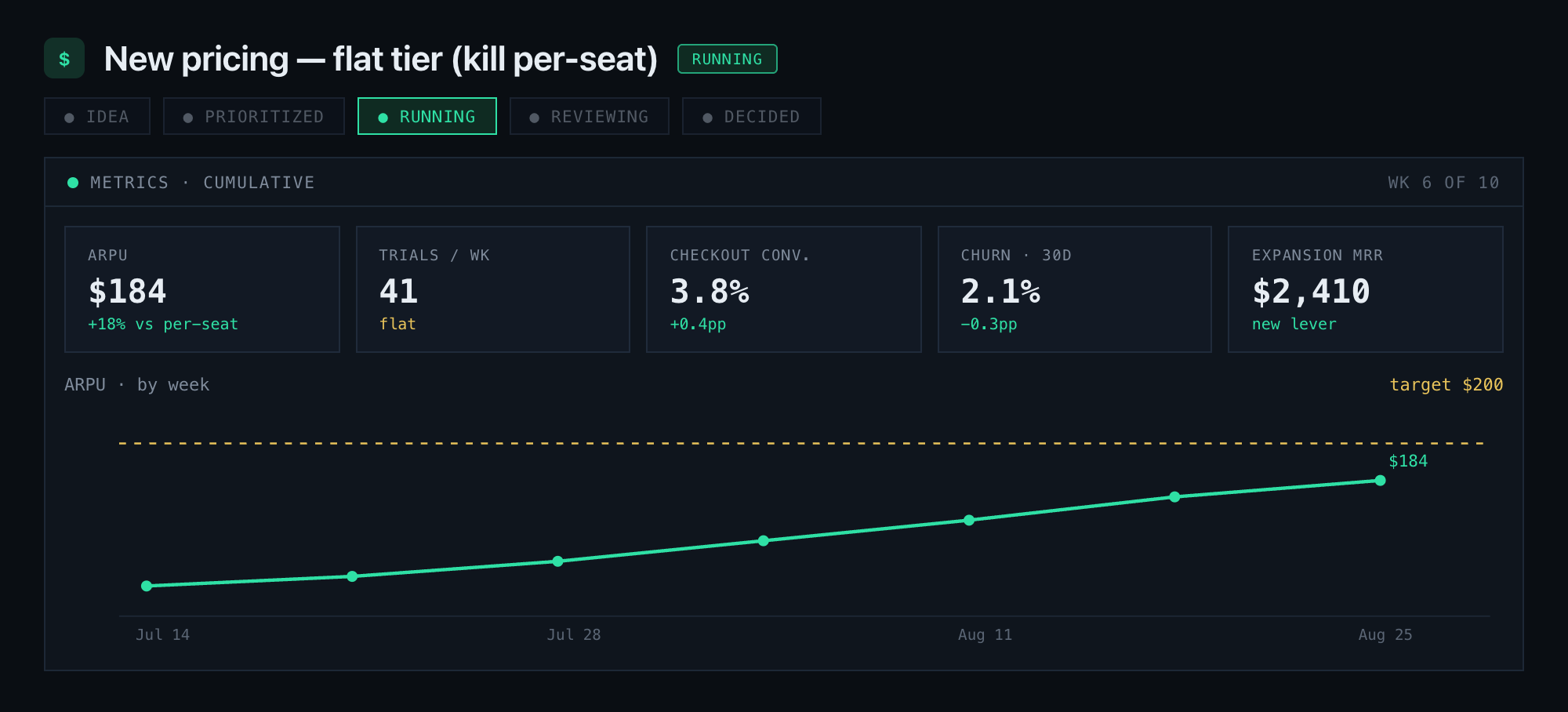
Each bet captures a hypothesis, a numeric confidence level, the trade-offs accepted, and the metric that will decide it, then moves through stages from Idea to Decided and closes with a verdict of Won, Killed, or Inconclusive and a post-mortem that separates skill from luck. The record stays permanent and timestamped, preserving the decision rationale and outcomes. One plan is available for $39 per month or $390 per year, and you can see the full feature set on the Betlog product page before you commit your team to it.
FAQ
What causes low self-worth?
Low self-worth usually comes from a mix of repeated negative feedback, unfavorable comparisons to others, and internalized criticism from early relationships or environments. It is a separate concept from self-serving bias, which actually tends to shrink in people who struggle with low self-worth, since they are less likely to credit themselves for good outcomes.
How can you build a stronger sense of self?
Building a steadier sense of self generally involves accumulating honest evidence of your own competence over time, rather than relying on either inflated self-credit or harsh self-criticism after any single outcome. Keeping an honest record of decisions and their results, rather than a retroactively edited story, is one practical way to build that evidence base.
What does self-esteem mean?
Self-esteem refers to the overall value a person places on themselves, distinct from self-confidence in a specific skill or situation. Self-serving bias is partly a defense mechanism for self-esteem, since crediting ourselves for wins and externalizing blame for losses protects our overall sense of worth from being challenged by any single bad outcome.
What behaviors suggest a lack of self-respect?
Behaviors like consistently deferring to others’ judgment against your own evidence, tolerating repeated boundary violations, or struggling to state your own needs can signal a lack of self-respect. This is distinct from self-serving bias, which is specifically about how people explain the causes of their successes and failures rather than how they treat themselves day to day.
How does self-serving bias affect decisions made under uncertainty?
When an outcome is uncertain and could plausibly have several causes, self-serving bias makes it easier to pick whichever explanation protects our self-image, since no single cause is forced by the evidence. Treating a decision as a bet made with incomplete information, and recording the reasoning before the outcome is known, is one of the more reliable ways to keep that flexibility from turning into a self-serving story later.
Sources
- Is There a Universal Positivity Bias in Attributions? A Meta-Analytic Review of Individual, Developmental, and Cultural Differences in the Self-Serving Attributional Bias.
- Core Self-Evaluations, Self-Leadership, and the Self-Serving Bias in Managerial Decision Making: A Laboratory Experiment


