Resulting Bias: Outcome Blind Reviews for Founders and Product Leads
Help founders and product leaders resist resulting bias with decision briefs, probability checks, outcome blind reviews, and a Betlog walkthrough.

On this page
- How resulting differs from hindsight bias and other errors
- Why resulting happens: the psychology behind it
- What resulting looks like in practice
- What research shows about outcome bias and fixing it
- How to avoid resulting: a practical toolkit
- An applied walkthrough: logging and reviewing one bet
- Separating skill from luck after the fact
- Building a review culture that resists motivated reasoning
- Premortems, backcasting, and thinking ahead of the outcome
- Treat your decisions as bets, not verdicts on yourself
- How Betlog helps you put this into practice
- FAQ
- Sources
Resulting, also called outcome bias, is an error of judging a decision by how it turned out instead of by the quality of the reasoning behind it. It matters because results depend on both skill and luck, and conflating the two teaches you the wrong lessons from both your wins and your losses. The fix is simple to state and hard to practice: assess the process, not the outcome.
TL;DR:
- A single result rarely proves decision quality; evaluate outcomes across similar decisions or when they expose flawed information or reasoning.
- Awareness alone rarely changes decisions; structured practice, repeated review rituals, and serious games retain lessons better than lectures or reading.
- Before committing, record the hypothesis, a numeric success probability, and success metrics, then timestamp the entry so later reviews cannot rewrite the reasoning.
- Review the reasoning before revealing results, then compare actual metrics with expectations and separate judgment from market conditions or other uncontrollable factors.
How resulting differs from hindsight bias and other errors
Resulting bias happens the moment you grade a decision using information that only showed up after the fact: a coin landed heads, a customer churned, a hire didn’t work out. You treat the result as proof the decision was good or bad, when the result is really a mix of the decision’s quality and whatever luck showed up along the way.
It gets confused with hindsight bias, which is related but distinct:
- Hindsight bias makes a past event feel like it was predictable all along, even when it wasn’t.
- Resulting bias uses the outcome itself as the yardstick for whether the decision was smart.
- The two often travel together: once you know how something ended, you both feel it was obvious and judge the decision maker by the ending.
Outcomes legitimately inform evaluation when you have a large enough sample of similar decisions to see a pattern, or when the outcome reveals that the original information or reasoning was flawed, not just unlucky. A single bad result almost never tells you that.
Why resulting happens: the psychology behind it
Resulting persists because your brain wants a clean story. Once an outcome exists, you build a narrative backward from it: a good result must mean good judgment, a bad one must mean a mistake. According to research summarized in Thinking in Bets, this is exactly what “resulting” describes: using the outcome as the primary proof of decision quality, even though the decision and the result are separate things connected by chance.
Three mechanisms drive it:
- Narrative-making: your mind prefers a tidy cause-and-effect story over an honest “we don’t fully know why this worked.”
- Reinforcement learning gone wrong: wins get repeated and losses get avoided, even when the win was lucky and the loss was the right bet that didn’t pay off this time.
- Self-serving attribution in teams: people claim credit for wins and blame bad luck, market conditions, or other departments for losses, which blocks honest review.
Social incentives make it worse. In a team setting, publicly admitting a good decision lost money feels riskier than quietly letting everyone believe the result was the whole story.
Pro Tip: Before discussing any result, ask the room to restate the original probability and reasoning out loud, before anyone mentions how it turned out.
What resulting looks like in practice
Resulting shows up constantly, usually disguised as normal commentary:
- A coach calls a fourth-down play that fails and gets labeled reckless, even though the expected value of the call was sound and a slightly different bounce would have made it a genius move.
- A pricing experiment that lifted conversion for two weeks gets rolled out company-wide as a “proven win,” without anyone checking whether the lift was noise.
- A hiring manager who picked a candidate who later struggled gets blamed for a “bad hire,” even if the decision was reasonable given what was known in the interview process.
- An investor who made a concentrated bet that happened to pay off gets called a visionary, while an equally reasoned bet that didn’t pay off gets called a mistake.
In each case, the actual quality of the reasoning at the time barely enters the conversation. The result does all the talking.
What research shows about outcome bias and fixing it
The experimental case for resulting bias is old and consistent. In Baron and Hershey’s classic studies, participants evaluated identical decisions, same information, same reasoning, differently depending only on whether the stated outcome was a success or a failure. The effect showed up reliably across multiple experiments, which is part of why the bias is treated as a durable feature of judgment rather than a one-off lab quirk.
- Identical decisions get rated as smarter when the outcome is good and worse when the outcome is bad, even when participants are told to judge the decision, not the result.
- A systematic review of bias-mitigation training found limited evidence that awareness-only interventions, reading about biases or attending a lecture, produce lasting change in real decisions.
- The same review found that structured practice, serious games, and repeated rituals show more retention than passive awareness training.
Knowing about resulting bias barely helps on its own, according to that systematic review; durable change comes from building the habit into how you actually review decisions, not from a slide deck about cognitive biases.
How to avoid resulting: a practical toolkit
You cannot out-think resulting bias with willpower, but you can build rituals that make it harder to fall into.
- Record the decision before you know the outcome: write the hypothesis, a numeric probability of success, and the metrics that will determine whether it worked.
- Replace vague confidence with calibrated probabilities. Assigning a number instead of a feeling forces sharper thinking and makes it possible to check your track record later.
- Track your hit rate over time: if you say 70% confident across a batch of calls, roughly seven in ten should actually land, and tracking this is what decision-quality frameworks call calibration.
- Run outcome-blind reviews: discuss the reasoning and information available at the time before anyone reveals how the bet turned out. Our guide to beating hindsight bias walks through the meeting structure.
- Reframe evaluation around a checklist of the decision process (framing, alternatives, information, reasoning, commitment) instead of a single thumbs up or down on the result.
Pro Tip: A two-minute decision brief, one sentence each for hypothesis, probability, and the metric that proves it wrong, catches most resulting bias before it ever gets a chance to form.
Low-friction rituals work better than elaborate frameworks because they get used. A three-question postmortem (what did we expect, what happened, what was luck versus judgment) beats a ten-page retro template that nobody fills out honestly.
An applied walkthrough: logging and reviewing one bet
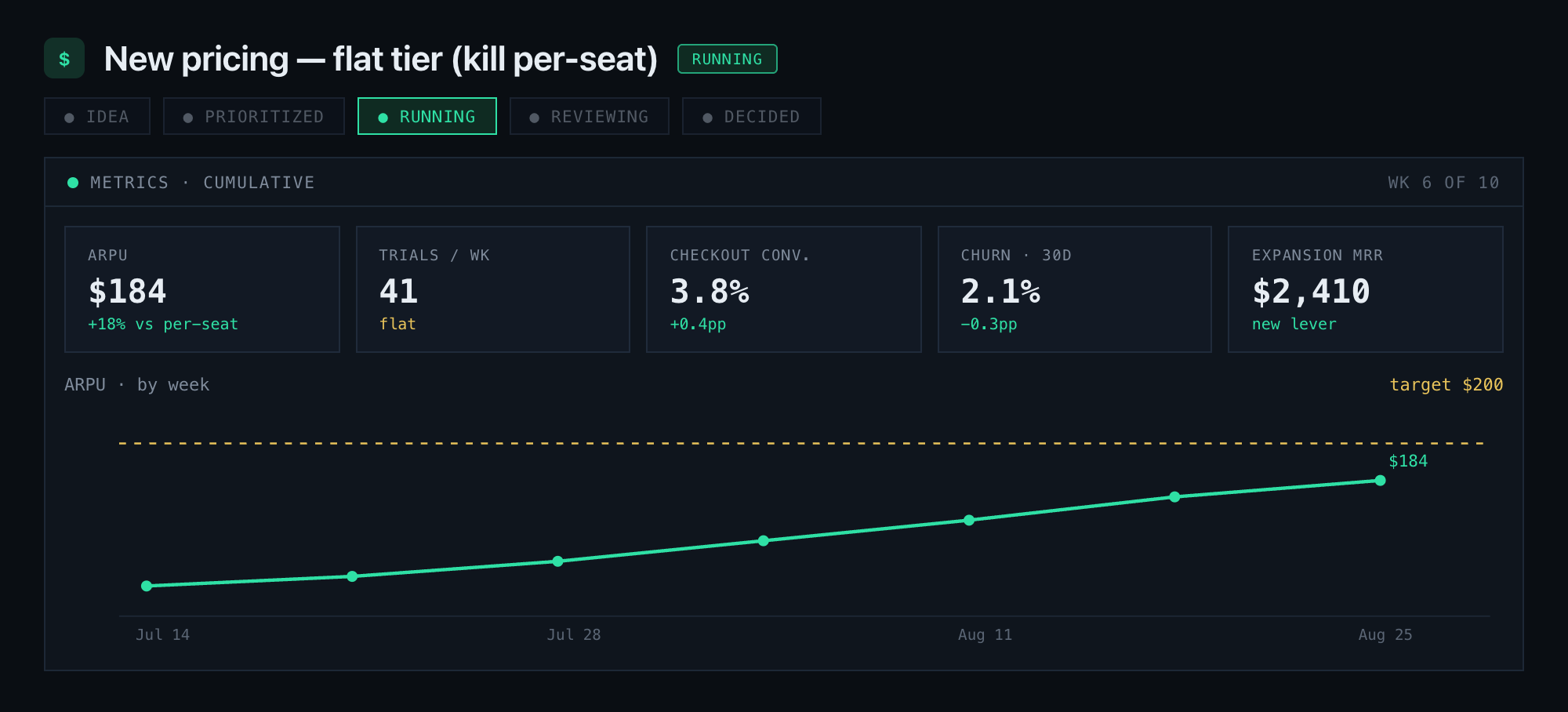
The hypothesis: higher prices won’t meaningfully hurt conversion because the product has become stickier. Metrics: conversion rate and revenue per customer, tracked weekly for six weeks.
The bet moves through clear stages, from Idea to Prioritized to Running to Reviewing to Decided, with every entry timestamped so nobody can rewrite the reasoning after the fact once the result is known.
- The original hypothesis and probability stay locked once the bet starts running.
- The review compares actual conversion and revenue against the stated expectation, not against a vague sense of how things “felt.”
- The postmortem assigns a verdict: Won, Killed, or Inconclusive, and separates how much of that verdict was skill versus market conditions outside anyone’s control.
| Element | What it captures |
|---|---|
| Hypothesis | Higher price won’t hurt conversion |
| Stated probability | 70% confident |
| Metrics | Conversion rate, revenue per customer |
| Verdict | Won, Killed, or Inconclusive |
Our decision journal approach is built specifically to check whether your 70% bets actually hit 70% over several rounds, which is what calibrated feedback looks like in practice.
Separating skill from luck after the fact
Once a bet closes, the real work is sorting out how much of the result came from good judgment and how much came from circumstances nobody controlled. This is sometimes called outcome fielding: instead of asking “did it work,” you ask “would this decision have been right across the range of outcomes that were plausible at the time.”
A useful method is to re-run the original probability estimate mentally and ask whether the actual result falls inside a reasonable range of what you expected. Thinking in Bets frames this as the core discipline behind post-mortems: separating luck from skill rather than defaulting to “it worked” or “it didn’t.”
Practical steps for outcome fielding include checking whether the metrics moved for the reason you predicted or for an unrelated reason, asking what a slightly different market condition would have done to the result, and explicitly writing down which parts of the outcome were inside your control and which weren’t. Treating a string of decisions as a portfolio rather than a series of pass or fail grades, an approach decision-quality resources recommend, makes this easier because no single bet has to carry the full verdict on your judgment.

Building a review culture that resists motivated reasoning
Resulting bias thrives in teams where admitting a loss feels like admitting incompetence. A dissent-friendly review culture removes that penalty by separating the evaluation of the decision from the evaluation of the person who made it.
Practical rituals that support this include rotating who argues the opposing case in a review, so pushback isn’t tied to someone’s permanent role as the skeptic. Blameless postmortems, structured around what was known at decision time rather than who gets credit or blame, keep the conversation anchored to reasoning instead of ego. Our five-stage blameless postmortem format gives teams a repeatable structure for this.
Re-anchoring the discussion to the actor’s information, what the decision maker actually knew at the time, produces more reliable learning than discussing what seems obvious now. Teams that want a sharper version of this can pair internal review rituals with structured research sessions that surface what information was realistically available before a call was made, which helps separate a bad process from simply incomplete data.
Pairing this with a short, consistent set of postmortem questions, rather than an open-ended debate, keeps reviews from drifting into blame. Our set of postmortem questions is built around exactly that kind of structure.

Premortems, backcasting, and thinking ahead of the outcome
The best defense against resulting bias happens before the decision, not after. Mental time travel techniques force you to imagine outcomes before they’re real, which weakens the pull of any single result later.
A premortem asks your team to imagine the decision has already failed and write down why, before you commit. This surfaces risks that optimism usually hides and gives you a documented list of failure modes to check against later, instead of inventing them retroactively once something goes wrong.
Backcasting works in the opposite direction: picture the specific future you want and work backward to the decisions that would get you there, which clarifies what actually needs to be true for success, separate from how lucky you’d need to be.
Both techniques work because they create a record made before the outcome exists, which is the same principle behind documenting decisions with incomplete information. When the outcome eventually arrives, you have something honest to compare it against instead of a memory that’s already been reshaped by hindsight.
Treat your decisions as bets, not verdicts on yourself
The founders who improve fastest aren’t the ones who win more often. They’re the ones who stop grading themselves on wins and losses and start grading the reasoning instead. That shift scales better for a small team than any amount of individual willpower, because it turns review meetings into learning sessions instead of trials.
A simple experiment worth running this week: write one decision brief before you commit to something, then hold an outcome-blind review of your last closed decision before anyone states how it turned out. Track your stated confidence against reality for a quarter, and you’ll likely find your calibration is worse than you assumed.
— Cesar
How Betlog helps you put this into practice
We built Betlog around the idea that every decision is a bet: a commitment made with incomplete information, where the result depends on both judgment and luck. Each bet you log captures the hypothesis, a stated probability, the trade-offs you accepted, and the metrics that will decide it, moving through clear stages from Idea to Decided.
Because every entry is timestamped, you can’t quietly rewrite your reasoning once you know how things turned out. You can see pricing and start tracking your own bets whenever you’re ready.
FAQ
What does “resulting bias” mean?
Resulting bias is the habit of judging a decision as good or bad based on how it turned out, rather than on the quality of the reasoning at the time it was made. It confuses luck with skill, since any single outcome reflects both the decision and chance.
What are the four types of bias?
There’s no single official list of exactly four biases; cognitive bias research covers dozens of distinct patterns grouped loosely by cause, such as memory biases, attribution biases, and decision biases like resulting and hindsight bias. Definitions vary by source, so it’s more useful to focus on the specific biases relevant to your decisions than to memorize a fixed count.
What does outcome bias mean?
Outcome bias is another name for resulting bias: it’s the tendency to rate an identical decision more favorably when the result was good and less favorably when the result was bad. Baron and Hershey’s experiments demonstrated this effect consistently across multiple studies.
What are the three kinds of bias?
As with the “four types” framing, there isn’t one agreed-upon list of exactly three biases; the term covers a wide range of mental shortcuts that affect judgment. For decision-making specifically, the ones worth knowing well are resulting bias, hindsight bias, and self-serving attribution, since all three distort how teams learn from past calls.
How is decision quality different from outcome quality?
Decision quality refers to the reasoning, information, and process used at the time a choice was made, while outcome quality is simply how things turned out. A good decision can still produce a bad outcome because uncertainty and luck are part of nearly every real decision.
Sources
- Baron & Hershey — Studies on outcome bias (experimental paper)
- Systematic review on bias mitigation retention and transfer (Frontiers / PMC)
- Decision quality vs. outcome quality (McCombs TEE blog)
- Thinking in Bets (Annie Duke) summary / book notes


