Thinking in Bets Summary: The One Page Bet Template for Teams
Turn Annie Duke’s Thinking in Bets into a one page team decision template, with premortems, outcome reviews, and calibration rituals founders can use today.

On this page
- What thinking in bets means and why the frame matters
- Why we’re bad at evaluating decisions: the cognitive traps
- Core models and tools Duke recommends
- A practical one-page bet template and rituals you can use today
- Chapter-by-chapter shortcut: where to find the tactics
- About Annie Duke and why her background matters
- Memorable quotes and quick takeaways
- Operationalizing Thinking in Bets for small teams
- Who benefits most and how to start
- Keep a decision journal without the overhead
- FAQ
- Sources
Thinking in Bets teaches that every decision is a bet under uncertainty, so we should judge choices by the reasoning and probabilities we held before the outcome, not by how things turned out. Annie Duke offers tools like probability estimates, premortems, and truth-seeking groups to sharpen that reasoning. The payoff for a team is a repeatable way to log decisions, review them honestly, and get better at making the next one.
TL;DR:
- Record each recurring decision before commitment, including a numeric confidence estimate, hypothesis, assumptions, falsification criteria, owner, and review date; review it after the outcome.
- Run a 10 to 15 minute premortem before major decisions, imagining failure and separating controllable risks from chance before the team commits.
- Assess calibration across repeated decisions: calls made at 70% confidence should succeed near 70% of the time, while one result proves little.
- Teams making recurring pricing, hiring, or roadmap decisions should test the habit for 4 to 8 weeks, since patterns emerge across multiple bets.
What thinking in bets means and why the frame matters
Most of us evaluate decisions the way we grade a test: right answer, wrong answer. Thinking in Bets argues that this is backward for almost any decision that matters, because information is incomplete and luck plays a role in nearly every outcome. A good decision can still lose. A reckless one can still win. Judging purely by results teaches us the wrong lessons, over and over, without us noticing.
Poker is the model Duke builds this around, and it fits for a specific reason: a poker player never sees the other hands, so every bet is a probability estimate made with partial information, and the same is true of a pricing change, a hire, or a product bet. Chess, by contrast, is a poor model for most real decisions because both players see the whole board.
A short example makes the point concrete. A football team calls a pass play in a high-leverage moment, the pass gets intercepted, and the play is instantly labeled a bad decision. But if the probability of success was higher than the alternative run play, the call was correct even though it failed. The outcome was bad. The decision wasn’t.
A few things follow from treating decisions this way:
- Confidence should be expressed as a probability, not a flat yes or no.
- A loss doesn’t automatically mean the process was flawed.
- A win doesn’t automatically mean the process was sound.
Why we’re bad at evaluating decisions: the cognitive traps
Our instinct to judge decisions by outcomes has a name: resulting. Duke uses the contrast between poker and chess to show how resulting works. A poker player who goes all in with the statistically best hand and loses to a lucky card made the right bet. If we only look at the chip count afterward, we conclude the opposite. The same trap shows up when a founder green-lights a well-reasoned pricing test that happens to land during a slow sales month and gets treated as proof the whole idea was weak.
Hindsight bias makes resulting worse. Once we know the outcome, our brain quietly rewrites what we “knew” beforehand, so we remember being more certain than we actually were. Experimental work and the RAFT model find that recall-assistance techniques reduce hindsight bias materially, which is a direct argument for writing probability estimates down before you know how things turn out: a written record can’t be quietly rewritten the way memory can.
Motivated reasoning compounds the problem. We’re generally more comfortable crediting wins to our own skill and blaming losses on bad luck, which means the natural review process tends to reinforce whatever we already believed. Add emotional tilt, the state of decision-making while frustrated, anxious, or overconfident after a win, and the quality of judgment drops further at exactly the moments that matter most.
Three traps do most of the damage:
- Resulting: judging the decision by the outcome instead of the reasoning behind it.
- Hindsight bias: rewriting our prior confidence after we already know what happened.
- Motivated reasoning and tilt: crediting skill for wins, blaming luck for losses, and deciding worse under emotional pressure.
Core models and tools Duke recommends
Duke’s toolkit is built to counter the traps above, and each piece addresses a specific failure point.
Expressing confidence as a probability, rather than “I think so” or “probably,” forces a clearer commitment. Calibration is what you get from checking: if your 70%-confidence calls actually win around 70% of the time across many bets, your judgment is well calibrated; if they win 90% of the time or 40% of the time, something in your process needs adjusting.

Mental time travel tools pull reasoning out of the present moment. A premortem asks the team to imagine the decision has already failed and work backward to explain why, surfacing risks that optimism tends to hide. Backcasting works forward from a desired future state to the steps that would get there. The 10-10-10 exercise asks how a choice will look in 10 minutes, 10 months, and 10 years, which helps separate short-term emotion from long-term consequence.
Dissent-to-win structures turn disagreement into a feature instead of a threat. The practical rules are straightforward:
- Gather all relevant information before debating conclusions.
- Never punish someone for delivering bad news.
- Acknowledge conflicts of interest openly.
- Practice organized skepticism rather than polite agreement.
And the simplest tool of all is the question “wanna bet?” Offering to put something on the line, even informally, exposes whether we actually believe what we’re claiming or whether we’re just talking in an inflated certainty.
Pro Tip: Before a big decision, write down your confidence as a number. If you can’t, you’re not ready to decide yet.
A practical one-page bet template and rituals you can use today
A bet record is only useful if it’s filled out before the outcome is known, and it needs to be short enough that people actually do it. Duke’s framework translates into a one-page format with these fields:
- Decision date and the options considered.
- The hypothesis and the measurable outcome that would confirm it.
- Probability or confidence level, stated as a number.
- Key assumptions the bet depends on.
- What evidence would change the decision (falsification criteria).
- Risks and trade-offs accepted by choosing this option.
- Owner and review date.
Before the bet runs, hold a short premortem: 10 to 15 minutes imagining the decision has failed, listing every plausible reason why, and capturing which risks are controllable versus which are pure chance. Our premortem facilitation guide walks through the agenda in more detail, and a partner guide on running a premortem covers a similar structure for founders pressure-testing a strategic call.
When the review date arrives, the post-mortem has one job: separate process from luck. Ask whether the original reasoning was sound given what was known at the time, independent of how things turned out, and write down the learning in a sentence that can’t be quietly reinterpreted later.
| Bet field | What it captures | When it’s recorded |
|---|---|---|
| Hypothesis | What we expect to happen and why | Before the decision |
| Confidence | Probability estimate, as a number | Before the decision |
| Falsification criteria | What evidence would prove it wrong | Before the decision |
| Post-mortem verdict | Process vs. luck, and the learning | At review |
Calibration becomes visible once you have a run of closed bets. A pattern of winning 90% of your “70%” bets means you’re underconfident; winning 40% means you’re overconfident and the gap points to a specific habit worth fixing.
Chapter-by-chapter shortcut: where to find the tactics
Not every chapter carries the same weight for a reader short on time. The early chapters build the core argument, resulting, luck versus skill, and why outcomes mislead us. The middle stretch is where the tools live: probability language, calibration, and truthseeking groups. Later chapters lean on stories from poker, politics, and business to illustrate the ideas already introduced.
- Early chapters: the theory, resulting, and the poker-versus-chess framing.
- Middle chapters: premortems, dissent structures, and calibration practice.
- Later chapters: applied stories that show the tools in use rather than new tools themselves.
If you only have an afternoon, the middle section is where the actionable material concentrates.
About Annie Duke and why her background matters
Annie Duke spent years as a professional poker player before turning to writing and consulting on decision-making, and she holds a background in cognitive psychology. That combination shows up directly in the book: the poker stories aren’t decoration, they’re worked examples of probabilistic reasoning under real stakes, and the cognitive research grounds the explanations of why our judgment goes wrong in the first place. Business and sports examples round out the case that the same traps show up far outside the card table.

Memorable quotes and quick takeaways
A few lines from the book work as standalone rules:
- Treat every decision as a bet, because it is one.
- A good process can still lose. A bad process can still win.
- “Wanna bet?” is a fast test of how confident you really are.
- Don’t shoot the messenger who brings you bad news.
- Judge yourself on the reasoning, not the scoreboard.
The one-sentence takeaway: write your confidence down before you find out if you were right.
Operationalizing Thinking in Bets for small teams
A decision journal turns these ideas into a habit rather than a one-time read. We built Betlog around exactly this workflow: a bet moves through Idea, Prioritized, Running, Reviewing, and Decided, with the hypothesis, confidence level, and falsification criteria locked in before anyone knows the outcome, which is what actually blocks hindsight bias from creeping in later.
- Idea and Prioritized stages capture the hypothesis and probability before commitment.
- Running and Reviewing stages hold the metrics and assumptions steady until review.
- Decided stage closes with a Won, Killed, or Inconclusive verdict and a post-mortem.
Pro Tip: Attach your bet review to an existing sprint or leadership meeting instead of scheduling a new one. It survives longer that way.
Who benefits most and how to start
The teams that get the most out of this book are the ones making repeated, similar calls, pricing, hiring, roadmap bets, where a pattern can actually form. Start with one recurring decision and log it for 4 to 8 weeks before judging anything. A single result tells you almost nothing; calibration only shows up across a run of bets. Pull in dissent and a quick premortem before committing, since both widen the information you’re betting on before it’s too late to change course.
— Cesar
Keep a decision journal without the overhead
A notebook works until the team grows past three people, and that’s where most good intentions around decision journals quietly die. Betlog exists to carry the habit forward: it’s a decision journal built for founders and small teams who want hypotheses, confidence levels, premortems, and post-mortems in one permanent, timestamped record instead of scattered documents.
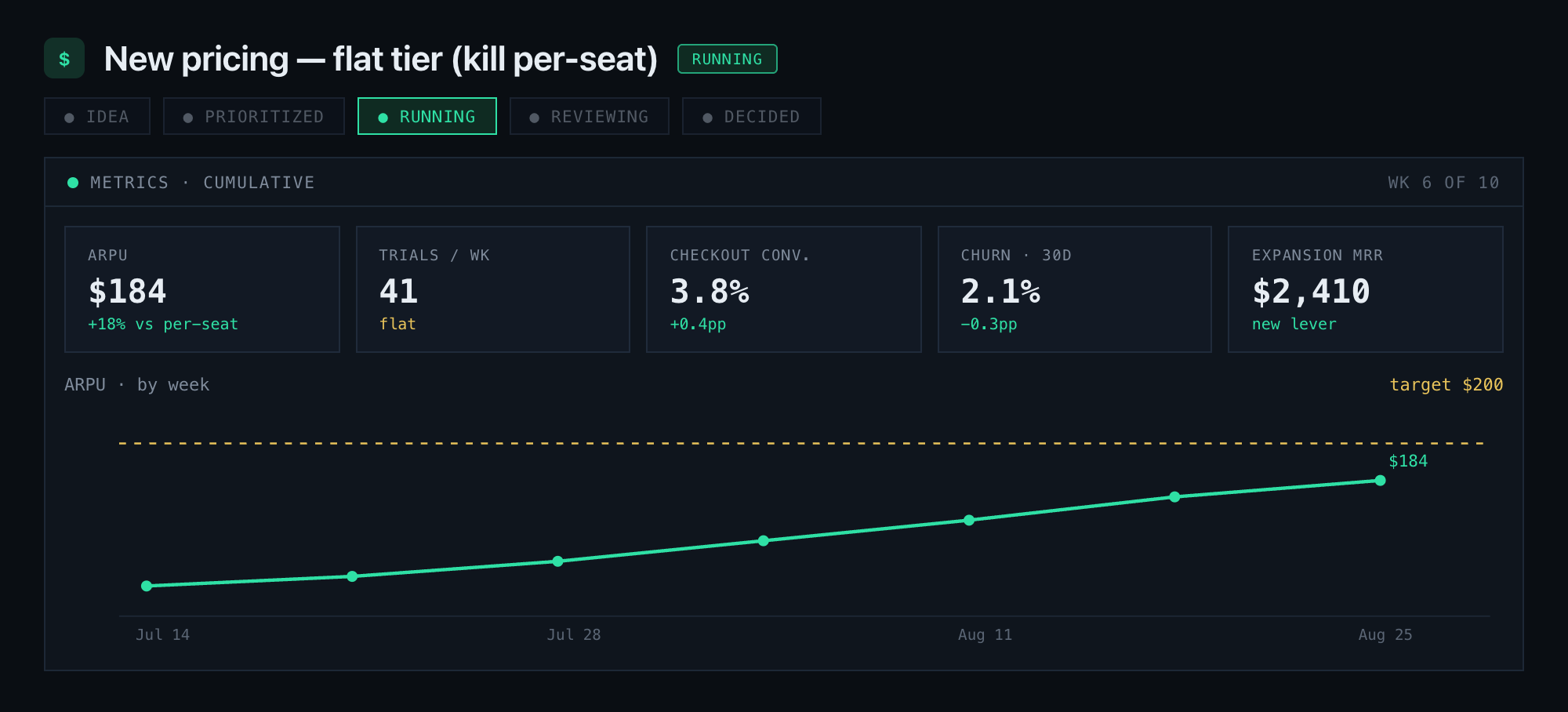
- Capture the hypothesis, probability, and falsification criteria before the outcome is known.
- Close every bet with a Won, Killed, or Inconclusive verdict and a short post-mortem.
- Track calibration across closed bets instead of judging any single result.
One plan covers the full workflow at $39 per month or $390 per year. Start logging your next decision before you know how it turns out.
FAQ
Is Thinking in Bets worth reading?
Yes, for anyone who makes repeated decisions under uncertainty, founders, product leads, managers, since the book gives concrete tools like probability estimates and premortems rather than general advice. The publisher’s description frames it around poker, business, sports, and politics examples that make the ideas easy to apply outside the card table.
What happened to Annie Duke?
Annie Duke moved from a professional poker career into writing and consulting on decision-making, drawing on a background in cognitive psychology. Her site frames her current work around helping people treat everyday choices as bets to improve long-term decisions.
What does thinking in bets mean?
It means treating decisions as bets made under incomplete information, where the outcome depends on both the quality of the reasoning and on luck. Duke’s own framing is that most decisions are bets, and better decision-making starts with acknowledging the missing information and the role luck plays.
What is Annie Duke’s best book?
Thinking in Bets is her most widely referenced work and the one that introduced the decision-as-bet framework along with tools like premortems and calibration practice. Reviews, including one from the Chicago Tribune, highlight how directly its poker-based lessons translate into investing and broader decision-making.
How do I know if my decisions are well calibrated?
Track your confidence percentages against actual outcomes across a run of similar decisions, not just one. If your 70%-confidence calls win close to 70% of the time, your judgment is well calibrated; a large gap in either direction points to overconfidence or underconfidence worth correcting.
Sources
- Thinking in Bets by Annie Duke | Penguin Random House
- Annieduke
- Hindsight bias: Reconstruction after feedback (RAFT) — Max Planck / academic paper


