Founders: One Paragraph Decision Documentation and Copyable ADRs
Turn decisions into repeatable learning with copyable one-paragraph records and ADRs, append-only governance, confidence tracking, and short post-mortems.

On this page
- Why decision documentation matters for teams
- What good decision documentation looks like
- Practical templates and a worked example you can copy
- Integrating records into workflow and governance
- Preserve learning: capture confidence, run post-mortems, and calibrate
- Practical trade-offs: where documentation earns its keep
- Betlog as a direct solution for structured decision journals
- Sources
- FAQ
Decision documentation is a brief, timestamped record of a choice, its rationale, and the conditions under which the team would revisit it. Start now: take your next high-stakes decision and write one paragraph covering the context, the option you chose, who owns it, and what would trigger a second look. That single habit, repeated, builds the organizational memory most teams never get around to writing down.
TL;DR:
- Most decisions related to structural, cross-team, or costly-to-reverse choices should be documented to ensure organizational memory and accountability.
- A decision record must include context, options, rationale, and consequences, along with metadata such as owner, date, status, revisit condition, and success criteria.
- Insert decision records into the team’s existing workflow and tools, assign clear ownership, and maintain an append-only history to prevent loss of original reasoning.
- Capturing confidence levels and expected outcomes before decisions are made enhances learning and helps evaluate forecasting accuracy in post-mortems.
- Utilizing structured templates and dedicated tools like Betlog can embed decision documentation into routines, ensuring consistency, calibration, and easier retrieval.
Why decision documentation matters for teams
Undocumented decisions cost teams twice: once when they get relitigated by people who weren’t in the room, and again when a new hire spends weeks reconstructing why the roadmap looks the way it does. Without a record, institutional memory lives in a few people’s heads, and it walks out the door when they do.
There’s a subtler cost too. When teams judge decisions only by how they turned out, they fall into what decision researchers call resulting: crediting good outcomes to skill and bad ones to bad luck, regardless of the reasoning behind them. A timestamped record written before the outcome is known protects against that. It lets you compare what you expected against what happened, instead of rewriting your own history to match the result.
Not every choice deserves a formal record. Prioritize:
- Decisions that are expensive or slow to reverse.
- Choices that affect more than one team or function.
- Calls where the reasoning, not just the conclusion, will matter later.
A structured decision record typically needs four core elements to support retrieval and learning: context, options, rationale, and consequences, according to Harvard Business School Online. Skipping any of the four is usually what turns a record into a decision nobody can actually learn from.
What good decision documentation looks like
A useful record answers four questions: what problem were we solving, what options did we weigh, what did we decide and why, and what trade-offs did we accept. Harvard Business School Online frames this as keeping records lightweight and close to where the work happens, in markdown or version control, rather than buried in a slide deck nobody reopens.
Beyond the four core fields, a complete record carries metadata that makes it searchable and actionable later:
- Owner: who made or is accountable for the call.
- Date: when the decision was made, not when it was written up.
- Status: proposed, decided, superseded.
- Revisit condition: the specific trigger or date that brings it back for review.
- Success criteria: the metric or signal that will tell you whether it worked.
Not every decision warrants the same weight. A quick record fits a reversible, low-stakes call: a paragraph is enough. A full architectural decision record (ADR) fits something structural, cross-team, or expensive to undo.
| Format | Best for | Typical length | Core fields |
|---|---|---|---|
| Quick record | Reversible, low-stakes calls | One paragraph | Context, decision, owner, revisit condition |
| Full ADR | Structural, cross-team, hard-to-reverse calls | Half a page to one-page | Context, options, rationale, consequences, status, changelog |
The National Academies recommend a similar structured sequence for weightier calls: clarify the decision, gather facts, develop alternatives, assess them, decide, implement, and monitor, using a consequence table to make trade-offs visible before you commit.
Practical templates and a worked example you can copy
Here’s a quick markdown template you can paste into a repo or wiki for a low-stakes, reversible call:
- Context: one sentence on the problem and why it matters now.
- Decision: the option chosen, in plain language.
- Owner: who is accountable.
- Revisit condition: the date or trigger that brings this back.
For anything structural, expand it into a full ADR: context and problem statement, options considered with their trade-offs, the decision and rationale, consequences (both intended and accepted downsides), status, and a changelog field for later supersession. Community ADR templates on GitHub offer ready-made versions of this structure that teams commonly adapt rather than build from scratch.
A worked example makes the difference concrete. Say a product team is choosing between building a feature in-house or licensing it from a vendor.
- Context: users are asking for export functionality; building it will take an estimated six weeks.
- Options: build in-house, license a vendor SDK, or defer the feature entirely.
- Decision: license the vendor SDK for the first two quarters, with a plan to build in-house if usage justifies it.
- Confidence: the team states a measured level of confidence that licensing will meet performance needs without a rebuild inside a year.
- Success metric: export usage above a set threshold with no more than a handful of support tickets per month.
- Revisit condition: reassess at the two-quarter mark or immediately if the vendor changes pricing.
Writing the confidence level and the metric down before the outcome is known is what turns this from a status update into a record you can actually learn from later.
Integrating records into workflow and governance
Documentation fails when it lives somewhere separate from the work. Harvard Business School Online points to integration friction as the main reason teams end up performing “documentation theater,” writing records nobody reads because they sit in a tool nobody opens. Keep decision records where the team already works: a repo, a project board, or a chat integration tied to the tool the team lives in day to day.
Ownership needs to be explicit, not assumed. The DACI framework (Driver, Approver, Contributors, Informed) gives every decision a named driver and approver, so it’s never unclear who actually made the call versus who was just consulted, according to Harvard Business School Online.
Set clear triggers for what gets recorded (irreversible, cross-team, or expensive-to-undo calls) and clear rules for how records change over time. The strongest governance signal is append-only: never silently edit an old decision. Mark it superseded and link to the new one, preserving the original reasoning intact.
Pro Tip: Build a one-line habit into your process: no decision moves to “implemented” status until the owner has affirmed the record exists.
A simple process looks like this: decision created, owner affirms it, implementation gets tracked against the stated success criteria, and a post-mortem closes the loop once the revisit condition triggers.

Preserve learning: capture confidence, run post-mortems, and calibrate
The real payoff of decision documentation shows up after the outcome, not before. If you captured a confidence level and expected metrics up front, a post-mortem becomes a comparison exercise: what did we predict, and what actually happened. That comparison is what separates skill from luck instead of letting hindsight rewrite the story.
- Record confidence as a probability, not a hunch, before the outcome is known.
- Compare predicted metrics to actual results in a short post-mortem once the revisit condition triggers.
- Track calibration across multiple decisions, not just one.
Individualized feedback on forecasting accuracy has been shown to reduce overconfidence and improve calibration over time, according to research on automated calibration training. A simple dashboard comparing predicted probabilities to outcomes can surface the same drift for a small team, and partner resources on backtesting methodology walk through similar comparison techniques for checking forecasts against results.
Governance memory matters here too. The Decision Provenance Standard formalizes audit-ready records, with a sealed affirmation lifecycle and append-only change logs so a record’s original reasoning stays intact even as decisions get revisited or reversed.
Practical trade-offs: where documentation earns its keep

Not every decision deserves the same ceremony. The trap teams fall into isn’t writing too little, it’s writing too much on low-stakes calls while the genuinely irreversible ones go unrecorded. I’ve found the useful line is simple: if reversing a decision would cost real time, money, or trust, it earns a full record. If it doesn’t, a paragraph is plenty.
The habit that actually sticks isn’t the template, it’s writing down confidence and expected outcome before you know how things turn out. That’s the piece most teams skip, and it’s the piece that turns a decision log into something you can actually learn from.
— Cesar
Betlog as a direct solution for structured decision journals
Templates and markdown files work until nobody maintains them. Some tools build the whole lifecycle into one solution: hypothesis, expected outcome, confidence as a probability, trade-offs, tracked metrics, and a closing post-mortem, moving through explicit stages from Idea to Decided.
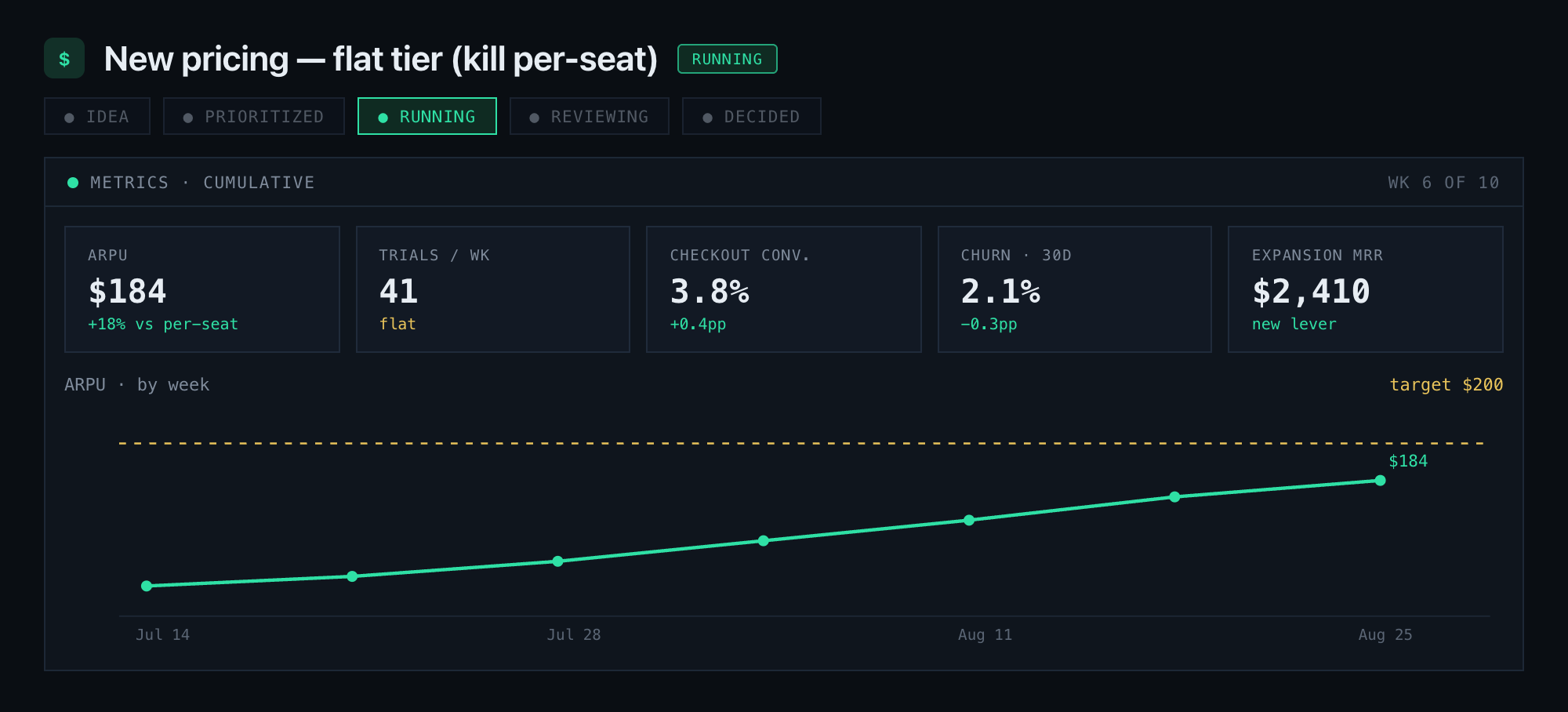
- Records live in one place instead of scattered across docs and chat threads.
- Confidence can be captured as a number, not a vague impression, so calibration can be measurable over time.
- Closed bets can end in a clear verdict instead of a story rewritten after the fact.
If your team is ready to turn decision documentation into a routine rather than a one-off exercise, see Betlog’s plan and pricing to get started.
Sources
For deeper reading: AWS’s ADR guidance for templates, the Decision Provenance Standard for audit-ready governance, and the National Academies on structured decision steps.
- Decision-making techniques | HBS Online blog
- Structured decision making steps | National Academies
- Decision Provenance Standard™ (DPS)
FAQ
What is a decision document?
A decision document is a short, timestamped record that captures the context of a choice, the options considered, the rationale behind the final decision, and its expected consequences. It typically includes an owner, a status, and a condition that triggers a future review, according to Harvard Business School Online.
What are the four types of documentation?
Definitions vary by field, but for decision records specifically, the core categories are context or problem statement, options considered, rationale for the chosen option, and consequences or trade-offs. These four fields form the backbone of both quick records and full architectural decision records.
What are examples of documented decisions?
Common examples include a product team choosing to license a vendor SDK instead of building a feature in-house, or an engineering team recording why it chose one database over another. Each example typically includes the options weighed, the stated confidence in the choice, and the metric that will confirm whether it worked.
When should a team write a decision record instead of skipping it?
A record earns its place when the decision is expensive or slow to reverse, affects more than one team, or is likely to get relitigated later without a clear reason on file. Low-stakes, easily reversible choices are better served by a one-paragraph quick record than a full write-up.
How do you avoid common pitfalls in decision documentation?
The biggest pitfall is storing records somewhere separate from daily work, which Harvard Business School Online identifies as the main driver of documentation that nobody actually reads. The second is editing old records instead of marking them superseded, which erases the original reasoning that later reviews depend on.


