Cut Fix Time 60 to 21 Days: Postmortem Questions for Teams via Decision Journals
Use focused postmortem questions plus decision journaling to produce owned, dated action items, tag fixes into your backlog, and shorten repeat‑fix time.
On this page
- Postmortem Questions for Project Reviews
- Postmortem Questions for Incident Reviews
- Running the Meeting: Checklist and Agenda
- Three Frameworks Worth Copying
- Where Decision Journaling Fits Into a Postmortem
- Adjusting Questions for Team Size and Culture
- Getting Stakeholders and Cross-Functional Teams Involved
- Common Mistakes That Turn Postmortems Into Wasted Time
- What Happens After the Meeting Ends
- Author Perspective: What I’d Fix First
- Capture the Decision Before You Judge the Outcome
- Sources
- FAQ
Use these categorized postmortem questions (project and incident) plus a short facilitation checklist to run a blameless meeting that produces verifiable action items. Ask “what happened” and “how did our systems allow it,” never “who did this.” Split your question sets by type: project postmortems need goal, scope, and planning prompts; incident postmortems need detection, impact, and timeline prompts. Route every answer into an owned, dated action item.
TL;DR:
- Most postmortems should be conducted within a week of the incident or project completion to ensure accurate recollection and effective action planning.
- Using a structured, blameless question set focused on systemic factors rather than individual blame improves insights and prevents repetitive failures.
- Involving cross-functional teams, including support and product, enriches understanding of customer impact and systemic weaknesses.
- Clear ownership, deadlines, verification, and backlog tagging are essential for action items to translate into meaningful, trackable improvements.
- Recording decision hypotheses and confidence levels before action helps distinguish between bad decisions and bad luck during postmortems.
Postmortem Questions for Project Reviews
Run a project postmortem within a week of delivery, close, or cancellation, while memory is still sharp and before the team scatters onto new work. Waiting a month turns a useful review into a vague recollection exercise.
Group your questions by what you’re actually trying to learn, not by chronology. Here’s a set you can paste directly into a survey tool or read aloud in the room.
Goals and outcome alignment
- Did we deliver what we originally set out to build, and if not, when did the target shift?
- Which success metric mattered most, and did we hit it?
- Would the sponsor call this project a win? Why or why not?
Estimates and scope
- How far off was our original timeline estimate, and where did the drift start?
- What scope got added mid-project, and who approved it?
- Which requirement took longer than expected, and what did we misjudge about it?
Roles and decision points
- Where did decisions stall waiting on one person or approval?
- Which decision would we make differently with what we know now?
- Did everyone know who owned the final call on scope, budget, and quality trade-offs?
Milestones and timeline
- Which milestone slipped first, and what caused the delay to cascade?
- Where did we lose the most time: planning, build, review, or handoff?
- What early warning sign did we notice but not act on?
Planning assumptions and risks
- What assumption turned out to be wrong?
- Which risk did we identify but underestimate?
- What information did we not have that would have changed our plan?
What worked
- What process, tool, or habit should we keep exactly as is?
- Which team interaction made the work easier, and how do we repeat it?
- What would we tell a team starting a similar project tomorrow?
That’s roughly 27 prompts. Nobody needs all of them for every retrospective. Pick eight to ten based on where the project actually struggled, and save the rest for a pre-meeting survey so people can reflect before the group discussion pulls everyone toward the loudest opinion in the room.
Postmortem Questions for Incident Reviews
Run an incident postmortem for anything that caused customer-facing impact, breached an SLA, or nearly did either. A near miss deserves the same rigor as a real outage. If a mistake almost caused damage but a lucky break stopped it, the systemic gap is still there.
Structure the questions around the incident’s actual lifecycle: what broke, who noticed, how fast, and what stopped it from getting worse.
Customer and user impact (best collected in a pre-meeting survey, since support and success teams often have data the responders don’t)
- How many users or accounts were affected, and for how long?
- What could a customer see or experience during the incident?
- Did any customer-facing communication go out, and was it accurate?
Detection and observability (meeting discussion, since this usually needs back-and-forth)
- How did we find out, and how long after the actual start of the problem?
- Did our monitoring surface the issue, or did a person notice it first?
- What alert should have fired but didn’t?
Decision timeline and dead ends (meeting discussion, captured live on a shared timeline)
- What was the first theory about the cause, and was it wrong?
- Where did the team spend time investigating something that turned out to be unrelated?
- What made someone finally identify the real cause?
Contributing factors and safeguards (pre-meeting survey plus meeting discussion)
- What conditions had to line up for this to happen?
- What existing safeguard should have caught this, and why didn’t it?
- Has a version of this happened before, even partially?
Evidence and confidence (meeting discussion)
- What logs, dashboards, or traces gave us the clearest signal?
- How confident are we in the root explanation, on a scale of low, medium, or high?
Immediate versus permanent fixes (meeting discussion, feeding directly into action items)
- What did we do to stop the bleeding, and is that fix temporary or permanent?
- What would make this exact incident impossible, not just less likely?
Running the Meeting: Checklist and Agenda
A good question list still fails if the meeting itself is disorganized. Here’s the sequence that keeps a postmortem from turning into either a blame session or a two-hour ramble.
Before the meeting:
- Send a short survey (five to eight questions) 24 to 48 hours ahead so people write down what they remember before groupthink sets in.
- Gather the raw timeline: deploy logs, alert history, chat transcripts, ticket timestamps.
- Assign a facilitator and a separate scribe. The facilitator should not be the person most responsible for the incident.
During the meeting (60 to 90 minutes):
- Summary and stakes (5 minutes): what happened, in one paragraph.
- Walk the timeline (20 minutes): build it together, correcting each other’s memory in real time.
- Deep questions (25 minutes): work through the grouped prompts relevant to this specific case.
- Decisions and actions (20 minutes): assign owners and dates before anyone leaves.
Facilitation is mostly about phrasing. Open with a line like “we’re here to find what our process missed, not who missed it.” Every question should start with “what” or “how.” A question that starts with “why didn’t you” is an accusation wearing a question mark.
Pro Tip: If a discussion starts circling one person’s name, stop and rephrase the question as a systems question out loud: “let’s ask that as ‘what made it possible for this step to be skipped’ instead.”
Action items need four things: an owner, a due date, a way to verify it’s actually done, and a tag into the main project or engineering backlog so it doesn’t die in a postmortem document nobody reopens. Untracked action items decay fast, and overdue ones need an automatic escalation path, not a hope that someone remembers.
Three Frameworks Worth Copying
You don’t need to invent a template. Three formats cover almost every situation, and picking one and sticking with it matters more than which one you pick.
The three-question framework strips everything down to what actually drives learning: what was the knowledge gap, where did detection fail, and what change would make this specific incident impossible? Centering discussion on these three pillars shifts focus from individual mistakes to systemic gaps, and it’s fast enough to run after a minor incident without feeling heavyweight.
The four-question engineering format adds structure for technical teams: what did the user experience, where did the system or mental model break down, what factors contributed, and what changes with which owners follow? Short formats that route action items into the planning backlog measurably cut repeat incidents compared to exhaustive templates nobody rereads.
The six-beat narrative format works best for major incidents worth a written account: setup, first signal, investigation, turning point, resolution, and lesson. Writing it like a story your future self can follow preserves the reasoning a bullet-point template throws away.
For a minor bug fix, use three questions. For anything customer-facing, use four. Save the narrative format for incidents worth teaching from a year later.
Where Decision Journaling Fits Into a Postmortem
Most postmortems fail at the same spot: they judge the decision by how it turned out. A launch that flopped gets called a bad call even if the reasoning was sound and the market simply moved against it. That’s “resulting,” and it teaches teams the wrong lesson every time.
Picture a pricing experiment logged as a bet before launch: hypothesis (raising the price 15% won’t hurt conversion), confidence (65%), the metric that decides it (30-day conversion rate), and what would prove it wrong. If conversion tanks, the postmortem question isn’t “who chose this price.” It’s “was the 65% confidence level reasonable given what we knew, and did the metric move for the reason we predicted?”
Two practices you can start this week: write the pre-mortem hypothesis and confidence level before you ship anything consequential, and attach every postmortem action item back to the original decision record so the next review can check whether the fix actually worked. A tool like Betlog is built around exactly this loop.
Adjusting Questions for Team Size and Culture
A five-person startup and a 200-person engineering org need the same categories of questions, but not the same format. Question count and delivery method should scale with headcount and how comfortable people already are speaking up.
Small teams (under 10) can often skip the pre-meeting survey entirely and talk through the questions live, since trust is usually high and everyone already knows most of the context. The risk here is the opposite problem: an informal culture can drift into “we all know what happened” and skip the deep questions entirely. Force at least the three core prompts (knowledge gap, detection failure, prevention) even when the room feels casual.
Larger or newer teams need the written survey more, not less. Anonymous or semi-anonymous pre-meeting responses surface things people won’t say out loud in front of a director. If your organization has a hierarchy where junior engineers rarely speak up in front of leadership, consider running the deep-question portion in smaller breakout groups first, then reporting themes back to the full group.
Distributed and cross-timezone teams should lean harder on the written survey and asynchronous timeline-building, since a synchronous 90-minute meeting across six time zones rarely gets full participation anyway. Cultures with high power distance, where challenging a senior person’s decision feels risky, benefit from having the facilitator explicitly invite dissent by name: “I want to hear disagreement on this specific point before we move on.”
Getting Stakeholders and Cross-Functional Teams Involved
A postmortem that only includes the engineers who touched the code misses half the picture. Support, sales, and customer success teams often know things about impact and customer sentiment that never make it into a system log.
Invite anyone who has direct evidence, not just direct responsibility. A support lead who fielded twelve tickets during an outage can answer the “customer impact” questions better than anyone on the technical team. A product manager can speak to the original goal alignment questions on a project postmortem better than an engineer who joined mid-build.
Keep the invite list intentional, though. Including every stakeholder in every review inflates meetings past the point of usefulness and makes people reluctant to speak candidly in front of a large audience. A workable split: core responders and decision-makers attend the live meeting, while a wider circle contributes through the pre-meeting survey and receives the final summary. Executive sponsors usually want the summary and the action items, not a seat at the detailed timeline discussion. Save that access for cases where a decision they made directly shaped what happened.
Common Mistakes That Turn Postmortems Into Wasted Time
The single most common failure is asking “who” questions dressed up as “what” questions. “What led John to skip the review step” is still an accusation with John’s name in it. Rewrite it as “what in our process made it possible to skip the review step” instead, and the answer changes from a person’s judgment to a process gap you can actually fix.
The second failure is writing exhaustive documents nobody rereads. A postmortem written for compliance rather than for the team that has to act on it gets filed and forgotten. Shorter, sharper question sets that map directly to action items beat comprehensive templates every time.
The third failure is treating a single root cause as the goal. Real incidents almost always have several contributing factors stacked together. Listing them in plural, rather than hunting for the one root cause, gives you multiple places to intervene instead of one fragile fix.
The fourth failure is vague action items like “be more careful” or “improve communication.” Neither has an owner, a due date, or a way to verify it’s done. Every action item needs a specific, testable outcome. Instead of “improve monitoring,” write “add an alert that fires when queue depth exceeds 500 for more than two minutes, verified by triggering it in staging.”
The fifth failure is running the meeting so long after the incident that nobody remembers the reasoning behind their own decisions. Reasoning captured within days is measurably more accurate than an account written weeks later, once the messy middle has been smoothed into a cleaner story that isn’t quite true.
What Happens After the Meeting Ends
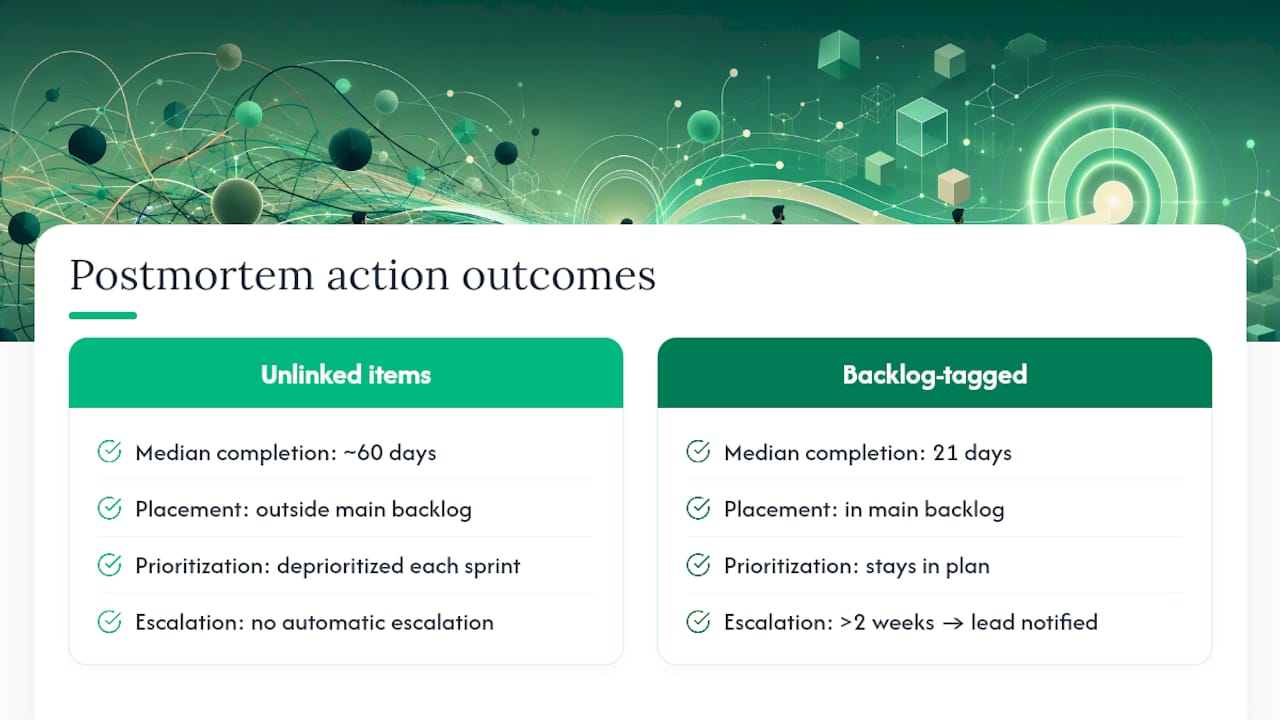
A postmortem’s value gets decided in the weeks after the meeting, not during it. Tag every action item into your team’s actual planning tool, not a separate postmortem tracker nobody checks. Items that live outside the main backlog get deprioritized the moment a new sprint starts.
Set a review checkpoint two to four weeks out specifically to check action item status, not to rehash the incident itself. At that checkpoint, ask one uncomfortable question: would an item from a previous postmortem, if it had actually been completed, have prevented this one? That single question does more to expose decaying action items than any status report.
Give overdue items an escalation path. If an action item tied to a real risk is more than two weeks overdue, it should surface to a lead or manager automatically rather than quietly sliding another sprint. Teams that tagged postmortem items into their main backlog with clear exit criteria cut median time to complete from around 60 days to 21 days.
Finally, revisit your question list itself every quarter. If certain prompts never surface anything useful, cut them. If a pattern of incidents keeps slipping past your current questions, add a targeted one aimed at that exact gap.
Author Perspective: What I’d Fix First
Most postmortems fail from neglect, not bad questions. Documents get filed, action items lose owners, and the same root cause resurfaces eight months later wearing a different symptom. Start small: run a pre-meeting survey this week instead of skipping straight to the group discussion. Next sprint, take exactly one lingering action item and force it into the real backlog with an owner and a date. On your next incident, try the six-beat narrative format instead of a bullet list and see if anyone actually reads it twice.
— Cesar
Capture the Decision Before You Judge the Outcome
Betlog gives you a place to log the hypothesis, confidence level, and success metric before a decision plays out, so your postmortem questions can separate a bad call from bad luck instead of judging everything by how it turned out. It fits directly into the meeting rhythm this article describes: a bet moves from Running to Reviewing, closes with a Won, Killed, or Inconclusive verdict, and generates its own postmortem questions tied to the original hypothesis rather than hindsight. Action items and confidence tracking live in the same record, so nothing gets lost between the meeting and the next sprint. One plan covers a team at $39 per month or $390 per year. Check the pricing page and start logging your next consequential call before you find out how it turns out.
Sources
A few sources worth bookmarking if you want to build out your own template library:
- Human error or system failure? Rethinking incident investigations in 2026
- The postmortem format that reduces incidents
- How to write a postmortem that reads like a story your future self can follow
- Incident postmortems that actually prevent repeat failures
FAQ
What are good questions to ask during a project postmortem?
Ask what outcome you set out to achieve and whether you hit it, where estimates drifted from reality, which decision you’d make differently, and what specifically should be repeated on the next project. Group them by goals, scope, roles, timeline, and wins so the discussion doesn’t wander.
What is a postmortem assessment?
A postmortem assessment is a structured review held after a project ends or an incident occurs, aimed at identifying what happened, why, and what should change. It works best as a blameless, systemic review rather than an evaluation of individual performance.
How do you run a good postmortem meeting?
Send a short survey 24 to 48 hours beforehand, assign a facilitator separate from whoever was most involved in the incident, and structure the meeting around a shared timeline followed by deep questions. Close by assigning every action item an owner, a due date, and a way to verify it’s actually complete, and tag it into your main backlog before the meeting ends.
What gets checked in a postmortem?
A postmortem checks the timeline of what happened, how and when the issue was detected, the customer or user impact, the contributing factors that allowed it, and whether existing safeguards should have caught it sooner. It also checks whether any action item from a prior postmortem could have prevented this one, which is often the most revealing question on the list.
How is a postmortem different from a decision journal review?
A postmortem examines what happened after the fact, while a decision journal like Betlog captures the hypothesis and confidence level before the outcome is known. Pairing the two lets a team ask postmortem questions against the original reasoning instead of judging a call purely by how it turned out.