45 minute Go No Go Decision Meeting: Score, Log Confidence, Learn
Practical playbook for teams running go no go decisions: use a weighted scorecard, silent scoring, and a decision journal to log confidence and learn.

On this page
- What a Go/No-Go Decision Is and Why It Matters
- When to Run a Go/No-Go Checkpoint
- Core Criteria and a Weighted Scoring Model You Can Copy
- A Step-by-Step Go/No-Go Process and Meeting Checklist
- Who Decides: Roles, Attendees, and Accountability
- Common Mistakes and Cognitive Traps to Avoid
- How to Apply Betlog’s Decision-Journal Practices to Go/No-Go Calls
- Three Rules for Teams Adopting Go/No-Go
- Keep the Receipts With a Decision Journal Built for This
- Sources
- FAQ
A go/no-go decision is a committed checkpoint where a team compares a project against predefined criteria and picks one of three paths: go, no-go, or conditional go. Run it before any commitment that could cost more than the meeting itself. The rule of thumb is simple: if being wrong would cost more than an hour of your team’s time, it deserves a formal checkpoint rather than a hallway conversation.
TL;DR:
- A formal go/no-go decision should be based on predefined criteria scored independently, with a threshold usually set at 60% to proceed.
- Use structured scoring models covering strategic fit, ROI, feasibility, resources, risks, and win probability to standardize evaluation and reduce bias.
- Run the decision meeting with silent scoring first, discuss only where scores diverge, and assign clear roles to prevent ownership ambiguity.
- Document each decision with the date, scores, rationale, and a re-decision trigger, and track initial assumptions and confidence levels in a decision journal.
- Avoid mid-meeting goalpost shifts, unrecorded dissent, and bias by pre-setting thresholds, capturing dissent reasons, and implementing decision accountability.
What a Go/No-Go Decision Is and Why It Matters
A go/no-go decision compares evidence against success criteria you set in advance, rather than deciding on gut feel in the room. That single distinction, criteria set before you look at the outcome, separates a real go/no-go ritual from a status update dressed up as a decision meeting.
Teams run this checkpoint before bidding on an RFP, launching a product, making a senior hire, or entering a new market. Each of these commits real money or time that can’t be easily recovered.
It’s also worth separating two questions people often blend together:
- Feasibility asks: can we technically do this?
- Worthiness asks: should we, given everything else competing for our attention and budget?
A project can be entirely feasible and still be the wrong bet. The checkpoint exists specifically to catch that gap. Without it, projects tend to survive on inertia alone. They become what some teams call zombie projects: initiatives that keep consuming budget and attention long after anyone can articulate why, protected mostly by the fact that stopping feels like admitting failure. A formal go/no-go ritual removes that protection and forces a real answer.
When to Run a Go/No-Go Checkpoint
You don’t need a go/no-go meeting for every decision. You need one at specific moments where the cost of being wrong exceeds the cost of the meeting itself.
- Before responding to a major RFP or proposal, when the bid preparation itself will consume significant staff time.
- At defined stage gates in a project, similar to how large institutional programs like the World Bank’s project cycle build in formal appraisal and readiness checks before committing further funding.
- Before a hire, market entry, or pricing change that would be expensive or awkward to reverse.
- When new material evidence appears mid-project, a lost key customer, a competitor’s launch, a budget cut, that changes the assumptions the original decision rested on.
- At scheduled checkpoints for long projects, so the team isn’t only reacting to bad news but proactively reassessing every quarter or milestone.
The guiding principle: run the ritual when the decision is expensive, hard to reverse, and materially uncertain. Skip it for decisions any team member could safely make alone.
Core Criteria and a Weighted Scoring Model You Can Copy
Most go/no-go failures trace back to one problem: nobody defined what “good enough” meant before the meeting started. A scoring model fixes that. It also matches the practitioner advice behind most structured decision protocols: standardize the inputs and you standardize the judgment, which cuts down on noise and bias in the room, a point backed by MIT Sloan’s research on structured assessment protocols.
Here’s a starting rubric most teams can adapt in an afternoon:
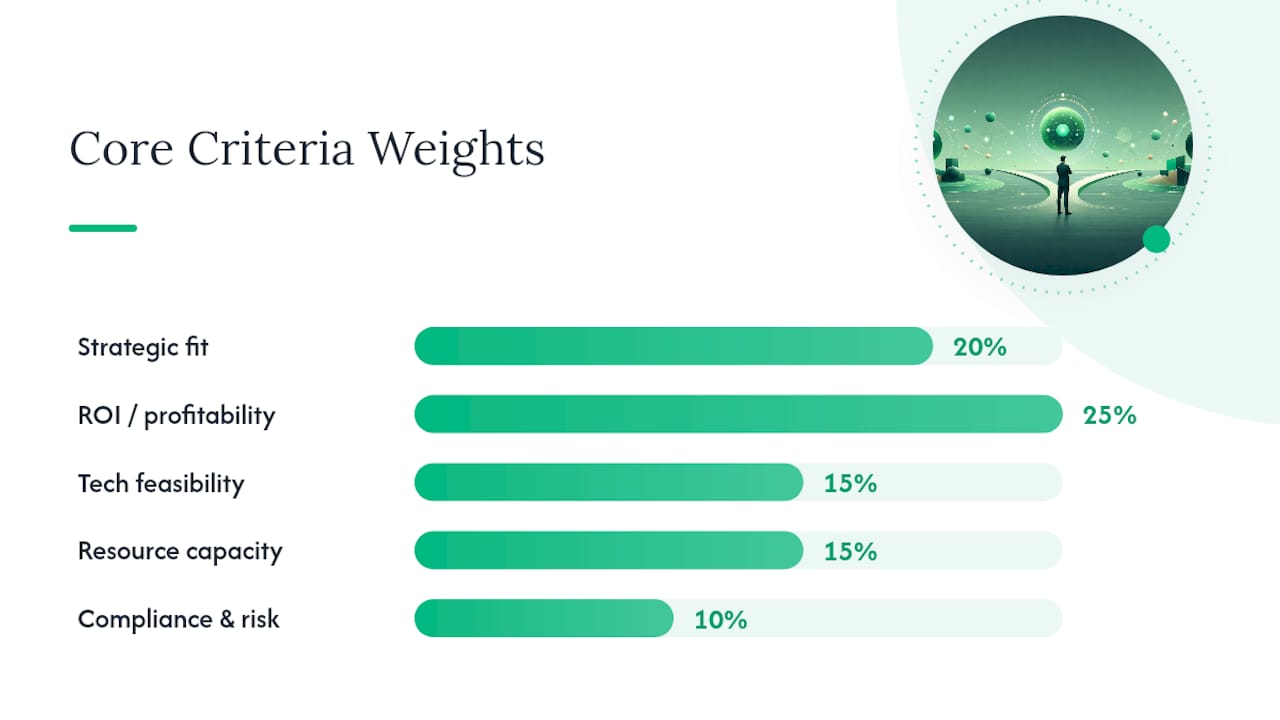
- Strategic fit (weight: 20%) — does this align with where the company is actually headed this year?
- ROI or profitability (weight: 25%) — what’s the expected return relative to the investment?
- Technical feasibility (weight: 15%) — can the team realistically build or deliver this?
- Resource capacity (weight: 15%) — do you have the people and budget without starving other priorities?
- Compliance and risk (weight: 10%) — any regulatory, legal, or reputational exposure?
- Win probability (weight: 15%) — for RFPs specifically, what’s the realistic chance of winning against the field?
Score each criterion 1 to 5, multiply by weight, and sum for a percentage. A common threshold: an average score of 60% or higher is a go, below 40% is a no-go, and the middle band is where conditional-go lives.
Conditional-go is the most underused tool in this entire process. Instead of forcing a binary choice on a score that’s genuinely uncertain, you convert the weak spot into a testable next step. Structured frameworks that use probability-based scoring and sensitivity analysis exist specifically to identify which single assumption is dragging the score down, so the team knows exactly what to test.
Pro Tip: If technical feasibility is your weakest score, don’t argue about it in the meeting. Assign a two-week technical spike, set a re-decision date, and score again with real data instead of a guess.
A Step-by-Step Go/No-Go Process and Meeting Checklist
The mechanics of the meeting matter as much as the criteria. A well-run 45-minute session with a proper packet beats a two-hour debate with none.
Before the meeting, assemble a packet containing:
- The evidence supporting each scoring criterion
- Model outputs from the weighted scorecard
- A short risk register listing the top three to five things that could go wrong
- The key assumptions the whole analysis rests on
Run the meeting in this sequence:
- Silent scoring first. Every attendee scores independently before anyone speaks, which surfaces genuine disagreement instead of letting the loudest voice anchor the room.
- Surface the gaps. Compare scores and discuss only where they diverge by more than one point.
- Discuss limits and assumptions, not the general merits of the idea.
- Tally the final score against the predefined threshold.
- Render the verdict: go, no-go, or conditional-go with a named experiment.
Document the decision immediately. A proper decision record needs the date, the final score, who attended, the verdict, the rationale in plain language, and a re-decision trigger if the verdict was conditional. Skip this step and you lose the ability to learn anything from how the decision actually played out.
Who Decides: Roles, Attendees, and Accountability
Unclear ownership kills more go/no-go meetings than bad criteria do. Before anyone scores anything, assign four roles borrowed from the RAPID framework: who recommends, who gives input, who performs the work if it’s a go, and who actually decides.
That last one matters most. One person or one clearly defined body holds the decision. Everyone else can advise, score, and argue, but a single decider prevents the classic failure mode where a “team decision” quietly becomes no decision at all because nobody wants to own a no-go call.
A few practical rules keep this honest:
- Give the decider explicit veto power, and make sure everyone in the room knows it exists before the discussion starts.
- Invite dissenting voices deliberately. If everyone in the room reports to the project sponsor, you’ll get a go every time regardless of the actual score.
- Separate seniority from evidence. The most senior person’s opinion doesn’t outscore a well-supported low score from someone closer to the technical reality.
Pro Tip: If your organization struggles with authority bias in these meetings, have the most junior qualified person present their score first, before rank has a chance to anchor the room.
Common Mistakes and Cognitive Traps to Avoid
Three failure patterns show up in nearly every broken go/no-go process, and all three have the same fix: discipline applied before the meeting, not during it.
- Sunk-cost thinking and resulting. Teams keep funding a project because of what’s already been spent, or judge a past decision as “good” purely because it happened to work out. Predefined criteria and a timestamped packet stop both, because the rationale exists in writing before anyone knows the outcome.
- Moving the goalposts mid-meeting. Someone doesn’t like the score, so the threshold quietly shifts. Lock the pass/fail threshold in the packet before scoring begins, and treat it as fixed.
- Skipping dissent capture. If the vote was 4 to 2, write down who voted which way and why. That record is the only thing that lets you tell, months later, whether the dissenters were right.
Practitioner guidance consistently points to the same fix for all three: pre-set thresholds, silent scoring before discussion, and a written record of disagreement, not just the final verdict.
How to Apply Betlog’s Decision-Journal Practices to Go/No-Go Calls
A go/no-go scorecard tells you whether to proceed. It doesn’t tell you, six months later, whether your reasoning was actually sound or whether you got lucky. That’s a different problem, and it’s the one a decision journal solves.
Treat every go/no-go call as a bet worth documenting in full:
- Hypothesis: what you believe will happen if you proceed.
- Expected outcome: the specific, measurable result you’re aiming for.
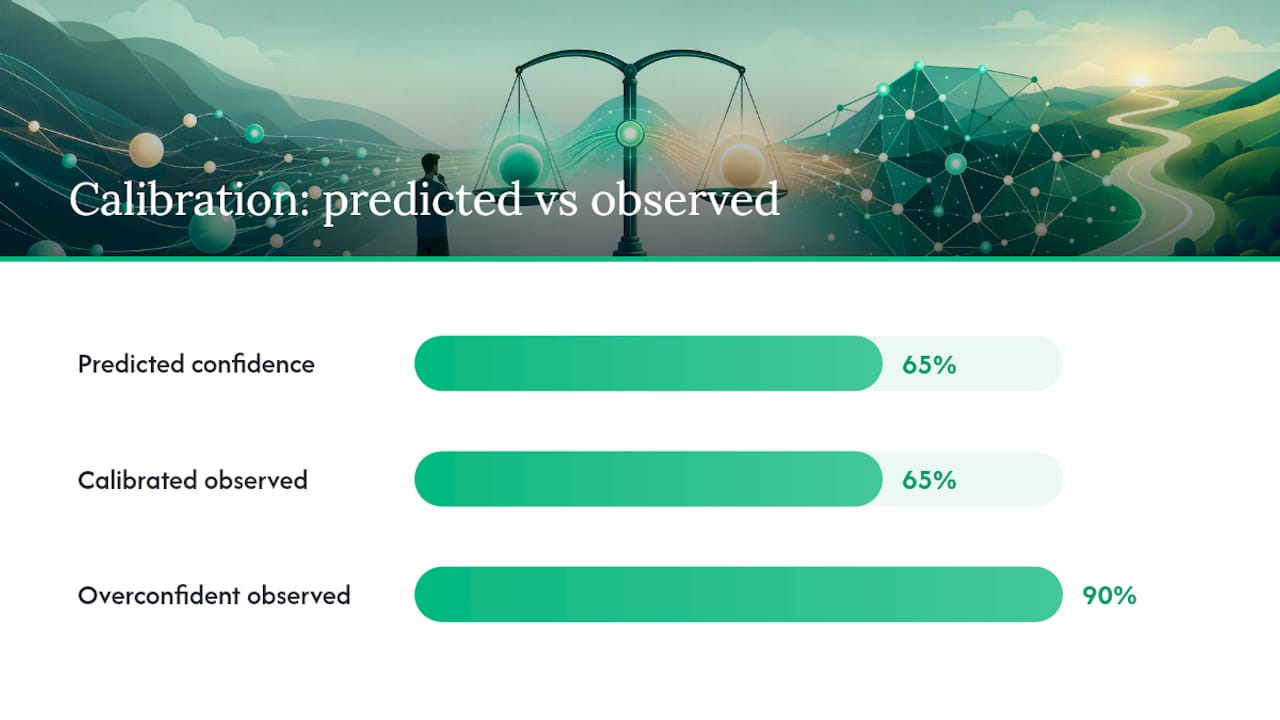
- Confidence as a probability: not “I think it’ll work,” but “I’d put this at 65%.” Betlog captures this as a number specifically so it can be checked later against reality.
- Trade-offs accepted: what you’re deliberately giving up by choosing this path.
- Decision metrics: the exact numbers that will tell you if you were right.
Move the bet through honest lifecycle stages, Idea, Running, Reviewing, Decided, instead of letting the story get rewritten in hindsight once you know how things turned out.
Pro Tip: After the verdict lands, run an outcome fielding pass: was the result skill, luck, or both? A team whose 65%-confidence bets win roughly 65% of the time is calibrated. One that wins 90% of the time it called 65% is probably underestimating its own certainty.
Three Rules for Teams Adopting Go/No-Go
Start small: pick one upcoming decision, not your whole pipeline. Set the threshold in writing before you score anything. And when a call lands borderline, don’t debate it into a false certainty, convert it into a two-week experiment with a fixed re-decision date instead.
— Cesar
Keep the Receipts With a Decision Journal Built for This
Decision journal tools give you the mechanics this article just walked through in a form your team will actually use every time, not just when someone remembers to. Every go/no-go call gets logged with its confidence probability, its trade-offs, and its decision metrics, timestamped before the outcome is known. That single detail is what prevents hindsight bias from quietly rewriting your team’s history six months later.
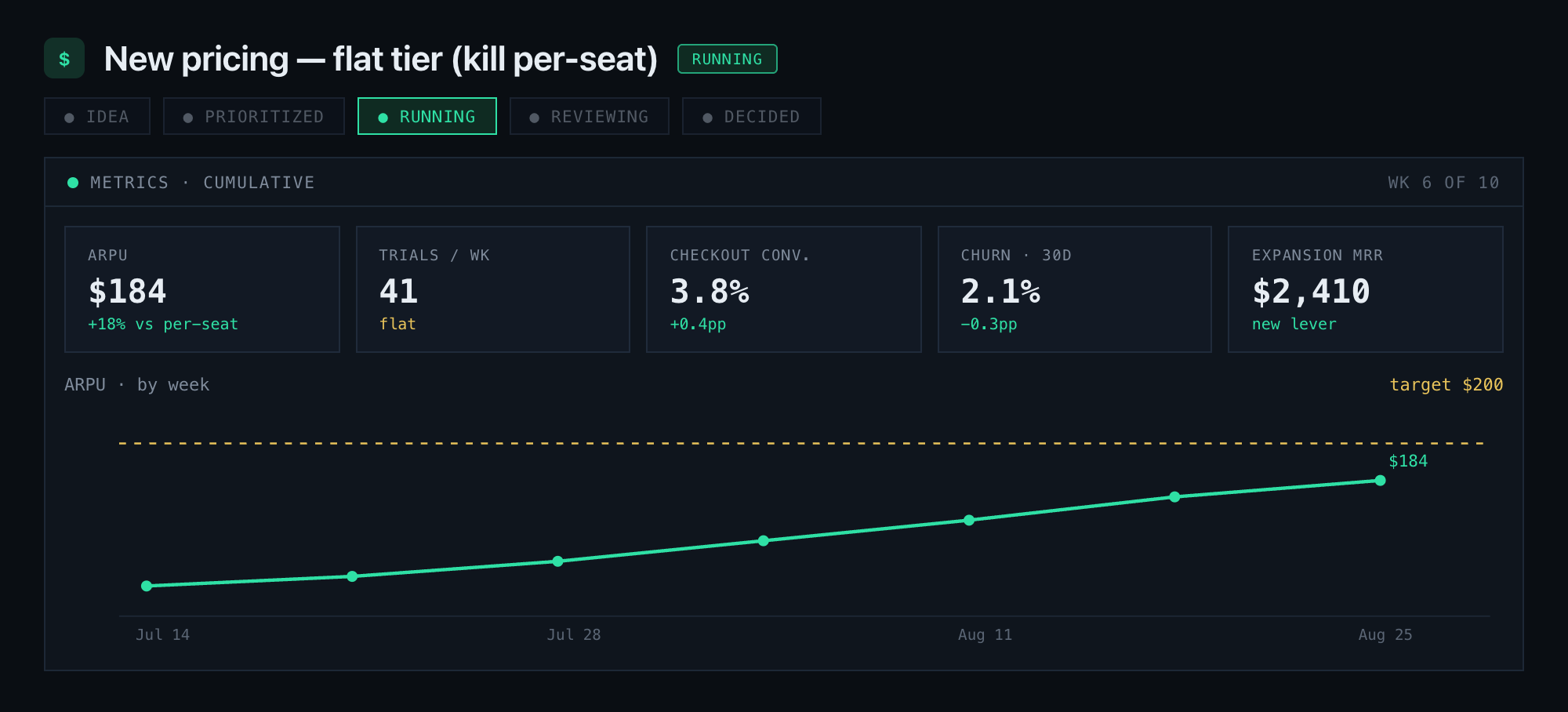
If your team runs go/no-go meetings but has no record of what was actually believed at the time, or why, that’s the gap worth closing first. Teams juggling their own review cadence alongside broader portfolio governance often lean on outside help too. Firms like The Strategy Haus advise on where structured checkpoints fit into program governance. Once the ritual is running, the missing piece is usually the paper trail. Start a trial on Betlog and log your next go/no-go call before the meeting, not after.
Sources
- Go/No-Go Decision Framework | Quantify Risk Before You Commit | Incertive
- Go/No-Go Decisions | MindTools
- A structured approach to strategic decisions | MIT Sloan Management Review
FAQ
What Does “Go/No-Go Decision” Mean?
It’s a formal checkpoint where a team compares a project or proposal against predefined success criteria and chooses to proceed (go), stop (no-go), or proceed conditionally pending more evidence (conditional go).
What Are Go/No-Go Criteria?
They’re the specific, weighted factors used to score a decision, typically strategic fit, ROI, technical feasibility, resource capacity, compliance risk, and win probability for competitive bids.
What Are Typical Go/No-Go Decisions?
Common examples include whether to respond to an RFP, launch a new product, enter a new market, make a senior hire, or continue funding a project at a stage gate.
What Are Examples of Go/No-Go Criteria in Practice?
A software company might score a new feature on customer demand, engineering effort, and revenue impact, while a services firm bidding on an RFP might weight win probability and profit margin most heavily, with a passing threshold set at 60% before the scoring even starts.
How Do You Avoid Bias in a Go/No-Go Meeting?
Use silent scoring before discussion so no one anchors the room, lock the pass/fail threshold before anyone sees the scores, and record dissenting votes with their rationale, a practice Betlog builds into its decision-logging workflow by timestamping confidence levels before outcomes are known.