6 Tests That Force Disconfirming Evidence for Product Teams
Product teams: use six negative tests, premortems, and a decision journal to surface disconfirming evidence and learn faster from your bets.

On this page
- What disconfirming evidence is and why the asymmetry matters
- Why people ignore or reinterpret disconfirming evidence
- Where ignoring counterevidence actually costs you
- How to actively search for disconfirming evidence
- Common barriers to updating beliefs and how to beat them
- How a decision journal puts this into practice
- A simple ritual worth adopting this week
- Turning this into a repeatable team habit
- Sources
- FAQ
Disconfirming evidence is any observation or data point that contradicts a hypothesis or claim, and it carries more logical weight than confirming evidence because a single credible counterexample can overturn a universal statement that a thousand confirmations never fully prove. That asymmetry is the backbone of good testing, in a lab or in a product roadmap. Later sections walk through how to actually find and use this kind of evidence before it finds you.
TL;DR:
- Most teams fail to actively seek disconfirming evidence because of confirmation bias, leading to fragile conclusions based only on supportive cases.
- Motivated reasoning and social pressures often cause individuals to reinterpret or dismiss data points that contradict their beliefs.
- Conducting pre-commitment negative tests and framing hypotheses as probabilities with specific falsification criteria significantly improve the chances of uncovering real evidence against assumptions.
- Implementing structured dissent, premortems, timestamped decisions, and habit-forming routines helps teams consistently challenge their beliefs and avoid reinforcement of biases.
- Using a decision journal or tools like Betlog embeds disconfirmation steps into the regular process, ensuring that negative evidence is considered before outcomes are final.
What disconfirming evidence is and why the asymmetry matters
Disconfirming evidence is a fact, result, or observation that contradicts what a hypothesis predicts. Confirming evidence supports a claim; corroborating evidence is confirming evidence that survived a genuine attempt to prove the claim false. Karl Popper argued that no number of confirmations can prove a universal claim true, since the next instance might break it, while one solid counterexample can refute it outright. That is why he placed falsifiability at the center of what separates a scientific claim from one that simply sounds plausible, as laid out in his conjectures and refutations.
The practical consequence shows up anywhere someone tests a belief against reality.
- Confirming evidence feels satisfying but is cheap: almost any hypothesis can collect some.
- Corroborating evidence only counts when the test could have failed and did not.
- Disconfirming evidence is the one result that forces a real update, not just a reassurance.
Teams that only chase confirmations end up with fragile conclusions built on cases that happened to go their way.
Why people ignore or reinterpret disconfirming evidence
The gap between knowing this logic and acting on it is almost entirely psychological. Motivated reasoning, described in Ziva Kunda’s review, shows that people do not passively fail to notice disconfirming evidence: they actively reinterpret it to protect a preferred conclusion, reaching for whichever belief, rule, or argument lets them keep what they already wanted to believe.
The Wason selection task showed decades ago that most people, when given a free choice of which evidence to examine, pick the test most likely to confirm their rule rather than the one most likely to break it, a pattern replicated in Wason’s original study and in later work. The bias is not just cognitive. Identity, emotion, and social belonging raise the stakes of being wrong in public, which makes a counterexample feel like a personal threat rather than useful information.
- Confirmation bias in test selection means people rarely design a test that could prove them wrong.
- Identity protection turns disagreement with a belief into a perceived attack on the person holding it.
- Being knowledgeable does not immunize anyone: a narrative review of science denial finds that motivated cognition and emotion drive rejection of well-established findings regardless of education level.
Where ignoring counterevidence actually costs you
Popper’s own standard was that a scientific claim has to specify, in advance, what observation would prove it false. A theory that predicts everything, and therefore nothing it could fail to explain, is not being tested at all.
- Scientific refutation: a prediction that specifies a precise, falsifiable outcome, then gets dropped the moment an experiment contradicts it, is the model Popper held up against vague theories that explain any result after the fact.
- Manufactured doubt: industries facing unfavorable findings have historically funded counter-studies and amplified uncertainty rather than updating, a pattern the science denial literature ties to motivated cognition rather than genuine scientific dispute.
- A roadmap hypothesis under test: a team believes a new onboarding flow will raise activation, runs the test, and watches activation drop instead. That single result outweighs months of internal confidence in the original design.
- A negative test that saved time: a team that first ran a small, cheap experiment designed to kill a pricing idea found the drop-off it predicted, and skipped a quarter of wasted build time on a feature nobody would have paid for.
How to actively search for disconfirming evidence
Looking for confirmation is the default. Looking for the evidence that would kill your idea takes a procedure, not just good intentions.
- Design a negative test first. Before you build anything, ask what result would prove the hypothesis wrong, and run the cheapest experiment that could produce that result.
- Ask which hypotheses a result would eliminate, not just which ones it supports. This flips the question that Wason’s successors found most people skip by default.
- Run a premortem. Before committing to a bet, have the team imagine it already failed and write down the most plausible reasons, which surfaces objections people would otherwise self-censor.
- Bring in structured dissent or a red team. A party with no stake in the outcome, internal or external, can attack the reasoning without the emotional investment that blocks the original team.
- Write the hypothesis as a probability, not a hunch. State your confidence as a number, say 70%, and name the specific metric that would falsify it, the same discipline traders use when they backtest a strategy against data instead of trusting a gut feeling.
- Timestamp the bet before the outcome is known, and set a rule for what you will do if the falsifying result shows up, so there is no room to quietly redefine success afterward.
Pro Tip: Write “what would prove this wrong” directly into your planning document, not as an afterthought after the result comes in.
Proceduralizing the search for failure, as Kareev and Halberstadt’s work suggests, turns disconfirmation from an occasional act of willpower into a routine step nobody skips.

Common barriers to updating beliefs and how to beat them
Even with a good process, the moment a disconfirming result lands is when most teams quietly backslide.
- Motivated reasoning and identity protection make a bad result feel personal: depersonalize it by critiquing the bet, not the person, and use a Ulysses contract that locks in the falsifying condition before anyone has a reason to wriggle out of it.
- Hindsight bias lets people claim “I knew it all along” after the fact: a timestamped premortem and decision record closes that door, since the original prediction is on file.
- Groupthink suppresses the one person who noticed the problem early: an anonymous challenge round before a decision is finalized gives dissent a safe channel.
- Emotional tilt after a loss pushes people toward rash reversals or stubborn denial: a short cooldown before the post-mortem keeps the analysis from being written in anger or relief.
How a decision journal puts this into practice
A written process only works if it is actually followed every time, which is the gap Betlog is built to close. Bets move through five stages, Idea, Prioritized, Running, Reviewing, and Decided, and the disconfirming question gets asked at the start, not the end.
- Every bet captures a confidence level as a probability, not a vague feeling, so the eventual result can be checked against it.
- A required field asks what would prove this wrong, forcing the negative test to exist before the outcome does.
- Defined metrics are locked in at the start, removing room to redefine success after the fact.
- Closed bets get an honest verdict, Won, Killed, or Inconclusive, plus a post-mortem that separates skill from luck instead of crediting every win to judgment.
More on the methodology is on the Betlog site.
A simple ritual worth adopting this week
The single change that helps most teams is not a bigger framework, it is a standing habit: run a short premortem before any bet that would be expensive to get wrong, and ask out loud what result would kill it. Accuracy, not being right, is the actual goal. A team that gets comfortable being wrong in public, on the record, learns faster than one that only celebrates its wins.
— Cesar
Turning this into a repeatable team habit
Most teams know they should look for disconfirming evidence and still skip it under deadline pressure, because the habit has no home. Betlog gives it one: every bet logged in the tool asks for the hypothesis, a confidence percentage, the metrics that will decide it, and what would prove it wrong, before the outcome is known.
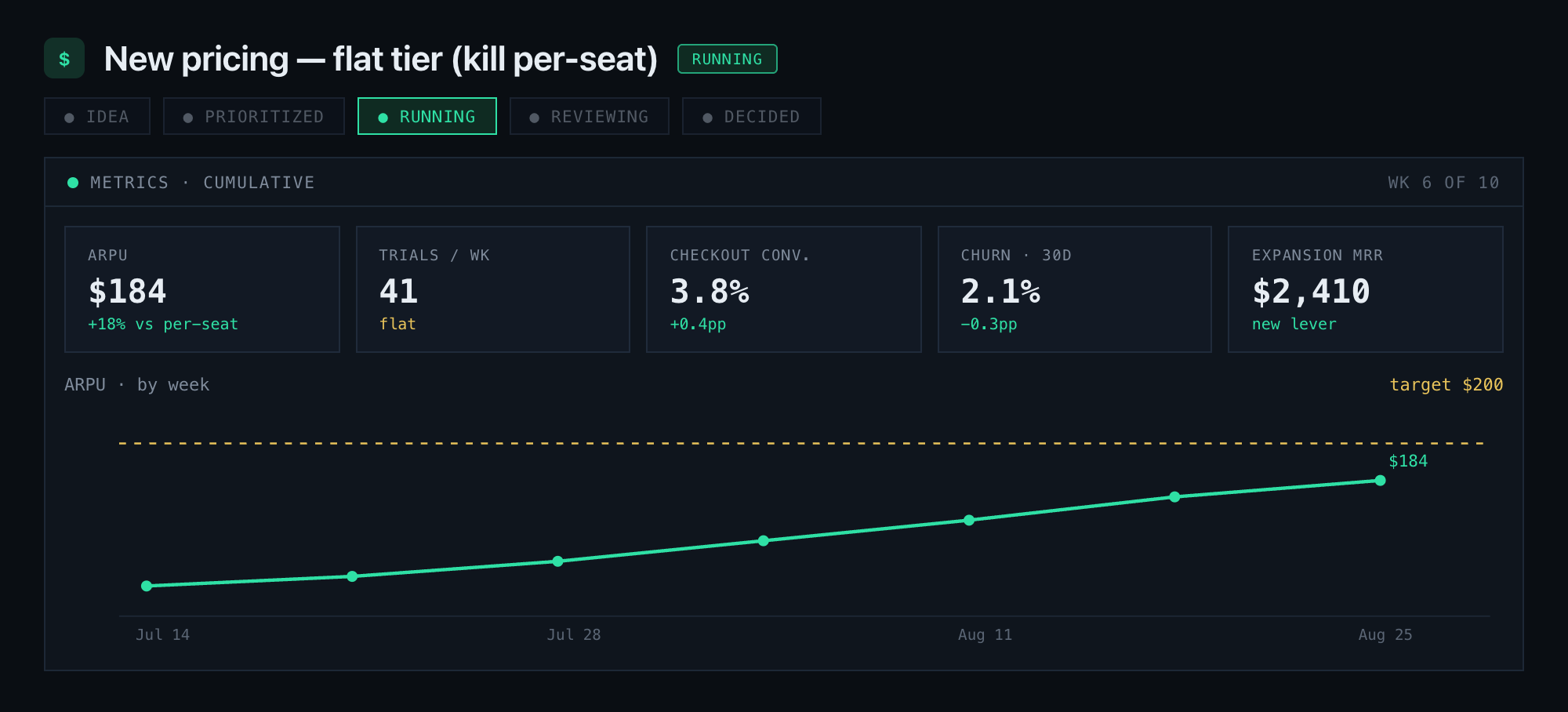
That structure does the work a premortem and a post-mortem would otherwise require someone to remember to run. Reviews surfaced in consulting work on structured opposition point the same way: outside or independent challenge catches what internal confidence misses, and a permanent record is what makes that challenge stick instead of fading after the meeting ends. Betlog runs on one plan, $39 per month or $390 per year, for teams ready to put their bets, and their disconfirming tests, on the record.
Sources
For the philosophical foundation, see Popper’s conjectures and refutations. On the psychology, Kunda’s review of motivated reasoning and the original Wason selection task cover the mechanisms, while the Hogrefe review of science denial covers how these play out at scale.
- Science: Conjectures and Refutations (Karl Popper excerpt PDF)
- Motivated reasoning: A review of theory and research (Kunda) — PubMed
- Science denial: A narrative review and recommendations — European Psychologist (Hogrefe)
- Wason’s rule discovery task and tests of confirmation bias — original task PDF
FAQ
What is denying contrary evidence?
Denying contrary evidence means dismissing, reinterpreting, or explaining away information that contradicts a belief instead of updating that belief. Kunda’s research shows this is often an active process of motivated reasoning, not simple oversight.
How does disconfirming evidence differ from confirming evidence?
Confirming evidence supports a claim but can never fully prove a universal one true, while a single credible disconfirming instance can logically refute it. This asymmetry, central to Popper’s falsifiability, is why scientists design tests aimed at breaking a hypothesis rather than only supporting it.
Why do people prefer confirming evidence over disconfirming evidence?
People tend to pick tests that could confirm a belief rather than ones that could break it, a pattern documented in the Wason selection task. Identity, emotion, and social pressure make a counterexample feel threatening, which pushes people toward comfortable confirmation instead.
What practical steps help a team find disconfirming evidence?
Writing a hypothesis down with a numeric confidence level, naming what result would prove it wrong, and running a premortem before committing are the core steps. Tools like Betlog build those fields into the decision process itself so the negative test happens before the outcome, not after.


