expected value decision making
Founders: run a 6 step expected value worksheet, check the worst 5–10% outcomes, and log forecasts with Betlog to improve calibration.

On this page
- What Expected Value Actually Means
- How to Calculate EV, Including on a Decision Tree
- When Raw EV Leads You Wrong
- A Practical EV Worksheet You Can Copy
- How Betlog Turns This Worksheet Into a Habit
- Expected Value in Finance, Health, and Project Work
- Accounting for Costs That Are Not Measured in Money
- Where Your Probabilities Should Come From
- Cognitive Biases That Distort Expected Value
- Expected Value Versus Maximin and Minimax Regret
- Expressing and Tracking Probabilities Over Time
- Why I Lean on EV Less Than Most People Expect
- Put This Into Practice With Betlog
- FAQ
- Sources
Expected value turns uncertain outcomes into a single number you can act on: use it when a decision is repeatable, marginal, or close to a coin flip, and you can put real numbers on probabilities and payoffs. Skip raw expected value, or adjust it, when one outcome could wipe you out, or when the stakes are too personal for a spreadsheet to capture. The worksheet further down shows exactly how to run the math and when to override it.
TL;DR:
- Raw expected value can be misleading in situations with catastrophic risks or irreversible outcomes, requiring additional survival checks before proceeding.
- Use probability ranges rather than single estimates and record them before starting calculations to improve calibration and decision accuracy over time.
- The decision should be weighted more heavily on the potential to stay solvent or avoid disaster, especially when outcomes are severe or the decision is one-off.
- Incorporate non-monetary costs like reputation and team morale within multi-criteria EV calculations to reflect the true impact of decisions.
- Running the EV worksheet repeatedly, tracking assumptions, and reviewing outcomes builds better judgment and reduces cognitive biases like overconfidence and anchoring.
What Expected Value Actually Means
Expected value (EV) is the probability-weighted average of every possible outcome of a decision. You multiply each outcome’s payoff by its probability of happening, then add the results together. That single number tells you what a decision is worth on average if you faced it many times.
Picture a simple gamble: a coin flip pays $150 on heads and costs $100 on tails.
- Heads: 0.5 × $150 = $75
- Tails: 0.5 × (-$100) = -$50
- EV = $75 minus $50 = $25
Take that bet every time you can, because the average outcome favors you by $25 per flip. That is EV in its purest form: payoff times probability, summed.
Expected value is not the same as expected utility. A dollar means less to you once you already have a lot of them, and a loss can hurt more than an equivalent gain helps. Expected utility theory adjusts the math for that curve, which matters most when the stakes stop being pocket change.
How to Calculate EV, Including on a Decision Tree
Four steps cover almost any EV calculation:
- List every realistic outcome of the decision, including the ones you would rather ignore.
- Assign a value to each outcome in whatever unit matters: dollars, hours saved, users gained.
- Assign a probability to each outcome, making sure they sum to 100%.
- Multiply each value by its probability and add the products together.
A decision tree just organizes this visually. Say you are deciding whether to launch a paid feature. EMV for Branch A is (0.4 × $50,000) minus (0.6 × $5,000), or $20,000 minus $3,000, which nets $17,000.
Before committing, ask what it would be worth to remove the uncertainty entirely: that is the expected value of perfect information, or EVPI. If a $2,000 user survey could tell you with certainty which branch wins, and the information would change your decision, paying for it beats guessing. If the survey costs more than the swing in EV it could protect, skip it.
When Raw EV Leads You Wrong
A positive EV does not automatically mean you should take the bet. Betting your entire runway on an 85% chance to triple it is positive EV and still reckless, because the 15% outcome ends the company. Experimental evidence from Darden shows people routinely prefer a certain $800 over an 85% chance at $1,000, even though the gamble’s EV is higher. That preference is not irrational: it reflects how much a guaranteed loss would hurt relative to an equivalent gain.
- EV treats every dollar as equal, but a dollar that keeps you solvent is worth more than a dollar of extra upside.
- Catastrophic, irreversible outcomes deserve a floor check before an EV check: can you survive the worst case even once?
- Expected utility theory replaces raw dollars with a value curve that bends as stakes rise, which better matches real decision-making.
One useful rule of thumb comes from the Kelly criterion, a staking formula used for repeated positive-EV bets that sizes each bet to maximize long-run growth while limiting ruin risk.
A Practical EV Worksheet You Can Copy
Before you trust an EV number, build it from the ground up instead of pulling a probability out of the air.
- Name the metric. State exactly what you are forecasting: revenue, retention, conversion rate, time saved.
- Anchor on a base rate. Find the closest comparable case you have data on, and start there instead of from a gut feeling.
- Express a range, not a point estimate. Give a 50%, 80%, and 95% confidence range for the outcome. If you are only 50% sure the number falls between 10% and 15%, say so.
- Compute the EV across your listed outcomes and probabilities using the four-step method above.
- Run a survivability test. Ask what happens in the worst 5% to 10% of outcomes, and whether you can absorb it.
- Set a review date. Decide when you will check the forecast against reality, not just whether it “felt right.”
A forecast only counts if it is checkable: it needs a claim, a timeframe, and a metric. “Revenue will probably grow” is not checkable. “Monthly revenue exceeds $40,000 by June 30” is.
Pro Tip: Write your probability range down before you start the work, not after you see early results. It is the only way to find out later whether you were actually right or just lucky.
That log is what turns guessing into calibration over time.
How Betlog Turns This Worksheet Into a Habit
A worksheet only works if someone revisits it, which is the part most teams skip. We built Betlog to record the parts of a decision that normally live in someone’s head or get rewritten by hindsight once the outcome is known.
- We capture the hypothesis, the confidence level as an actual probability, the trade-offs accepted, and the metric that will decide the bet, all before the outcome is known.
- Bets move through explicit stages (Idea, Prioritized, Running, Reviewing, Decided) so nothing quietly disappears or gets reframed after the fact.
- Every closed bet ends in a post-mortem that separates whether the decision was sound from whether it happened to work out.
Calibration is the payoff. Calibration research shows these miscalibration patterns are common and predictable, which is exactly why timestamped logs matter more than memory.
Pro Tip: Log a pricing test or a hire the same way: hypothesis, confidence, metric, review date. Watching a hire move from Running to Reviewing with the original reasoning intact is a faster way to learn than any retrospective conversation held after the fact.
Expected Value in Finance, Health, and Project Work
The math stays identical across fields; only the inputs and the tolerance for bad tails change.
In health decisions, EV shows up in screening and treatment choices, where a low-probability, high-cost outcome (a missed diagnosis) often outweighs a higher-probability, low-cost one, which is why clinicians weigh consequences as heavily as likelihood rather than optimizing for the average case alone.
In project management, EV shows up as a rough forecasting tool: multiply the probability of hitting each milestone on time by the cost of delay, and you get a number that tells you where to put contingency budget.
The common thread across all three fields: EV is strongest wherever the decision repeats, or where the sample size is big enough that the average outcome is what actually matters, like a portfolio of trades, a population of patients, or a backlog of features. It gets weaker the closer you get to a single, irreversible decision with a severe downside.
Accounting for Costs That Are Not Measured in Money
Plenty of real decisions involve payoffs that do not convert cleanly into dollars: reputation, team morale, time, customer trust. A purely monetary EV calculation will quietly ignore these, which can lead you to a number that looks right and isn’t.
Multi-criteria expected value handles this by scoring each outcome across more than one dimension, then weighting the dimensions before combining them. You might assign the support strain a value of negative $8,000 worth of team capacity, even though no invoice says so, and fold that into the same calculation.
The practical version: list the outcomes, score each one on every dimension that matters to you (revenue, time, reputation, team capacity), assign a rough dollar-equivalent weight to the non-monetary dimensions, and then run the same probability-weighted sum. It will not be precise, but a rough number that includes the real costs beats a precise number that ignores them.
Where Your Probabilities Should Come From
An EV calculation is only as good as the probabilities feeding it, and most people pull numbers out of thin air instead of grounding them.
Start with the base rate: how often has this type of decision worked out in the past, for you or for comparable cases? If you have never run a pricing experiment, look at how similar changes performed elsewhere before assigning a probability from scratch. Research on expert forecasting finds that experts routinely neglect base rates in favor of case-specific stories, which tends to make forecasts overconfident.
When no clean base rate exists, break the decision into smaller pieces you can estimate individually, then combine them. A launch’s success probability might split into “will the feature ship on time” times “will users adopt it” times “will adoption translate to revenue,” each easier to estimate than the combined question. Comparing your estimate against similar past decisions, sometimes with outside help from someone who has seen more comparable cases than you have, such as the historical reference classes consultants use when sizing a new strategy, tends to sharpen the number further.
Cognitive Biases That Distort Expected Value
The math is simple. The inputs are where things go wrong, usually in predictable directions.
Overconfidence inflates the probability you assign to the outcome you want, which quietly inflates the EV in your favor before you have run a single number. Hindsight bias works the opposite direction after the fact: once you know how a bet turned out, it feels like you always knew the odds, which erases the chance to learn anything from the gap between your forecast and reality. Resulting, judging a decision purely by its outcome rather than by the quality of the reasoning behind it, is closely related: a good bet that loses gets treated as a bad decision, and a reckless bet that wins gets treated as skill.
Anchoring on the first number you see, whether it is your own initial guess or someone else’s, biases every probability that follows it. Calibration research also points to a common pattern where people overpredict rare events and underpredict common ones, a bias worth checking for directly when a probability feels unusually round, like exactly 50% or exactly 90%. The fix for most of these biases is the same: write the probability down before you know the outcome, and compare it against reality later instead of trusting your memory of what you expected.

Expected Value Versus Maximin and Minimax Regret
EV is not the only framework for deciding under uncertainty, and it is worth knowing when another one fits better.
Maximin picks the option whose worst-case outcome is the least bad, ignoring probabilities entirely. It fits decisions where the downside is severe enough that the average outcome barely matters, such as choosing a vendor when one option’s worst case is an outage and another’s worst case is a late invoice. Minimax regret instead picks the option that minimizes your maximum regret: it asks, for each choice, how much worse off you would feel compared to the best possible choice in that same scenario, and picks the option with the smallest such gap across all scenarios.

EV outperforms both when probabilities are reasonably well known and the decision repeats often enough for averages to matter, like a portfolio of marketing experiments. Maximin and minimax regret earn their place when probabilities are murky, the decision happens once, or a bad outcome is not just costly but existential. A founder picking between two acquisition offers with uncertain integration risk might lean on minimax regret rather than EV, since the probabilities are shaky and the wrong call is a one-time event with no do-over.
Expressing and Tracking Probabilities Over Time
A probability is only useful if it is specific enough to be wrong. “Likely” and “probably” hide more than they reveal, so translate them into a number or a range every time.
Calibration studies based on Random Support Theory show that expressing ranges rather than single-point guesses catches a meaningful share of the miscalibration that point estimates hide.
Either way, the only way to find out is to keep a record instead of relying on memory, which tends to round every past forecast toward whatever actually happened.
Why I Lean on EV Less Than Most People Expect
I use EV freely for anything repeatable: pricing tests, ad spend, feature experiments. For one-off, hard-to-reverse calls, like a cofounder split or a major pivot, I weight optionality and reversibility over the raw number, because a single bad tail can end the thing EV was supposed to help. For runway-sensitive bets, fractional Kelly keeps me from betting the number I calculated with more confidence than the input probabilities deserve.
— Cesar
Put This Into Practice With Betlog
Running the EV worksheet once is useful. Running it every time a real decision comes up, and actually checking the results later, is what builds calibration. We built Betlog to make that second part effortless instead of something that quietly stops happening after the first few weeks.
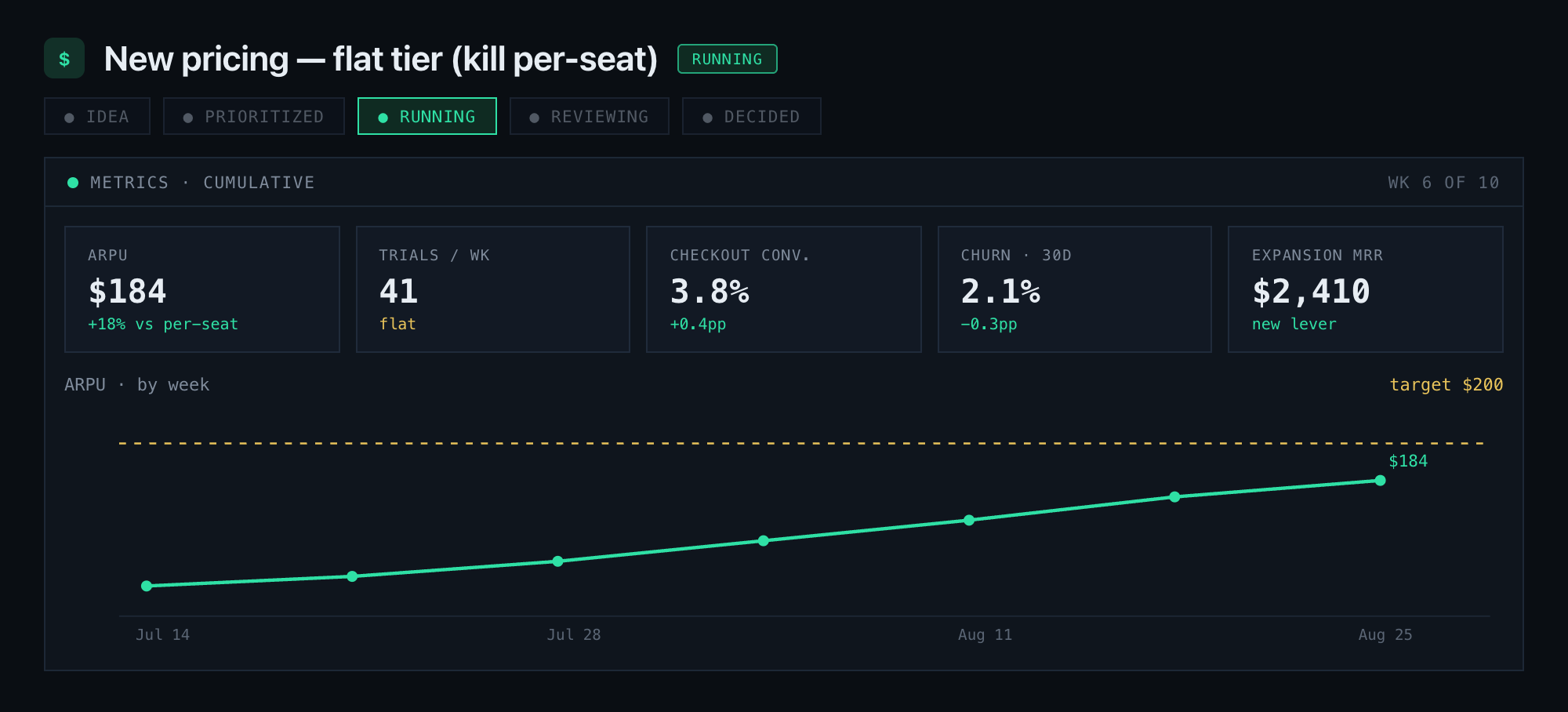
- We record the hypothesis, the confidence level as a real probability, and the trade-offs accepted before anyone knows the outcome.
- Bets move through clear stages (Idea, Prioritized, Running, Reviewing, Decided) so nothing gets reframed in hindsight.
- Every closed bet gets a post-mortem that separates whether the call was sound from whether it happened to work out.
Check Betlog pricing for the current plan, or look at the full Betlog workflow before you commit your team to it.
FAQ
What is the formula for calculating EMV?
Expected monetary value (EMV) is the sum of each outcome’s payoff multiplied by its probability of occurring. For a decision with outcomes $A$ and $B$, EMV equals (probability of $A$ × payoff of $A$) plus (probability of $B$ × payoff of $B$), continued for every possible outcome.
How do you calculate the EVPI?
The expected value of perfect information (EVPI) is the difference between the expected value of a decision made with perfect information and the expected value of the best decision made under current uncertainty. In practice, it tells you the maximum amount worth paying to remove the uncertainty before acting, as practical guidance on expected value notes when weighing whether more research is worth its cost.
How do you calculate expected value?
Multiply each payoff by its probability, then add the results together to get the expected value.
How do you calculate expected value on a decision tree?
Work backward from each branch’s endpoint: multiply the payoff at each endpoint by the probability of reaching it, then sum those products for every endpoint on that branch to get its expected monetary value. Compare the EMV of each branch at the decision node and the higher number indicates the stronger choice, though a survivability check on the worst-case branch is worth running before committing.


