Decide Faster with Incomplete Information: 5 Steps for Founders
A practical five-step workflow founders and small product teams can use to decide with incomplete information. Includes bias fixes, a worked example, and...

On this page
- Frameworks for deciding without full information
- A step-by-step workflow for deciding on partial information
- The biases that wreck decisions made under uncertainty
- When more research is actually worth the wait
- A worked example: one bet from hypothesis to post-mortem
- What founders keep getting wrong about uncertainty
- Make this repeatable with a decision journal
- FAQ
- Sources
When you lack perfect information, treat the choice as a calibrated bet: state your hypothesis, record a numeric confidence, pick an experiment sized action, and schedule an honest post-mortem. This is the core of thinking in probabilities rather than certainties. A premortem can sharpen the hypothesis before you commit, and a decision journal can hold the record so you judge the choice by its reasoning, not just by luck.
TL;DR:
- Reversible and low-stakes decisions benefit from quick probability estimates rather than thorough research, while irreversible, high-stakes decisions require premortems and defined thresholds.
- Writing down hypotheses, confidence levels, and kill criteria before testing helps prevent bias and separates skill from luck in decision outcomes.
- Conducting honest post-mortems and recording confidence before seeing new data improve decision accuracy and reduce hindsight and confirmation biases.
- Most teams over-research unnecessary information; focus on questions that could change your next action and skip lengthy investigations if outcomes won’t influence your decision.
- Using a decision journal or structured tool like Betlog ensures consistent tracking of assumptions and outcomes, fostering better calibration over time.
Frameworks for deciding without full information
Three frameworks cover most situations where information is thin. Pick based on how reversible the decision is, how urgent it feels, and how many people need to agree.
A premortem asks your team to imagine the decision has already failed, then write down why. Teams that run this exercise individually first, then share aloud, surface more distinct failure modes than teams that brainstorm together from the start, and studies of the technique found no meaningful increase in planning time for the extra rigor it adds, based on field and lab studies of the premortem technique.

Thinking in probabilities means swapping “I think this will work” for “I’d put this at 65%.” That number is falsifiable. You can check it later against what happened, and across many decisions you can see whether your 65% calls actually land around 65% of the time.
Thresholds and backcasting work backward from the outcome you need. Define the minimum result that would justify continuing, and the result that would justify killing the project, before you start. This removes the temptation to move the goalposts once you’re emotionally invested.
- Premortem: best for one time, high stakes calls with a planning phase.
- Probabilities: best for recurring decisions you want to calibrate over time.
- Thresholds and backcasting: best for anything with a clear kill point, like a paid pilot or a hire with a trial period.
Reversible, low urgency decisions rarely need more than a quick probability estimate. Irreversible, high stakes ones deserve a premortem and a written threshold before anyone signs anything.
A step-by-step workflow for deciding on partial information
This sequence works whether you’re one founder or a five person team arguing about a roadmap call.
- Name the decision and the minimal criteria. Write the exact choice and the one or two facts that must be true for either option to make sense.
- Write the hypothesis and a number. State what you expect to happen, the metric that will prove or disprove it, and a confidence estimate as a percentage, not a feeling.
- Pick the smallest useful test. Choose an action sized to answer the question cheaply, and set a deadline or kill criterion before you start.
- Run it and collect only what you need. Watch the metric you defined. Resist the urge to add five more dashboards once the test is live.
- Post-mortem honestly. When the result comes in, separate what you controlled (skill) from what you didn’t (luck), and write down the lesson before hindsight rewrites it.
Pro Tip: Write your confidence number down before you look at any new data that day. Once you’ve seen the result, your memory of what you originally believed will quietly shift to match it.
The biases that wreck decisions made under uncertainty
Four mental traps do most of the damage, and each has a specific countermeasure.
- Resulting and hindsight bias: judging a decision by its outcome instead of its reasoning. A timestamped record from before you knew the result is the only honest way to review it later, since people tend to reconstruct past decisions to match what they currently believe rather than what they actually decided, according to research on memory distortions for past decisions.
- Confirmation bias through active sampling: once you lean toward an option, you unconsciously search for evidence that supports it. Research on confirmation bias in active information search found that people tend to sample more confirmatory evidence for favored options, and this biased sampling relates to persistence in their choices. The fix is structural: assign someone to argue the other side before you look at any more data.
- Overconfidence: fixed by binning your probability estimates and checking them against outcomes over time, a practice grounded in the finding that explicit confidence judgments relate to brain activity and influence the decisions people choose to engage with, per research on metacognitive judgment before decisions.
- Omission neglect from delay: waiting to decide can make you miss what’s absent from your information, not just what’s present.
Delaying a decision after you’ve learned something tends to reduce your ability to notice what’s missing and can make you feel more confident than warranted, according to research on decision timing and omission neglect. For low-stakes calls, deciding sooner with a quick experiment beats sitting on the information.
When more research is actually worth the wait
Most teams research too much, not too little. The only question that matters: could this new information change the action you’d take? If not, skip it.
Use this checklist before commissioning any more research (see our Buyer Decision Guide):
- Is the decision reversible? If you can undo it cheaply, decide now and learn from the result instead.
- Is the missing information even knowable in time? Some unknowns resolve with a week of digging; others never resolve, no matter how long you wait.
- Does your action change what happens next? When waiting itself alters the outcome, deciding early can be the rational move, since in sequential situations new evidence that can’t change the terminal action has no real value, based on decision-theory analysis of the value of information.
- What does waiting cost? Lost time, lost momentum, and a competitor moving first all count.
For reversible choices, run a cheap probe: a limited pilot, a short A/B test, or a handful of customer calls. Save the long research project for decisions you genuinely can’t undo.
A worked example: one bet from hypothesis to post-mortem
Here’s how the bet gets recorded from start to finish.
- Decision and criteria: raise price now, or wait a quarter for more usage data. Minimal criterion: churn must stay under a pre-agreed ceiling.
- Hypothesis and confidence: “Revenue per account rises without a meaningful churn spike.” Confidence: 60%.
- Metrics and kill criteria: track 30-day churn and upgrade rate; kill the price change if churn crosses the ceiling before day 30.
- During the test: log the hypothesis, confidence, and kill criteria before launch, in a record nobody edits after the fact. This is the exact pattern a decision journal such as Betlog is built to hold.
- Post-mortem: if churn stays flat and revenue rises, ask whether that was the pricing logic working or a lucky quarter with low competitive pressure, and write down which it was.
What founders keep getting wrong about uncertainty
Most teams have frameworks but often lack the discipline to record their confidence before outcomes and revisit decisions honestly.
Three rules worth applying immediately: make your bets small and reversible whenever you can. Record a probability, not a feeling, before you act. Post-mortem every closed bet, win or lose, and separate the skill from the luck.
— Cesar
Make this repeatable with a decision journal
A decision journal gives the workflow above a permanent home: the hypothesis, the confidence number, the metric, and the kill criteria all get written down before the outcome exists, so a post-mortem can honestly separate good judgment from good luck. That’s the gap most teams fall into. They remember their decisions the way the outcome made them feel, not the way they actually reasoned at the time.
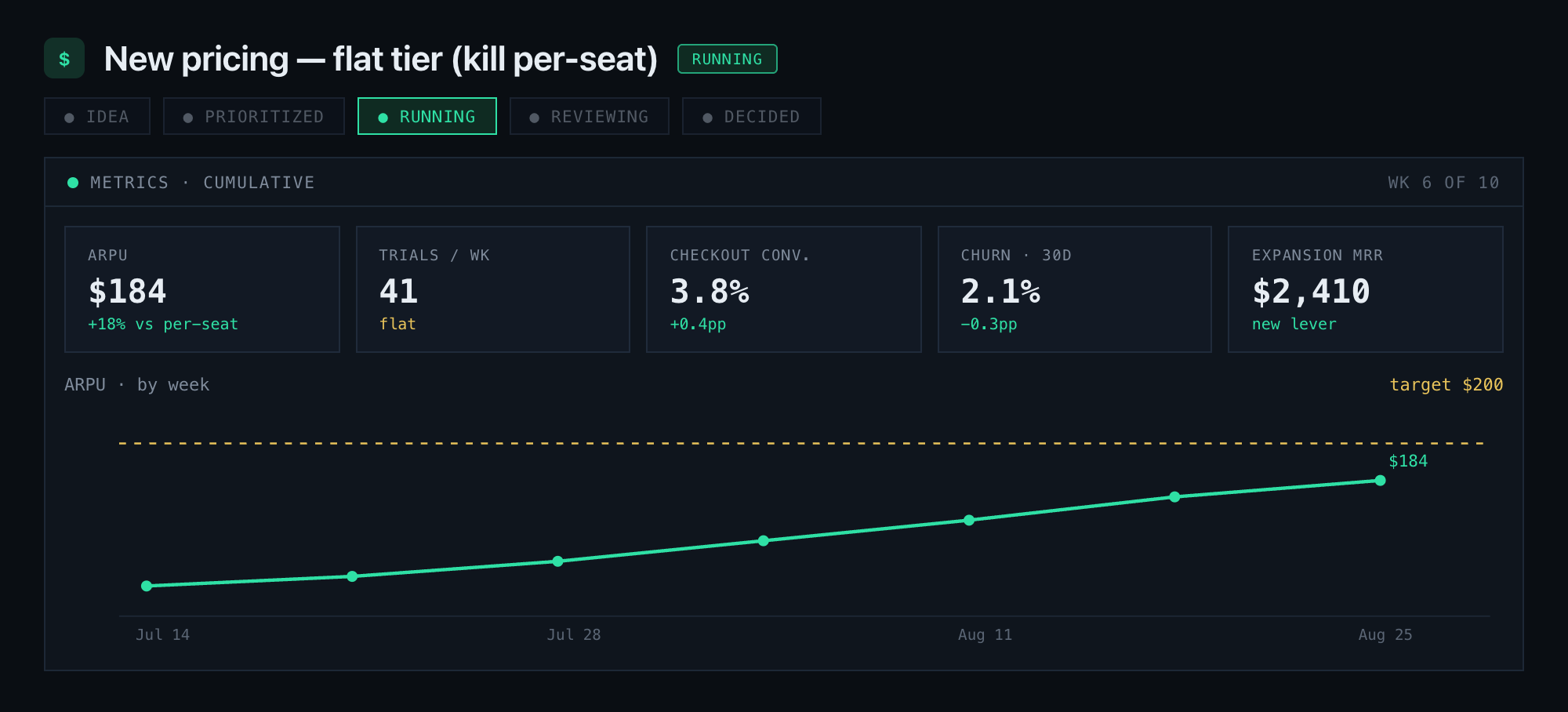
This isn’t the only way to build the habit. A shared document or a simple spreadsheet works if your team actually uses it consistently. Betlog is built specifically for this: bets move through stages from Idea to Decided, and every closed bet ends with a recorded verdict. If you want to see how it fits your team’s cadence, check the Betlog pricing page for the current plan.
FAQ
What is the 10-10-10 rule for decisions?
The 10-10-10 rule asks how you’ll feel about a decision in the short, medium, and long term, which helps separate short-term emotional reactions from longer-term consequences. It’s a mental time-travel technique similar in spirit to a premortem: both force you to imagine the future before you commit.
What is the root cause of indecisiveness?
Indecisiveness usually comes from treating a decision as something that needs to be certain before you act, instead of accepting it as a bet made with incomplete information. Writing down a probability and a kill criterion, rather than searching for certainty, tends to break the loop.
What are the 4 Cs of decision-making?
Definitions vary across sources, but a common version covers clarity on the problem, considering the options, choosing deliberately, and committing to the action. The exact labels matter less than having an explicit step for each one before you act.
What are the 5 steps in making tough decisions?
A practical sequence is: name the decision and its minimal criteria, write a hypothesis with a numeric confidence estimate, pick the smallest useful test, run it while tracking only the metric that matters, and close with a post-mortem that separates skill from luck. This mirrors the workflow operators use for recurring bets under uncertainty.


