30 Minutes to Better Bets with Mental Time Travel for Founders
Copyable premortem steps for founders. Timebox a session, log a probability and kill criteria, and keep a locked record to separate luck from skill.

On this page
- Why resulting and overconfidence sabotage team decisions
- Premortem: a copy-and-run facilitation template
- Backcasting for strategic bets and discontinuous innovations
- Calibration and updating: operational rules that make bets learnable
- A pricing bet from idea to post-mortem
- Checklist: governance, rituals, and anti-patterns
- What mental time travel means for a decision team
- How this differs from imagining the future casually
- What the forecasting research tells us about this skill
- Where this gets used beyond product and growth bets
- Where the method breaks down
- Why I started timestamping every bet
- Turn mental time travel into a permanent record with Betlog
- FAQ
- Sources
Mental time travel is the set of premortems, backcasting exercises, and structured future simulations teams use to anticipate failure modes, set kill criteria, and calibrate probabilistic confidence before a decision plays out. Used well, it produces better bet quality, less hindsight bias, and a team that gets measurably better at judging its own odds over time. The methods below show exactly how to run it.
TL;DR:
- Premortems increase the detection of future failure reasons by framing them as hypothetical setbacks to lower social risk.
- Recording a specific probability and a falsifier before launch helps prevent hindsight bias and promotes accountability.
- Small, regular probability updates improve forecasting accuracy more than infrequent, large revisions over time.
- Backcasting suits uncertain, innovative markets by mapping dependencies backward from a desired future rather than predicting demand upfront.
- A structured decision record ensures reasoning and confidence levels are timestamped and not revised after outcomes are known.
Why resulting and overconfidence sabotage team decisions
Most teams judge a decision by how it turned out, a habit decision researchers call “resulting.” A good call that loses money gets treated as a bad call, and a reckless bet that pays off gets treated as genius. This is motivated reasoning dressed up as hindsight, and it teaches teams the wrong lessons from both wins and losses.
Mental time travel techniques exist to interrupt that pattern before the outcome is known. The clearest evidence comes from the premortem method, which asks a team to imagine a project has already failed and work backward to explain why.
- Resulting conflates decision quality with luck, rewarding risky wins and punishing sound losses.
- Premortems work by making dissent socially safe: instead of criticizing a plan directly, team members describe a hypothetical failure, which lowers the social cost of raising concerns.
- Forecasting research shows the same overconfidence problem shows up in probability estimates, not just post-decision storytelling.
A structured premortem can notably increase a team’s ability to identify reasons for a future outcome, according to research on prospective hindsight. That single shift in framing, from “what could go wrong” to “imagine it already has,” accounts for most of the effect.
Premortem: a copy-and-run facilitation template
A premortem works because it assumes failure instead of asking the team to predict it. That one reframe, from “will this work?” to “it’s six months from now and this failed, why?” gives people permission to voice the doubts they’d otherwise keep to themselves. The original premortem research found this shift in conversational frame, not just the exercise itself, is what makes dissent actionable rather than awkward.
- Timebox the session to 20 to 30 minutes, run it before launch, not after a decision has already hardened.
- Ask everyone to write their own failure reasons individually and silently for five minutes, no discussion yet.
- Go round-robin and have each person read one reason at a time, no rebuttals during this pass.
- Cluster the reasons into themes on a shared board: market risk, execution risk, resourcing risk, and so on.
- Assign one owner per cluster to propose a concrete mitigation or a kill criterion within 48 hours.
The output isn’t a list of worries, it’s a set of falsifiers: specific, observable signals that would tell the team to stop. Mitigations go into the plan; kill criteria go into the bet record, written down before anyone knows how things turn out.
Pro Tip: Write kill criteria as numbers and dates, not feelings, so no one can quietly move the goalposts later.
Backcasting for strategic bets and discontinuous innovations
Premortems work well for bets with a known shape. Backcasting is built for the opposite case: markets, products, or customer behaviors that don’t exist yet, where forward forecasting has nothing solid to extrapolate from. The method starts by picturing a specific future outcome, then works backward to map every dependency that has to exist for that outcome to be real.
Research on backcasting for discontinuous innovation identifies three pillars that make the exercise useful rather than speculative:
- A feature or product-evolution roadmap, sequencing what has to be built and in what order to reach the envisioned future.
- A market-segmentation sequence, identifying which early customer segment can adopt the product before the mass market is ready.
- Ecosystem de-risking, mapping the suppliers, partners, or infrastructure the future state depends on and what has to mature first.
The same research points to Tesla’s early strategy as an example of sequencing segment and ecosystem moves rather than forecasting demand outright, a pattern also documented by firms that build case studies around market-creation strategy. Teams running their own backcasting workshop should leave with three concrete artifacts: a reverse timeline from future state to today, a dependency map showing what blocks what, and a written early-market hypothesis naming the first real customer. Frameworks for sequencing product and market moves can help structure this sequencing work without reinventing it from scratch.
Calibration and updating: operational rules that make bets learnable
None of this matters without a way to check, later, whether the team’s confidence was justified. That requires stating confidence as a probability before launch, not a vague gut feeling recalled afterward.
- Record a specific probability (for example, 65%, not “probably”) alongside the hypothesis before the bet starts running.
- Name the metric that will decide the outcome and the falsifier that would prove the hypothesis wrong, in the same sitting.
- Schedule small updates on a fixed cadence (weekly, or at each new data point) rather than waiting for a single dramatic revision.
Updating frequency turns out to matter more than most teams assume. In a multi-year analysis of forecasting tournaments, small, frequent probability updates were strongly associated with higher accuracy than infrequent, large revisions, and team training and collaboration measurably reduced overconfidence over repeated forecasting rounds. Separately, automated calibration feedback that points out specific miscalibration patterns has been shown to reduce reliance on extreme probability categories.
When a bet closes, the post-mortem has one job: separate luck from skill. Compare the recorded probability to the actual outcome, note what information only became available after the decision, and write exactly one learning that the team cannot later rewrite once the result is known.
A pricing bet from idea to post-mortem
The decision record, logged before launch, might look like this:
- Hypothesis: raising the starter price by 20% increases net revenue without materially increasing churn.
- Confidence: 60%, recorded as a probability, not a hunch.
- Metric: 30-day net revenue retention compared to the prior cohort.
- Falsifier: churn rises more than 5 percentage points within 30 days.
- Trade-off accepted: slower new-signup growth in exchange for higher revenue per account.
- Kill criterion: revert the price if the falsifier triggers before day 20.
By day 30, churn settles at 3 points and net revenue is up. The post-mortem records the outcome as Won, notes that a competitor’s unrelated price increase likely helped retention (luck, not skill), and writes one learning: test price increases on a smaller cohort before a full rollout next time.
Pro Tip: Log the update the day you see the signal, not at review time, or hindsight will quietly rewrite your confidence level.
Checklist: governance, rituals, and anti-patterns
A premortem or backcast is only as useful as the record it leaves behind. The goal is a permanent, timestamped trail that nobody can edit once the outcome is known.
- Write kill criteria and falsifiers before the bet starts running, never after.
- Timestamp every entry so confidence levels and reasoning can’t be revised in hindsight.
- Assign divided responsibility: one person facilitates, another owns the record, a third challenges the plan.
| Anti-pattern | Why it fails | Quick fix |
|---|---|---|
| No kill criteria set | Team keeps a losing bet alive past the point of evidence | Require a kill criterion before any bet moves to Running |
| Edits after the outcome is known | Hindsight quietly rewrites the original confidence level | Lock the record once the bet starts; log updates separately |
| Social conformity in premortems | Real failure modes go unspoken to avoid friction | Collect reasons individually and silently before group discussion |
What mental time travel means for a decision team
In this context, mental time travel is a deliberate practice, not a passive mental habit: a team sits down and simulates a future state on purpose, either by imagining a bet has already failed (premortem) or by picturing a future outcome and mapping the path back to today (backcasting). Both techniques share a cognitive basis in the same skill, projecting forward or backward from the present and reasoning about a state that doesn’t yet exist.
What makes it useful for decision-making isn’t the imagining itself, it’s the structure wrapped around it: a fixed time box, individual reasoning before group discussion, a written record, and a probability attached to the outcome. Without that structure, teams tend to default to vague optimism or vague pessimism rather than specific, falsifiable predictions.

The practical version covered here draws its discipline from two different directions: the premortem’s roots in prospective hindsight research, and backcasting’s roots in strategic planning for futures that don’t exist yet. Both ask a team to leave the present moment deliberately, which is the one common thread across every technique in this guide.
How this differs from imagining the future casually
Prospection, in the broad sense, is simply imagining what might happen next, something people do constantly and informally. What separates the techniques here from casual daydreaming about outcomes is structure and consequence: a premortem or backcast is scheduled, time-boxed, produces a written artifact, and ties directly to a decision the team is actually about to make.
The same applies to recalling a past decision. Reflecting on “what we did last time” is useful, but it isn’t the same exercise as a formal post-mortem, which requires a recorded probability made in advance to compare against the actual result. Without that advance record, any reflection on a past decision is vulnerable to the same hindsight bias the whole practice is meant to prevent: the team remembers being more confident, or less surprised, than it actually was.
The distinction matters practically. A team that “thinks about the future” informally before a launch gets none of the benefit documented in premortem research, because the value comes specifically from the individual-writing, round-robin, and clustering structure, not from the general act of imagining failure. Treating mental time travel as a scheduled exercise with defined inputs and outputs, rather than a mindset, is what makes it repeatable across a team rather than dependent on one person’s intuition.

What the forecasting research tells us about this skill
The strongest evidence for structured future simulation comes not from imagination studies but from forecasting tournaments, where predictions are scored against real outcomes over years. Two findings stand out for teams running their own version of this practice.
First, training and team collaboration measurably reduced overconfidence and improved accuracy across a multi-year tournament, suggesting the skill is learnable rather than fixed. Second, forecasters who updated their estimates frequently and in small increments outperformed those who waited for big, infrequent revisions, a pattern that held across four years of tournament data.
Separately, automated feedback that flags specific miscalibration patterns reduced overconfidence by discouraging the use of extreme probability categories like 0% or 100%. Taken together, this research points away from treating forecasting as a talent some people have and others don’t, and toward treating it as a practice built from small, frequent, recorded updates, the same discipline a premortem or backcast tries to instill at the decision level rather than the individual-forecaster level.
Where this gets used beyond product and growth bets
The same structured simulation shows up anywhere a team needs to commit resources before the outcome is knowable. Product teams use premortems before launches and backcasting before entering markets that don’t exist yet, but the pattern generalizes to hiring decisions, partnership bets, and pivots.
Strategic planning research on backcasting under volatile, uncertain conditions finds the technique useful specifically for organizational alignment, getting a team to agree on dependencies and sequencing before committing resources, not just for predicting a single number. That alignment function matters as much as the predictive one: a backcasting workshop often reveals disagreement about what the future even looks like before it gets to the question of how to reach it.
The common thread across every application is the same: a decision gets made under incomplete information, and the team wants a record of its reasoning that survives contact with the actual outcome. Whether that decision is a pricing change, a senior hire, or an entry into a new market, the structure, probability, falsifier, scheduled update, post-mortem, stays the same even as the subject matter changes.
Where the method breaks down
Mental time travel techniques reduce bias, they don’t eliminate it. Research on commercialization forecasting found that over-reliance on case-specific cues and neglect of base rates causes miscalibration even among people using structured methods, since a vivid, specific failure scenario can crowd out the plain base rate of how often similar bets succeed.
A premortem can also surface failure modes without anyone actually committing to act on them. Imagining failure is not the same as setting a kill criterion, and a team that skips the conversion from “here’s what could go wrong” to “here’s the number that would make us stop” gets the emotional benefit of the exercise without the governance benefit.
Backcasting carries a different risk: it can produce a roadmap that looks rigorous while resting on an unverified assumption about the future state itself. Mapping dependencies backward from a future that’s picked wrong just produces a well-organized plan for the wrong outcome.
Neither technique fixes social pressure on its own. A premortem run in a room where junior staff don’t feel safe contradicting a senior leader’s pet project will quietly undercount the real risks, no matter how well the facilitation steps are followed. The format lowers the social cost of dissent, it doesn’t remove organizational hierarchy from the room.
Why I started timestamping every bet
Early on, our team kept “remembering” that we’d been more confident in a launch than our notes actually showed once we checked. A premortem on our next pricing bet surfaced a churn risk none of us had said out loud before. Writing it down, with a probability, before launch changed how we argued afterward: about the decision, not the result.
— Cesar
Turn mental time travel into a permanent record with Betlog
We built Betlog to hold exactly the fields this guide walks through: hypothesis, probability, trade-offs, metrics, and the falsifier that would prove a bet wrong, recorded before anyone knows the outcome. Every bet moves through Idea, Prioritized, Running, Reviewing, and Decided, and closes with a post-mortem that separates luck from skill instead of letting hindsight rewrite the story.
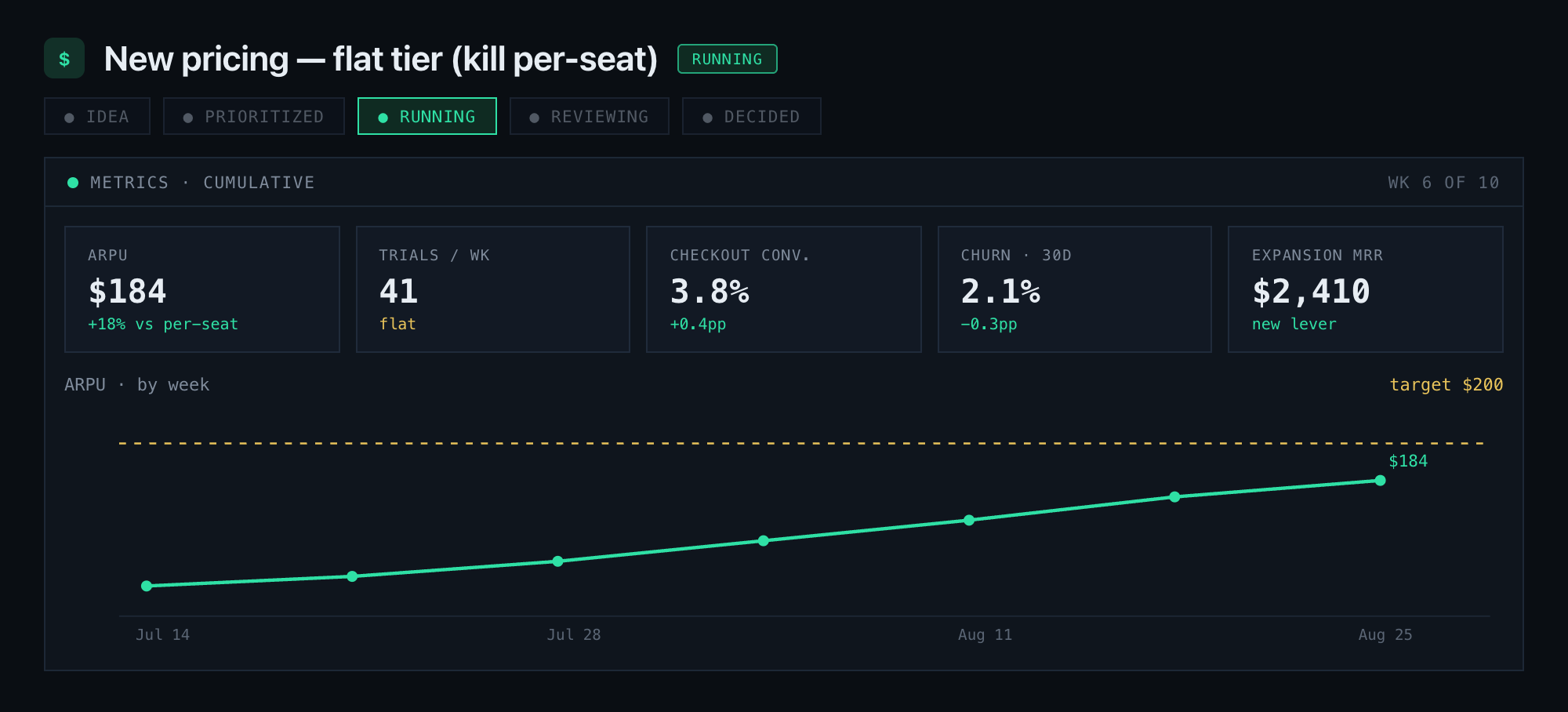
A simple starting ritual: log one premortem on your next bet and one post-mortem on a bet that already closed, win or lose. Our pricing page lists the one plan we offer, $39 per month or $390 per year, so your team can start keeping receipts on its next decision.
FAQ
What is mental time travel in decision-making?
Mental time travel, in this context, refers to structured techniques like premortems and backcasting that help teams simulate a future outcome before committing to a decision. The goal is to surface failure modes, set kill criteria, and record a probabilistic confidence level that can later be checked against the real result.
How does a premortem reduce hindsight bias?
A premortem asks a team to imagine a project has already failed and explain why, which research describes as prospective hindsight and found can increase a team’s ability to identify reasons for a future outcome by about 30%. It works because treating the failure as a settled fact, rather than a possibility, makes it socially safer for people to name specific risks.
What’s the difference between a premortem and backcasting?
A premortem assumes a specific bet has already failed and works backward to find the reasons, while backcasting starts from a desired future state and maps the product, market, and ecosystem dependencies needed to reach it. Premortems suit a bet that’s already defined; backcasting suits markets or products that don’t exist yet.
How often should a team update its confidence level on a bet?
Forecasting tournament research found that small, frequent updates to probability estimates predicted higher accuracy than waiting for one large revision. A weekly check-in against the agreed metric, with a small adjustment logged each time, tends to work better than silence followed by a dramatic reassessment.
Does Betlog help teams run premortems and post-mortems?
Yes, our decision journal captures the hypothesis, confidence level, falsifier, and trade-offs before a bet starts running, then closes it with a post-mortem that separates luck from skill. The record stays timestamped, so a team’s reasoning before the outcome can’t be quietly rewritten after it.
Sources
- Performing a project premortem
- Backcasting from the future: strategies for accelerating and de‑risking discontinuous innovations
- Small steps to accuracy: Incremental belief updaters are better forecasters
- Automated calibration training for forecasters - Stone - 2023
- Good Judgment Project reporting (geopolitical forecasting tournament summaries)


