Reduce Motivated Reasoning in Teams With One Tracked Bet in 30 Days
Research backed explainer for teams: why motivated reasoning happens and how precommitment, decision journals, and one tracked bet reduce it.

On this page
- How motivated reasoning works as a mental process
- What motivated reasoning looks like in real life
- What the research says about how fixable this is
- Why motivated reasoning costs more than it looks like
- Research-backed ways to reduce motivated reasoning
- A worked example: turning the steps into a habit
- A small-experiment approach beats a grand overhaul
- An optional next step for teams ready to systematize this
- FAQ
- Sources
Motivated reasoning is the tendency to process information in ways that favor a conclusion we already want to reach, rather than the conclusion the evidence actually supports. It tilts what we search for in memory, what counts as “enough” evidence, and which arguments feel persuasive. Research on debiasing suggests the pull is manageable but rarely erased.
TL;DR:
- Debiasing efforts show small but real improvements, yet their effects often do not transfer reliably to complex, real-world decisions.
- Motivated reasoning biases memory search, argument construction, and evidence evaluation, often leading to skewed judgments aligned with emotional or identity stakes.
- Significantly, motivated reasoning causes teams to conflate outcomes with decision quality, perpetuating errors and reinforcing polarized beliefs.
- Practical reductions include using precommitment rules, maintaining decision journals, and building dissenting review processes.
- Implementing small, structured experiments to test and track decisions over time is more effective than comprehensive overhauls in mitigating motivated reasoning.
How motivated reasoning works as a mental process
Psychologist Ziva Kunda’s influential 1990 paper draws a distinction that still anchors the field: reasoning driven by accuracy goals aims to reach the correct conclusion, while reasoning driven by directional goals aims to reach a particular, preferred conclusion. According to Kunda’s theoretical account, directional motivation does not make people invent evidence out of nothing. Instead, it changes which memories get retrieved, which rules of inference feel applicable, and how new information gets built into a justification that would satisfy a reasonably skeptical observer.
The mechanism plays out in a few linked steps:
- Biased memory search: We recall examples, facts, and precedents that support the preferred conclusion more readily than ones that undercut it.
- Biased construction: We build chains of reasoning and causal stories that connect the evidence we have to the answer we want.
- Asymmetric standards: We apply a loose, forgiving test to evidence we like and a strict, skeptical test to evidence we do not.
Confirmation bias is a close relative but not identical. Confirmation bias describes a search pattern: seeking information that confirms an existing belief. Motivated reasoning is broader. It includes that search pattern but also covers how we evaluate evidence once we have it and how much scrutiny we apply, driven by an emotional or identity-based stake in the outcome rather than by the belief alone.
What motivated reasoning looks like in real life
- Everyday rationalization: Someone buys an expensive gadget on impulse, then spends the next week reading reviews that praise it and dismissing the ones that flag its flaws as written by “haters.”
- Partisan evidence search: A voter encounters a critical news story about a preferred political figure and immediately looks for reasons the source is biased, while accepting a flattering story about the same figure without checking its source at all.
- Organizational resulting: A product team ships a feature that happens to coincide with a sales spike from an unrelated seasonal trend, and the post-mortem credits the feature rather than examining the confound.
Signs that reasoning has turned motivated rather than accuracy-seeking include a sudden interest in a source’s credibility only when its conclusion is unwelcome, explanations that arrive after the decision rather than before it, and a team’s willingness to spend ten minutes defending a weak result but zero minutes testing a strong one.
What the research says about how fixable this is
A large 2025 study of Danish voters tested whether partisan motivated reasoning works mainly through emotion regulation, the idea that we twist facts to feel better about our side. The study of 4,186 Danish voters found mixed support for that account, suggesting that expressive responding or social motives, signaling loyalty to a group rather than privately believing a distorted fact, may explain a meaningful share of partisan patterns.
A 2025 systematic review and meta-analysis of 54 randomized controlled trials and 10,941 participants found that educational debiasing interventions produce a small-to-moderate effect on targeted reasoning tasks (g = 0.26, 95% CI 0.14 to 0.39). That is a real but modest improvement, and the review flags that transfer from a training exercise to messy, real-world decisions remains uncertain.

The practical read: training people to spot bias helps a little on the exact task they trained for. It does not reliably follow them into a budget meeting or a hiring decision. Durable change seems to require pairing any training with structural habits, not relying on insight alone.
Why motivated reasoning costs more than it looks like
The clearest individual cost is what decision researchers call resulting: judging whether a decision was good or bad by how it turned out rather than by the quality of the reasoning at the time it was made. A bet that lost can still have been the right call given the information available, and a reckless bet that paid off is still reckless.
- Lost learning: teams credit wins to skill and losses to bad luck, so the same reasoning errors repeat.
- Skewed incentives: people start optimizing for defensible outcomes rather than for sound process.
- Polarized belief: corrective facts bounce off identity-protective reasoning instead of updating it, as laid out in reviews of partisan motivated cognition.
A team that never separates decision quality from outcome quality cannot tell its good judgment from its good luck, which means it cannot actually get better.
Research-backed ways to reduce motivated reasoning
- Use precommitment. Decide the rule before the outcome is known: “If churn rises above 5% after the price change, we revert within two weeks.” Experimental work on precommitment and decision control finds that precommitment, even when designed as revocable, reduces impulsive reversals and increases adherence to decisions made in a calm, “cold” state.
- Keep a decision journal. Record the hypothesis, a numeric confidence level, the metrics that will judge it, and what evidence would prove it wrong, all before the result is in.
- Run calibration exercises. Track whether your 70%-confidence predictions actually come true about 70% of the time, and adjust your internal sense of certainty accordingly.
- Build dissent-friendly reviews. Assign someone to argue the other side before a decision locks in, and schedule post-mortems that explicitly separate skill from luck rather than simply asking “did it work?”
Pro Tip: Write down what would change your mind before you look for evidence, not after.
A structured checklist for spotting decision friction and hesitation points, like the one from HockWorks, can help teams notice where motivated shortcuts are creeping into a workflow before a decision gets made.

A worked example: turning the steps into a habit
Picture a small team testing a pricing change. The workflow runs in stages: an idea gets logged, then a hypothesis and a confidence number get recorded before launch, then the test runs against pre-chosen metrics, then a precommitment rule decides what counts as success or failure, then a post-mortem closes the loop.
- Recording the hypothesis before results arrive blocks after-the-fact rationalizing.
- A written falsifier gives the team something concrete to check itself against.
- Timestamps make it impossible to quietly rewrite what was “obvious all along.”
A decision journal such as Betlog is one example of a tool built around exactly this staged structure.
A small-experiment approach beats a grand overhaul
Teams rarely need a new philosophy of decision-making. They need one precommitment rule and one tracked bet, run for a month, reviewed honestly. Pick a decision you are about to make anyway. Write the hypothesis, a number for your confidence, and the fact that would prove you wrong. Then look at it again after the outcome lands.
Small, repeated experiments build calibration faster than any sweeping process redesign, because they generate feedback you can actually learn from.
— Cesar
An optional next step for teams ready to systematize this
Writing down a hypothesis once feels easy. Doing it consistently, with a confidence number, a falsifier, and a scheduled honest post-mortem, is where most teams drift back into resulting.
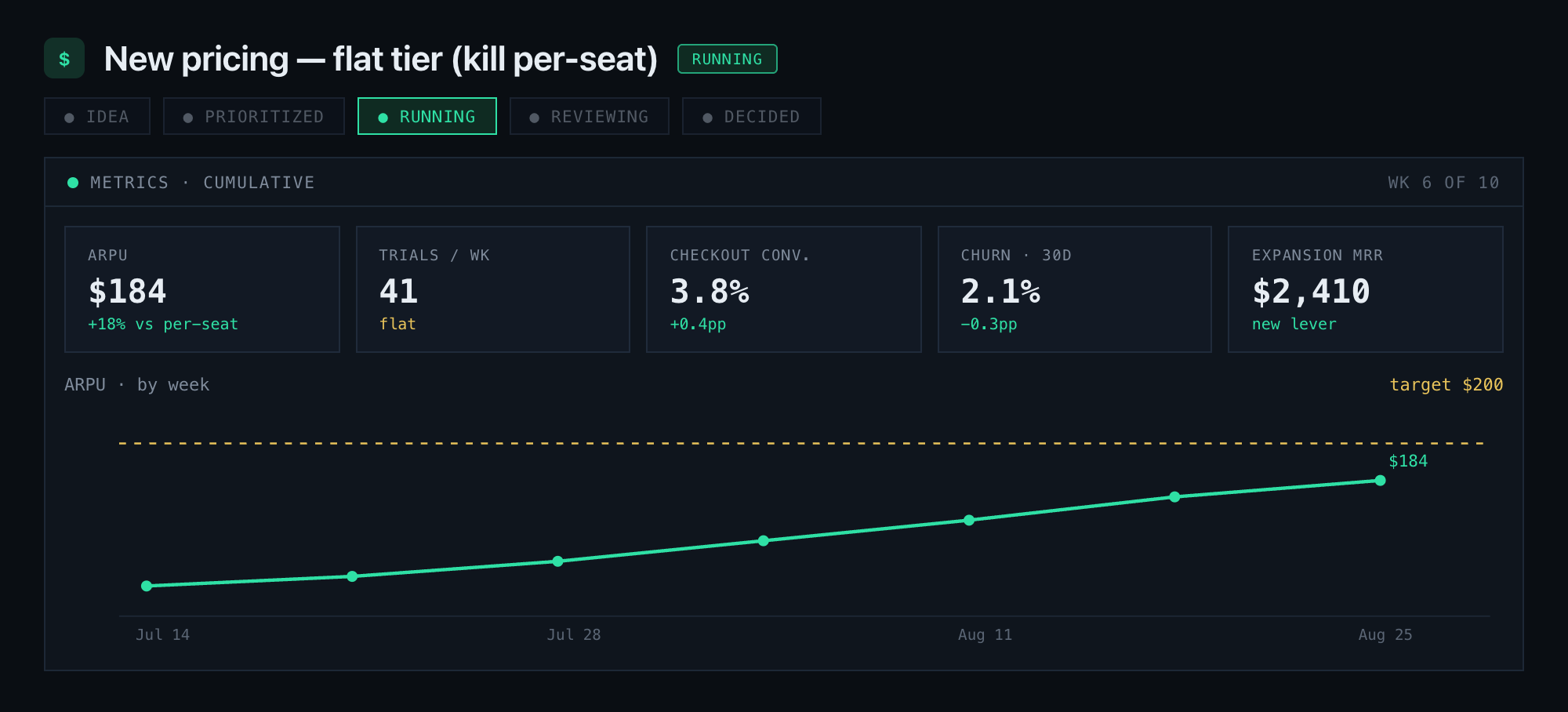
We built Betlog as a decision journal that timestamps each bet’s hypothesis and confidence level, tracks it through staged reviews, and closes it with a post-mortem that separates skill from luck instead of letting hindsight rewrite the story. It supports the precommitment and calibration habits described above without extra spreadsheets or ad hoc notes. One plan is available for $390 a year or $39 a month for teams who want to try the workflow directly.
FAQ
What is a motivated reasoning example?
A common example is buying a product on impulse, then only reading reviews that confirm the purchase was smart while dismissing critical reviews as unreliable. The same pattern shows up in politics, where a critical story about a favored figure gets scrutinized for bias while a flattering one does not.
Is motivated reasoning a fallacy?
Motivated reasoning is better described as a cognitive process or bias than a formal logical fallacy, since it describes a tilt in how evidence gets searched for and judged rather than a single flawed argument structure. Kunda’s framing treats it as a motivational influence on otherwise normal reasoning steps.
What is the difference between motivated reasoning and confirmation bias?
Confirmation bias specifically describes seeking out information that supports an existing belief. Motivated reasoning is broader: it also covers how loosely or strictly we judge evidence once we have it, driven by a stake in reaching a particular conclusion rather than the belief alone.
What is the root cause of lack of motivation?
This question falls outside what the research on motivated reasoning addresses, since motivated reasoning concerns biased belief formation rather than a general drop in drive or energy. A lack of motivation is a separate topic, typically tied to factors like goal clarity, fatigue, or low perceived reward, rather than directional reasoning bias.
Sources
- Systematic review and meta-analysis showing small improvements from educational debiasing interventions
- Kunda (1990) ‘The case for motivated reasoning’ — classic theoretical account
- Study testing the emotion-regulation account of motivated political reasoning
- Experimental work and reviews on precommitment and decision control


