Founders: Fix Overconfidence. Make 70% Bets Hit 70% With a Journal
For founders and operators: stop gut bets and build calibration. Use outcome feedback and a decision journal to turn confidence into measurable accuracy.

On this page
- 30-second takeaways on overconfidence bias
- What overconfidence bias actually means
- Why overconfidence happens in the first place
- Where overconfidence shows up in real decisions
- How overconfidence quietly degrades decision quality
- How to measure your own calibration right now
- Evidence-backed ways to reduce overconfidence
- What the research shows, and where it falls short
- How a decision journal turns this research into a habit
- My honest take after tracking my own bad bets
- How Betlog supports calibrated decision-making
- FAQ
- Sources
Overconfidence bias is when your confidence in your own judgments regularly exceeds how accurate those judgments turn out to be. It shows up three ways: overestimating your actual performance, overplacing yourself above peers, and overprecision in how narrow you think your range of error is. The single most useful fix is simple: start writing down a numeric confidence level before you know the outcome, then check it against what actually happened.
TL;DR:
- Write ten numeric ranges you are 90% sure contain the truth; fewer than nine correct means your estimates are too narrow.
- Regular feedback comparing forecasts with actual outcomes reduced overforecasting and improved calibration in experiments, with gains lasting after feedback stopped; overly frequent corrections added noise.
- For consequential decisions, record a hypothesis, confidence percentage, success metric, review date, and evidence that would disprove the claim before results arrive.
- Managerial overconfidence raised project delay probability by 1.8 to 2.3 percentage points in studied firms, but founders may hold private information outsiders cannot assess.
30-second takeaways on overconfidence bias
Overconfidence rarely feels like a flaw from the inside. It feels like certainty, which is exactly what makes it dangerous in hiring decisions, pricing changes, and roadmap bets.
- Overconfidence has three faces: thinking you performed better than you did, thinking you’re better than others, and thinking your estimates are more precise than they are.
- Outcome feedback measured against real results is one of the few interventions shown to reduce it, and the improvement can outlast the feedback itself.
- Awareness alone does not fix it. You need a record you can’t quietly rewrite after the fact.
- Your one-minute action: pick a decision you’re about to make, write down a percentage confidence that it will work, and set a date to check.
What overconfidence bias actually means
Overconfidence bias is a mismatch between how sure you feel and how often you’re right. Researchers break it into three distinct patterns, and knowing which one you’re prone to changes how you fix it, according to the overconfidence effect entry that catalogs the classic findings.
Overestimation is believing you’ll score higher, finish faster, or close more deals than you actually do. A founder who tells investors they’ll hit $50,000 in monthly recurring revenue by a certain date, then lands at half that, has overestimated.
Overplacement is the “better than average” effect: most drivers rate themselves as more skilled than the typical driver, which is a statistical impossibility for the group as a whole. In startups, this shows up as founders assuming their execution speed or product sense beats most competitors, without ever testing that belief against a benchmark.
Overprecision is the narrowest and most common trap. It’s when you state a range of outcomes that’s tighter than reality warrants, like promising a launch will land “between March 1 and March 5” when the honest range, given everything that can go wrong, is closer to three weeks. The overconfidence effect research found that in classic general-knowledge tasks, people who said they were 100% certain were still wrong about 20% of the time. That gap between stated certainty and actual accuracy is the whole phenomenon in miniature.
Each form can operate independently. You can be well-calibrated about your own performance while still overplacing yourself against competitors, or accurately ranked among peers while stating absurdly tight confidence intervals on a forecast.
Why overconfidence happens in the first place
Overconfidence isn’t a character flaw. It’s the predictable output of how memory, attention, and incentives interact.
Motivated reasoning plays a large role: we process information that confirms our abilities more generously than information that challenges them, because admitting a weakness carries an emotional cost. This is compounded by ego protection, where doubting your own strategy feels like doubting yourself as a founder or operator, so the mind quietly resists the doubt.
Availability bias adds to this. When a plan, a market, or a skill feels familiar, we mistake that familiarity for genuine understanding. You’ve read ten articles about a market segment, so it feels predictable, even though reading about something and successfully operating inside it are different skills entirely.
The hard-easy effect describes a specific pattern: people tend to be underconfident on easy tasks and overconfident on hard ones. A forecasting task with many moving variables, like predicting next quarter’s churn rate, invites more miscalibration than a simple true-or-false question, precisely because the complexity obscures how little you actually know.
Social and selection pressures reinforce all of this. Confident speech gets rewarded in meetings, pitches, and performance reviews more often than hedged, probabilistic speech does. Someone who says “I’m 65% sure this pricing change works” can sound less convincing than someone who says “this will definitely work,” even when the first person is better calibrated. Over time, teams select for confident-sounding people rather than accurate ones, and the habit of hedging gets trained out of the people who could most use it.

Where overconfidence shows up in real decisions
Market entry is a classic case. Entrepreneurs who launch into crowded or difficult markets often display confidence levels that don’t track the actual odds of survival, though the relationship isn’t purely irrational. Some of that confidence reflects private information the founder has and outsiders don’t, a nuance explored in research on behavioral CEOs.
Forecasting is another domain where it bites regularly, with insights available from prediction market accuracy data that help track and improve forecasting calibration. In experiments tracking inflation predictions, people systematically over-forecasted and expressed more certainty than their track record justified, a pattern detailed in the outcome-feedback study on forecasting bias. The same pattern shows up in sales forecasting inside companies, where reps and managers alike tend to skew projections upward.
Project timelines suffer from the same mechanism. Managerial overconfidence has been linked to a measurable rise in the probability that a project runs late, according to research on managerial overconfidence and project delays. If you’ve ever watched a roadmap slip by weeks while everyone involved swore the deadline was safe, you’ve seen this pattern firsthand.
How overconfidence quietly degrades decision quality
The damage from overconfidence rarely arrives as one bad call. It compounds through a few specific mechanisms that are worth naming individually.
The most direct is mispriced risk. When your stated confidence is higher than your actual accuracy, you take on bets sized for a sure thing when the odds are closer to a coin flip. A founder who is “certain” a feature will drive retention will often skip the cheap test that would have told them otherwise, because certainty makes testing feel unnecessary.
Memory compounds the problem. Research on memory recall bias found that overconfident individuals often continue recalling themselves as having been confident even after getting corrective feedback, and that the first piece of feedback they receive sticks more than later corrections do, according to research on memory recall bias. This means a single early success can anchor your self-assessment for a long time, even as later evidence contradicts it.
Then there’s resulting: the habit of judging a decision by how it turned out rather than by the quality of the reasoning behind it. A reckless bet that happens to pay off gets remembered as smart. A sound bet that loses to bad luck gets remembered as a mistake. This misattribution, crediting wins to skill and blaming losses on luck, prevents teams from learning the right lesson from either outcome.
Left unaddressed, these patterns reduce calibration over time instead of improving it. Without a structured way to separate what you predicted from what happened, feedback arrives too vaguely to correct anything, and the same miscalibrated confidence gets carried into the next decision.
How to measure your own calibration right now
Calibration isn’t abstract. You can test yours in under ten minutes with methods borrowed directly from the research on the overconfidence effect.
- Run the 90% interval test. Write down ten numeric estimates (your company’s current burn rate, last month’s conversion rate, a competitor’s team size) as a range you’re 90% sure contains the true answer. If fewer than 9 of your 10 ranges are correct, your intervals are too narrow.
- Try a ten-question calibration drill. Answer ten true-or-false general knowledge questions, attach a confidence percentage to each answer, then score yourself. If you said “90% confident” five times and got four of those right, you’re close to calibrated; if you got two right, you’re overconfident.
- Log real decisions with probabilities. Each time you make a consequential call, write the decision, your confidence percentage, and the date you’ll know the outcome.
- Compute your hit rate over time. After a batch of decisions resolve, check how often your 70%-confidence calls actually landed around 70% of the time.
Watch for red flags in meetings too: language with no hedge at all (“this will work,” “we’re definitely hitting the number”), timelines stated as single dates instead of ranges, and forecasts that never get revisited once they’re made.
Evidence-backed ways to reduce overconfidence
Fixing overconfidence isn’t about trying to feel less certain. It’s about building structures that force your stated confidence to meet reality on a schedule.
Outcome feedback is the most tested lever. In forecasting experiments, giving people consistent feedback on how their predictions compared to actual outcomes reduced both over-forecasting and overconfidence, and the improvement persisted even after the feedback stopped, according to the outcome-feedback study. The design matters more than the frequency: simple, regular feedback worked better than erratic or overly frequent corrections, which sometimes just added noise.
Calibration training works through repetition. Practicing probability estimates on low-stakes questions, then checking your hit rate, trains the same muscle you’ll use on high-stakes business decisions. Widening your intervals deliberately on the first few attempts helps correct the tendency toward overprecision.
Decision hygiene rituals catch bias before it compounds:
- Run a premortem before committing: write down every way the decision could fail before you start, not after.
- Ask “wanna bet?” when someone states a prediction with total certainty. It forces a number out of a vague claim.
- Use backcasting: imagine the outcome has already happened, then work backward to what must have been true along the way.
- Consider a Ulysses contract: commit in advance to a specific trigger (a date, a metric threshold) that forces you to revisit or kill a decision, so you can’t quietly rationalize your way past it later.
Operational post-mortems close the loop. After a decision resolves, record what you predicted, what actually happened, and whether the outcome reflected good reasoning or simple luck. Separating decision quality from outcome quality is the step most teams skip, and it’s the one that actually builds calibration over repeated cycles.
It takes five seconds and turns a vague feeling into a number you can actually be wrong about.*
What the research shows, and where it falls short
The strongest evidence for fixing overconfidence comes from controlled forecasting experiments. Outcome feedback measurably reduced over-forecasting and improved calibration in these studies, and the effect held up after the feedback was removed, which suggests real learning rather than a temporary incentive, according to the outcome-feedback research.
On the organizational side, managerial overconfidence has been tied to a measurable rise in the probability of project delays, roughly 1.8 to 2.3 percentage points higher in the firms studied, according to research on managerial overconfidence. That’s a modest-sounding number that compounds across dozens of decisions a year.
Two caveats matter. First, not all apparent overconfidence is irrational. Founders and executives sometimes hold private information that outsiders can’t see, so what looks like overconfidence from the outside can be a reasonable bet given what they actually know, a point raised in research on behavioral CEOs. Second, feedback isn’t a cure-all: it can increase random noise in your estimates even as it reduces systematic bias, and motivated beliefs can resist correction even when the evidence is right in front of you. Measurement helps, but it doesn’t make the bias disappear overnight.
How a decision journal turns this research into a habit
Reading about calibration doesn’t build it. What builds it is a record you check against reality on a fixed schedule, which is the exact structure a decision journal is built around.
A useful record for any consequential call needs a few fields: the hypothesis you’re testing, a numeric confidence level (not “I think so,” an actual percentage), the metric that will decide whether you were right, a timeline for when you’ll know, and, critically, what evidence would prove you wrong before you’ve seen the outcome.

Periodic calibration reviews are where the payoff shows up.
A worked sketch makes this concrete. Six weeks later, churn rose by three points. That distinction, logged honestly, is what separates learning from guessing next time.
My honest take after tracking my own bad bets
I once told a small team I was “sure” a feature would cut support tickets by half. No record meant no accountability, and no accountability meant I made the same kind of overconfident call again a month later.
That single habit exposed how often my gut said “90% sure” about things that, once checked, landed closer to 50-50.
Start with one decision this week. Write the number down before you know the answer.
— Cesar
How Betlog supports calibrated decision-making
We built Betlog around the exact gap this article describes: the distance between how confident you feel and how often you’re actually right. Every bet you log captures the hypothesis, a numeric confidence level, the trade-offs you’re accepting, and the metric that will decide the outcome, so the reasoning is on record before you know how things turn out.
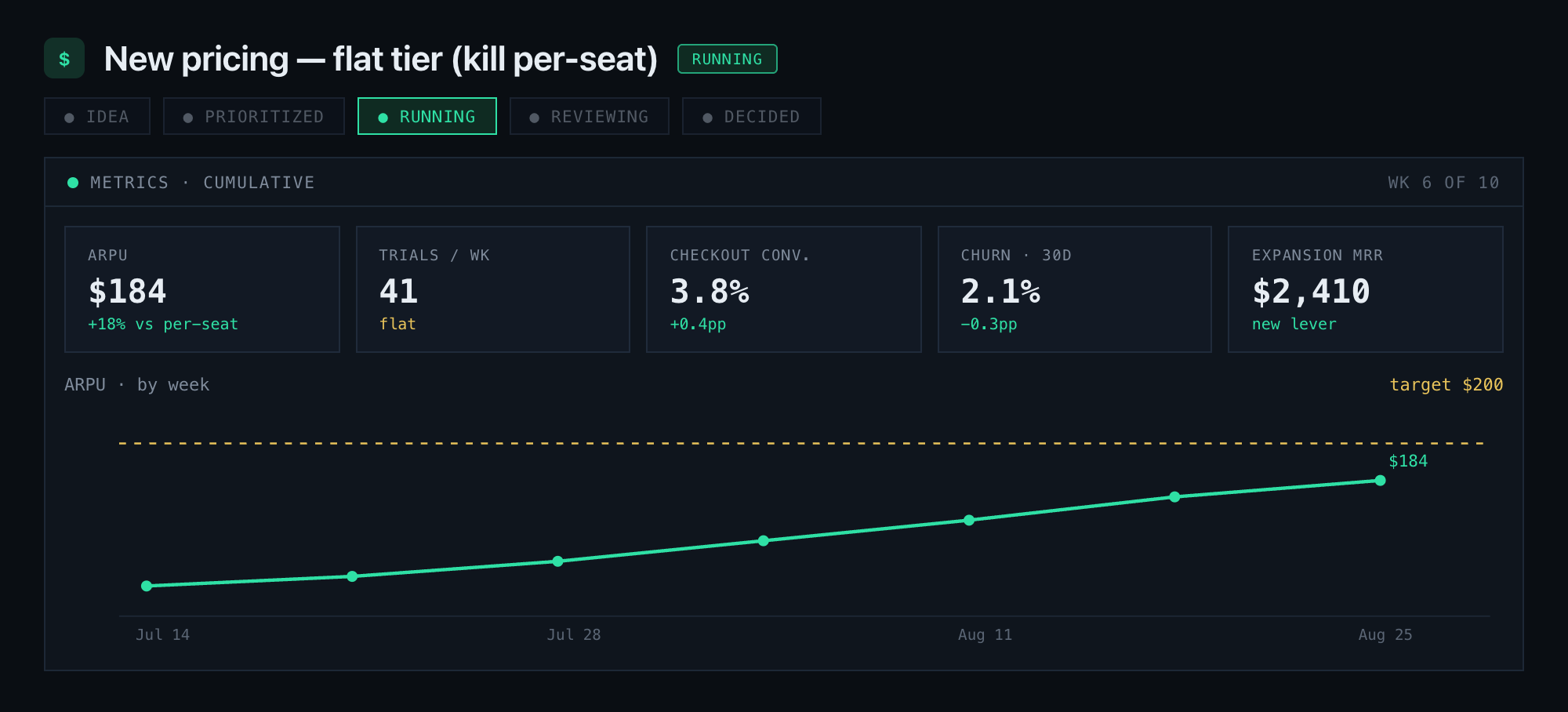
Bets move through clear stages, from Idea to Running to Decided, and close with an honest verdict rather than a vague sense of how things went. Each closed bet gets a post-mortem that separates whether the call was good reasoning or good luck, reinforcing the habit this entire article has been building toward.
What this looks like in practice:
- A permanent, timestamped record of every confidence level you stated, so hindsight can’t quietly rewrite what you actually believed at the time.
- A running calibration log showing whether your stated confidence corresponds with actual outcomes.
- A structured post-mortem format that separates decision quality from outcome, so losing bets still teach something.
We offer one plan on our pricing page, at $39 per month or $390 per year, for teams ready to replace gut-feel verdicts with a record they can actually learn from.
FAQ
What is an example of overconfidence bias?
A common example is a manager who states a project will finish “by the end of the month” with total certainty, then misses the date, a pattern linked to measurably higher delay rates in studies on managerial overconfidence. Another everyday example is most drivers rating their own skill as above average, which can’t be true for the group as a whole.
Is the Dunning-Kruger effect the same as overconfidence bias?
They’re related but distinct. Overconfidence bias is the general pattern of confidence exceeding accuracy across overestimation, overplacement, and overprecision, while the Dunning-Kruger effect specifically describes how people with low skill in a domain tend to overestimate their competence in that domain more than skilled people do.
Is overconfidence narcissism?
No, they’re different constructs. Overconfidence is a judgment error about the accuracy of your own estimates or abilities, while narcissism is a personality trait involving grandiosity and a need for admiration, and someone can be well-calibrated in their judgments while still scoring high or low on narcissism.
Is overconfidence good or bad?
Overconfidence is mostly harmful for decision quality because it leads to mispriced risk and missed warning signs, but a mild degree of it can sometimes support persistence through difficult tasks. The practical goal isn’t zero confidence, it’s calibration: making sure your stated confidence actually matches your track record, as outcome-feedback research on reducing over-forecasting demonstrates.
Sources
- Overconfidence effect — Wikipedia
- Outcome feedback reduces over-forecasting of inflation and overconfidence in forecasts — Judgment and Decision Making (2023)
- Memory recall bias of overconfident and underconfident individuals after feedback — MDPI (2022)
- Managerial overconfidence and project completion delays — EconStor (2022 analysis)


