Quitting Decision Framework: 8 Steps Teams Can Log Before a Call
Use kill criteria, expected value, and a fixed review date to make quitting decisions auditable. Apply premortems, team templates, and a worked founder...

On this page
- What a quitting decision framework actually is
- Set states-and-dates: how to create observable kill criteria
- Use expected value and base rates to compare staying vs. quitting
- Premortems and mental time travel: how to visualize good and bad futures
- Run the quitting decision: an 8-step practical process
- Emotional and cognitive traps that block good quitting
- Ready-to-use templates: decision brief, kill-criteria table, premortem script
- How teams use Betlog to run quitting decisions
- Why most people quit too late, not too early
- A practical way to put this framework into daily use
- FAQ
- Sources
Use explicit kill criteria, an expected value check, and a set review date to make quitting a disciplined, auditable decision instead of an emotional reaction. Together these three elements turn a vague feeling of “this isn’t working” into a structured call you can defend later. The rest of this guide shows how to set each piece, run a premortem, and capture what you learn so the next decision gets sharper.
TL;DR:
- Set each trigger around an observable leading indicator and review date, such as 500 weekly active users by week ten, rather than a vague feeling.
- Estimate outcomes for staying and quitting, then compare values weighted by probability; when totals are close, use base rates to break the tie.
- A solo premortem takes 10 minutes; teams can spend 30 to 60 minutes writing failure stories silently before discussion, limiting the loudest voice’s influence.
- Use the framework only when you have alternatives, measurable progress, and time to act; it adds little to a single event with no remaining choice.
What a quitting decision framework actually is
A quitting decision framework is a small set of rules you agree to before emotions or sunk costs cloud your judgment: a measurable trigger, a comparison of what staying versus leaving is worth, and a fixed date to revisit the call. It borrows directly from decision science rather than motivation and willpower, which is why it holds up under pressure.
The approach works for a job, a product bet, a fundraising push, or a side project, and you can learn how to crowdsource business decisions as a founder to get structured feedback during these processes. It is less useful for decisions with no real alternative or no way to measure progress, such as a one-time event you are already committed to finishing. The method is anchored by three ideas:
- Expected value: weighing the probability-weighted outcomes of continuing against the outcomes of stopping.
- Optimal stopping: the mathematical question of when further search or persistence stops paying off.
- Sunk-cost bias: the pull to keep going because of what you already spent, not because of what is likely ahead.
Apply the framework when you have a genuine choice, some data to track, and enough time before the decision becomes irreversible. Skip it for one-off, no-alternative situations where there is nothing left to decide.
Set states-and-dates: how to create observable kill criteria
A kill criterion is a specific, observable state tied to a specific date, not a feeling. “States-and-dates” means naming the exact metric or signal (the state) and the exact moment you will check it (the date), so the decision is made in advance rather than negotiated in the moment. Founders who use this approach describe it as the main way they avoid staying in a failing bet past the point where more effort helps, according to an interview with Annie Duke.
Good kill criteria favor leading indicators (signals that predict the outcome early) over lagging ones (results you only see once it’s too late to act).
- Job example: “If I haven’t been given a scoped project with real ownership by the end of Q2, I raise it directly; if nothing changes within 60 days, I start interviewing.”
- Project example: “If weekly active usage hasn’t crossed 500 by week 10, we stop building new features and reassess.”
- Product bet example: “If paid conversion stays under 2% after two full pricing experiments, we kill the tier.”
Set a cadence for checking these criteria (weekly, monthly, or at a milestone) and define what happens at each checkpoint: an automatic kill means the threshold triggers a stop with no new debate, while “seek more information” means the signal is ambiguous and you gather one more data point before deciding.
Pro Tip: Write kill criteria the same day you start the commitment, while you’re least attached to a particular answer.
Use expected value and base rates to compare staying vs. quitting
Expected value (EV) is the probability of each outcome multiplied by its value, summed across all the realistic outcomes you can name. You don’t need precision, a rough estimate with ranges beats no estimate at all.
- List the realistic outcomes of staying (best case, likely case, worse case) and assign rough probabilities that add up to 100%.
- Do the same for quitting: the value of the next best use of your time, money, or energy.
- Multiply and sum each path’s probabilities by their estimated value, then compare the two totals.
- Check against a base rate: how often do similar bets (projects, hires, startups in this category) succeed? Borrow that number if you don’t have your own history.
One practitioner note: decision researchers and founders who use expected-value checks and states-and-dates criteria report that the practice reduces paralysis and encourages earlier course corrections, according to tactical advice for founders built on Annie Duke’s work.
Say a product feature took some months to build and currently converts poorly. Staying longer may have a small chance of reaching a viable conversion rate but mostly will stay flat. Quitting now frees that engineering time for a different bet with a historically higher base rate of success. When the math is close, the base rate usually breaks the tie.
Premortems and mental time travel: how to visualize good and bad futures
A premortem asks you to imagine the decision has already failed, then work backward to figure out why. Annie Duke’s recommended practice pairs this with “mental time travel”: picture both a good future and a bad future in specific, dated detail before you commit further, a method described in a framework for life’s toughest decisions.
Run it like this:
- Set a future date (three months, one year) and assume the decision has played out.
- Write the failure story: what specific signals showed up along the way that you ignored?
- Write the success story: what specific signals would have told you this was working?
- Convert both stories into kill criteria: the failure signals become your states-and-dates triggers.
A solo version takes 10 minutes with a notebook. A team version runs 30 to 60 minutes: each person writes their failure story silently first, then the group compares notes before agreeing on shared criteria. Writing silently first prevents the loudest voice in the room from anchoring everyone else’s imagination.
Run the quitting decision: an 8-step practical process
A repeatable process turns “should I quit?” from a one-time agonizing conversation into a routine you can run in an afternoon. This sequence tracks closely with how structured decision-making is formally defined: clarify the decision, build alternatives, assess trade-offs, decide, implement, and monitor.
- Clarify the decision: write one sentence stating exactly what you’re deciding and by when.
- Identify alternatives: list what you’d do instead, including “do nothing differently.”
- Choose measures: pick two or three metrics that will tell you whether you’re on track.
- Estimate probabilities and EV: run the rough calculation from the section above.
- Set kill criteria and cadence: states-and-dates, plus a checkpoint schedule.
- Decide and record: write the decision, your confidence level, and your reasoning before you know the outcome.
- Monitor: track the chosen metrics against the kill criteria on schedule.
- Review and post-mortem: once decided, write what you’d do differently and whether the call was a matter of skill or luck.
For group decisions, assign three simple roles: an owner who runs the process, a reviewer who checks the math and pushes back, and a decider who makes the final call if the group splits. Gather more data only when a kill criterion is ambiguous at checkpoint; once it’s clearly crossed, stop debating and act.
Pro Tip: Put a date on step 8 (the review) when you write step 6, otherwise it never happens.
If you want a deeper walkthrough of staging a decision from hypothesis to resolution, we’ve written about how to stage a bet in five steps for exactly this kind of workflow.

Emotional and cognitive traps that block good quitting
Sunk-cost bias is the tendency to keep investing in something because of what you’ve already put in, not because of what’s ahead, and it gets stronger the more strongly you feel connected to the version of yourself who made the original decision. Research on past-self continuity found that people who feel weaker continuity with their past self are more likely to escape a failing project, especially after a large prior investment, according to London Business School research.
Social judgment adds a second layer: people tend to overestimate how much others will think less of them for quitting, which keeps them stuck longer than the facts justify.
- Reframe the decision as a portfolio choice (reallocating one bet among many) rather than a verdict on your character.
- Pre-commit to your kill criteria with a trusted advisor who holds you to the plan, not just your mood.
- Log the reasoning before the outcome is known, so you can’t rewrite the story once you see how things turned out.
Ready-to-use templates: decision brief, kill-criteria table, premortem script
A decision brief needs five fields: the decision statement, the alternatives considered, the confidence level (as a probability, not a vague feeling), the metrics that will decide it, and what would prove the call wrong. A one-paragraph example: “Deciding whether to keep our current pricing page live. Alternative: revert to the old page. Metric: trial-to-paid rate over four weeks. Kill signal: no improvement by week four.”
A kill-criteria table keeps the governance rules visible in one place:
| Metric | Threshold | Cadence | Consequence |
|---|---|---|---|
| Trial-to-paid conversion | Below 8% | Weekly | Seek more data |
| Trial-to-paid conversion | Below 8% for four straight weeks | Monthly checkpoint | Automatic kill |
| Weekly active users | Flat for 60 days | Biweekly | Team review |
A short premortem script for a 10-minute solo run:
- Assume it’s three months from now and the decision failed. Write the first sentence of that story.
- List the three signals that would have warned you earlier.
- Turn each signal into a states-and-dates kill criterion.
- Write your confidence level that you’ll actually honor the plan once you’re emotionally invested.
If you’re working with incomplete information and tempted to delay the whole process until you have more certainty, it helps to read through five steps for deciding with partial data, since waiting for full certainty is rarely the right trade-off.
How teams use Betlog to run quitting decisions
Picture a three-person product team testing a new onboarding flow. The bet moves through stages, Idea, Prioritized, Running, Reviewing, so the team can see at a glance where it stands.
When the review date arrives, they write the verdict (Won, Killed, or Inconclusive) and a short post-mortem separating what was skill from what was luck before anyone remembers how it felt in the moment.
- Hypothesis and confidence recorded before the outcome, so resulting can’t creep in later.
- Kill criteria and dates attached to the bet from day one.
- A closing verdict and post-mortem that becomes part of a permanent, timestamped record.
Minimal logging like this is what makes a quitting call defensible to a cofounder or an investor months later, instead of a story that changes with hindsight. For a closer look at separating skill from luck after the fact, we’ve covered a field-tested decision audit that teams run after closing a bet.
Why most people quit too late, not too early
The common worry is that people quit too easily. The evidence points the other way: people tend to wait until a situation forces their hand rather than choosing to walk away while it’s still a choice, which wastes time and resources that could go toward a better bet, a pattern described in analysis of delayed exits. The real failure mode isn’t impulsiveness, it’s a refusal to set a trigger in advance, which leaves every quitting decision to be made under maximum emotional pressure, exactly when judgment is worst.
If you take one thing from a quitting decision framework, let it be this: the discipline isn’t in the willingness to quit, it’s in the willingness to decide the terms before you’re desperate. Founders, product leads, and managers making recurring bets should adopt this first, since they make enough calls for calibration to compound. Pick one live decision this week, write its kill criteria today, and put a review date on the calendar before you lose the nerve to set one.
— Cesar
A practical way to put this framework into daily use
Writing kill criteria on a sticky note works until you have five live bets running at once and no record of what you predicted. We built Betlog as a decision journal for exactly that gap: a place to log the hypothesis, confidence level, kill criteria, and review date for each bet, then move it through Idea, Prioritized, Running, Reviewing, and a final verdict of Won, Killed, or Inconclusive.
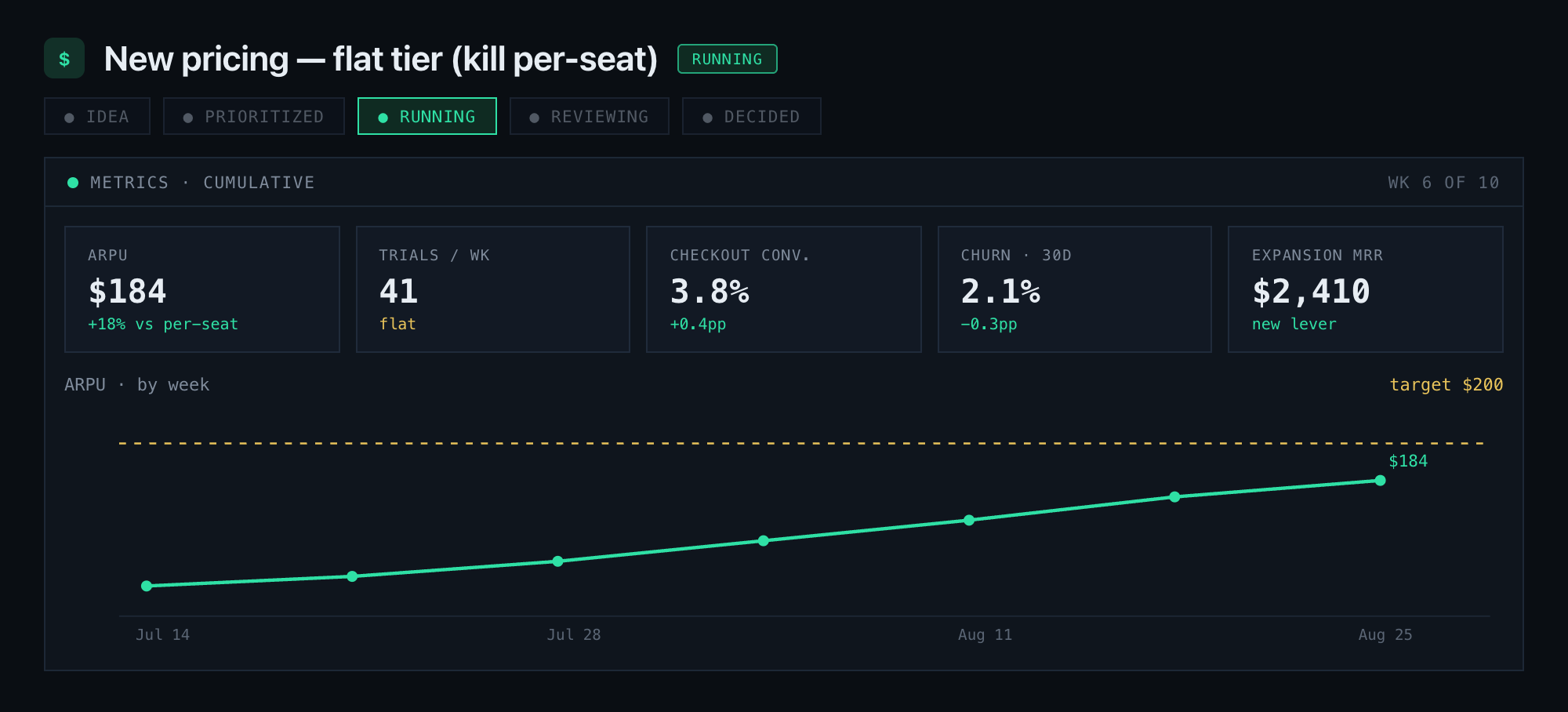
Every closed bet ends with a post-mortem that separates skill from luck, so the next quitting call starts from a sharper base rate instead of a gut feeling. If you want to try the method on a real decision this week, check our one plan at $39 per month or $390 per year and log your first bet.
FAQ
What are the five steps of a decision-making model?
A common version includes defining the decision, gathering alternatives, weighing trade-offs, deciding, and reviewing the outcome. This maps closely to structured decision-making’s stepwise process of define, develop alternatives, assess, decide, and monitor, which also underpins the eight-step quitting process described above.
What are signs it might be time to quit a job?
Common signals include a sustained gap between what you were promised and what you’re given, no measurable progress against goals you set months ago, and a growing sense that staying is driven by sunk cost rather than opportunity. A states-and-dates kill criterion, set before frustration peaks, turns these vague signs into a specific trigger you can act on.
What are the seven steps of a decision-making model?
Expanded versions typically add identifying the problem and implementing the choice to the five-step core: define the decision, gather information, identify alternatives, weigh evidence, choose among alternatives, implement, and review the result. The exact count varies by source, but the sequence from clarifying the question through post-decision review stays consistent.
What are the four steps of a decision-making framework?
A compressed version usually covers: clarify the decision, compare alternatives by expected value, decide, and monitor against pre-set criteria. It’s a tighter version of the eight-step process above, useful when a decision is small enough not to need a full team review.
How does a decision journal help with quitting decisions?
Logging a hypothesis, confidence level, and kill criteria before you know the outcome prevents hindsight from rewriting your reasoning later. Betlog’s bet lifecycle, from Idea through a final Won, Killed, or Inconclusive verdict, is built around that same principle of recording the call before the result is in.
Sources
- Past-Self Continuity and the Sunk-Cost Bias (London Business School research)
- Grit or Quit? Tactical advice for founders (First Round Review interview with Annie Duke)
- Structured Decision Making steps (SDM.org)
- When to quit: A simple framework for life’s toughest decisions (Big Think, Annie Duke)


