Ulysses Contracts: Psychiatric Directives Meet Founder Bet Logs
See how psychiatric advance directives and behavioral economics inform Ulysses contracts, then apply the idea with Betlog decision logs for founders.

On this page
- Origin and core features of a Ulysses contract
- How Ulysses contracts work in psychiatric care
- What the research says about commitment devices
- How to draft a Ulysses contract that actually works
- Turning precommitment into a repeatable business habit
- Why specificity matters more than intent
- A nonclinical way to put precommitment into practice
- FAQ
- Sources
A Ulysses contract is an advance self-binding instruction that commits your competent present self to actions or treatments your future self can’t easily undo. People use the idea two ways: as a commitment device against ordinary temptation, and, in psychiatry, as an advance directive authorizing care during a mental health crisis. The approach works best when it’s specific, facilitated, and reviewed regularly.
TL;DR:
- A valid directive requires signing while competent, observable activation triggers, a willing named proxy, and specific authorized actions rather than broad intentions.
- For psychiatric use, have a clinician or trained facilitator make triggers workable, confirm medical feasibility, and set a review date before a crisis.
- Commitment devices have improved savings and gym attendance in field trials, but uptake is uneven and signed participants may still miss targets.
- For personal or business decisions, record the hypothesis, confidence, accepted tradeoffs, and observable change signals, then review outcomes without treating journals as clinical directives.
Origin and core features of a Ulysses contract
The name comes from Homer’s “Odyssey.” Before sailing past the Sirens, Odysseus (Latinized as Ulysses) had his crew tie him to the mast and plug their own ears with wax, so his future, song-addled self could not steer the ship toward the rocks. That image became shorthand for any arrangement where a capable present self locks in a choice that a tempted or impaired future self might otherwise reverse.
You’ll see the same idea called a self-binding directive or a Ulysses clause, depending on the field. In psychiatric care, it’s usually folded into a broader psychiatric advance directive. Outside medicine, it shows up informally in savings plans, fitness pledges, and workplace commitments.
A document earns the name only if it has a few specific features:
- Competency at signing: the person was capable of informed decision-making when they created it.
- Explicit triggers: clear, observable conditions that activate the directive.
- A named proxy or facilitator: someone responsible for recognizing those triggers and acting on them.
- Specific authorized actions: concrete instructions, not vague intentions.
Without those four elements, a document is closer to a wish list than a working Ulysses contract.
How Ulysses contracts work in psychiatric care
Psychiatric advance directives (PADs) let a person document treatment preferences in advance, to be used if they later lose decision-making capacity. A Ulysses clause is a specific, stronger version: it authorizes care, including care the person might resist in the moment, such as hospitalization or medication, during a defined future crisis. According to a systematic review of psychiatric advance directives, only a small minority of PADs actually contain these override clauses, and most instead document general preferences rather than binding future refusals of care.
People with chronic, episodic conditions such as bipolar disorder are the most common candidates. Someone who has lived through repeated manic episodes often has a clear memory of what a relapse looks like from the outside, and some choose to pre-authorize intervention before the spiral reaches crisis level. The Journal of Medical Ethics lays out several arguments for honoring these contracts in chronic episodic illness, framing them as a way to extend a person’s autonomy across time rather than override it.
Facilitation matters here. A clinician or trained facilitator helps translate a patient’s own language (“don’t let me quit my medication again”) into something the care team can act on without guessing. Reviews of implementation note considerable variation in terminology and process from one jurisdiction to another, with limited data on lived experience once a directive is actually triggered.
Safeguards that recur across the literature include:
- Specific, observable activation criteria instead of broad statements.
- A scheduled review date so the directive doesn’t go stale.
- A named proxy who agrees to the role in advance.
- Clinician sign-off confirming the plan is medically workable.
Pro Tip: Write activation triggers as things a bystander could observe and confirm, not as internal feelings only you would recognize.
What the research says about commitment devices
The appeal of a Ulysses contract is obvious: lock in today’s values before tomorrow’s impulses take over. The evidence on whether this works is more mixed than the pitch suggests.
Field experiments have produced some striking results, including a large increase in savings balances in one commitment-savings trial, alongside measurable gains in gym attendance among participants who signed up for attendance contracts. These numbers show the mechanism can work, not that it always does.
The same research flags real caveats:
- Take-up is uneven. Plenty of people who would benefit never sign a commitment contract at all.
- Some people choose contracts that end up working against them, a problem researchers call mistaken take-up.
- A National Bureau of Economic Research working paper found high take-up for a gym-attendance contract requiring eight-plus visits, yet a meaningful share of those who signed up still missed their targets, and structural analysis in some cases pointed to lowered consumer surplus overall.
- Giving people more information about their own likely behavior sometimes reduced demand for the contract itself, suggesting some uptake was driven by overconfidence rather than accurate self-knowledge.
On the clinical side, the picture rhymes: Ulysses clauses in psychiatric directives are uncommon, and the literature is clear that they work best as targeted, facilitated tools rather than blanket refusals of future care. The throughline across both fields is the same. Commitment devices can change behavior substantially, but the design, the targeting, and the honesty of the person signing all determine whether that change helps or backfires.
How to draft a Ulysses contract that actually works
A usable Ulysses contract is built, not just written. Follow this sequence whether you’re drafting a personal commitment or a clinical self-binding directive:
- Confirm competency. Write and sign it while you’re thinking clearly, ideally with a witness or clinician present for anything medical.
- Define concrete triggers. State the exact, observable conditions that activate the directive, such as a specific symptom pattern or missed medication streak, not a general sense of “when things get bad.”
- Name a proxy or facilitator. Choose someone willing to recognize the trigger and act, and confirm they agree to the role before you finalize anything.
- Spell out authorized actions. List exactly what the proxy or care team is allowed to do, not just what you hope happens.
- Store it where it will be found. Share copies with your clinician, your proxy, and anyone else who needs to act on it, not just a drawer at home.
- Set a review date. Revisit the document on a schedule, since circumstances, medications, and relationships change.
- Build in revocation terms. Clarify how and when the directive can be updated or withdrawn while you’re competent.
Clinicians, lawyers, and trusted supporters each add something different: clinicians confirm feasibility, lawyers confirm enforceability where that matters locally, and supporters confirm the plan is actually livable day to day.
The most common drafting mistake is vagueness. “Help me if I spiral” gives a proxy nothing to act on. “Contact Dr. Lin and arrange a medication check if I miss three consecutive doses” gives them a job.

Pro Tip: Draft the trigger language with the person who will have to act on it, since a condition that makes sense to you in a calm moment may be unworkable for them to confirm in a crisis.
Turning precommitment into a repeatable business habit
The logic behind a Ulysses contract, bind your clear-headed self now so pressure or bias can’t rewrite the plan later, applies directly to how founders and teams make consequential calls, as discussed in this collaborative design decisions framework. A structured decision journal gives that logic a workable shape outside any clinical or legal context.
We move a decision through explicit stages that mirror a safe precommitment: declare the bet while you’re thinking clearly, name the signals that will tell you whether to continue, and commit to reviewing the outcome honestly rather than rewriting the story after the fact.
A concrete version of this workflow looks like:
- Log the hypothesis and your confidence level before the decision plays out.
- Name the specific signals that would trigger a change in course.
- Record the trade-offs being knowingly accepted.
- Close with a post-mortem that separates what was good judgment from what was luck.
This kind of logging reduces motivated reasoning at review time and builds calibration over months of entries. It’s a business tool, not a clinical one. For a mental health crisis, a proper psychiatric advance directive, created with a clinician, remains the right instrument.
Why specificity matters more than intent
Most advice about precommitment treats intent as the hard part, as if deciding to bind your future self is the real achievement. In practice, I’d argue the intent is the easy part. The failures I keep seeing in the literature, vague triggers, undefined proxies, directives nobody reviews, all trace back to specificity, not willpower. A Ulysses contract protects long-term values well when it’s facilitated, narrow, and checked on a schedule. One written alone, in broad language, with no one assigned to act on it, is closer to a diary entry than a safeguard. The more sweeping the authorization, the less useful it tends to be in the moment it’s needed.
— Cesar
A nonclinical way to put precommitment into practice
We provide founders and teams a structured, timestamped way to apply the logic of self-binding directives to business decisions: commit to a plan before pressure or hindsight can quietly rewrite it. Each bet captures the hypothesis, confidence level, and trade-offs accepted, then closes with an honest post-mortem instead of a convenient story.
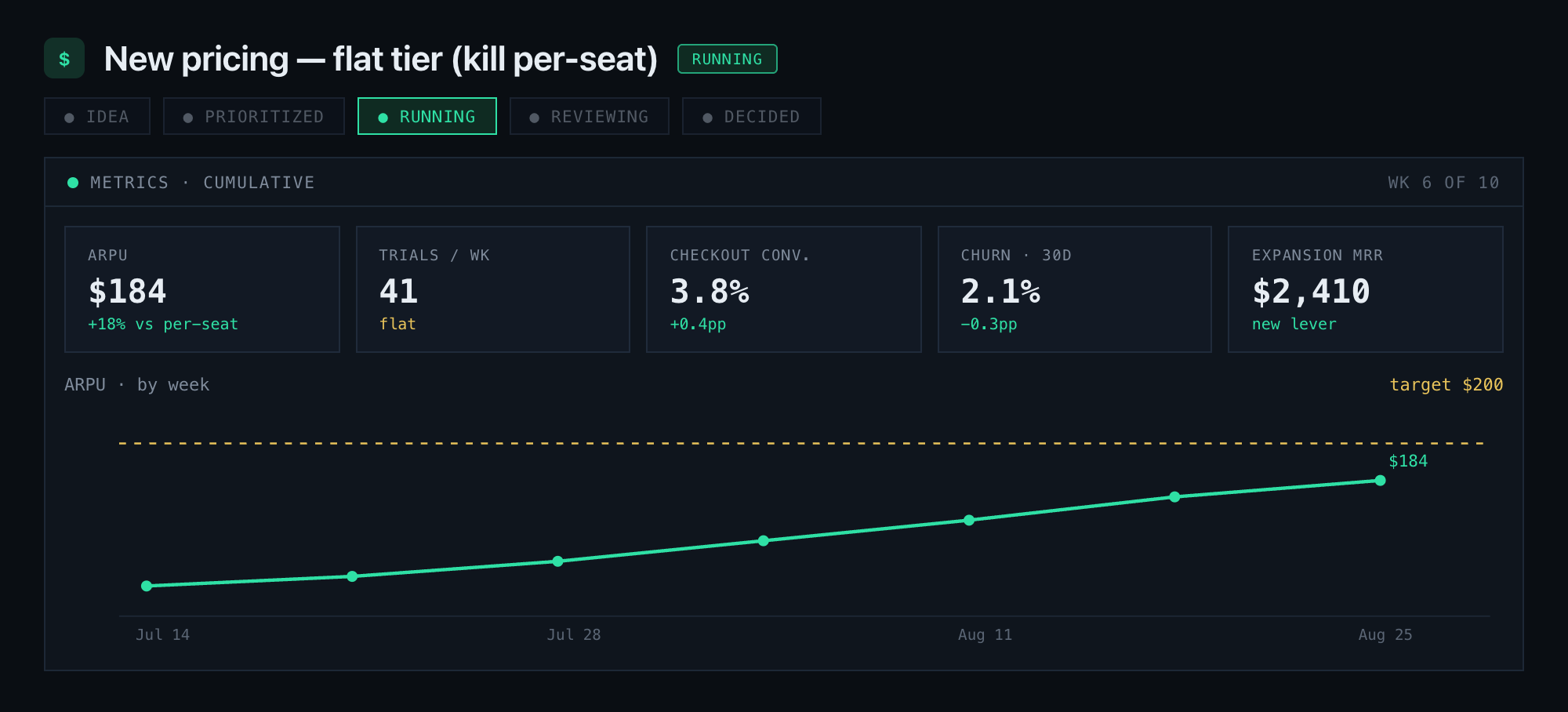
- Use a decision journal for product, pricing, hiring, and growth bets you want to hold yourself accountable to.
- Reserve clinical psychiatric advance directives for mental health crises, where a licensed clinician needs to be involved.
- Review closed bets on a schedule, the same way a well-built self-binding directive gets revisited rather than forgotten.
For teams that want sharper precommitment habits beyond the journal itself, a short exercise like mental time travel pairs well with logging the bet itself. If you’re ready to see how a tracked bet looks from hypothesis to verdict, our one plan is $39 per month or $390 per year.
This article is general information, not a substitute for advice from a qualified doctor. Consult a qualified healthcare professional about your own circumstances before acting on anything here.
FAQ
Why is it called a Ulysses contract?
It’s named after Ulysses, the Latin name for Odysseus, who had himself tied to the mast of his ship so he could hear the Sirens’ song without steering toward them. The name became a general term for any arrangement where a capable present self locks in a decision a tempted future self might otherwise undo.
Why was Ulysses tied to the mast?
In Homer’s story, the Sirens’ song was said to lure sailors to their deaths, and Odysseus wanted to hear it without risking the ship. He had his crew bind him before they came within earshot and told them to ignore any orders he gave until they were safely past, which is the precommitment mechanism the modern term borrows from.
What is the Ulysses syndrome?
“Ulysses syndrome” is a separate concept from a Ulysses contract. It refers to psychological distress experienced by migrants facing prolonged, multiple stressors, and it isn’t part of the commitment-device literature this article covers.
What is an Ulysses agreement?
A Ulysses agreement is another name for a Ulysses contract: an advance, self-binding instruction created while a person is competent, authorizing specific future actions or treatment. In psychiatric contexts it’s typically built into a psychiatric advance directive and includes named triggers, a designated proxy, and clinician involvement to make it clinically usable.
Sources
- PsychiatryOnline: Psychiatric advance directives and self-binding directives (systematic review)
- Ulysses Contracts in psychiatric care: helping patients to protect themselves from spiralling (Journal of Medical Ethics)
- Who Chooses Commitment? Evidence and Welfare Implications (NBER working paper)
- Field evidence on commitment devices (PubMed summary)


