After Action Reviews: Founders Close Bets Before Memory Shifts
Learn how founders run an after action review, ask four questions, capture evidence, and close team bets with decision journals, templates, and follow up.

On this page
- What an after-action review is and when to use it
- The four core AAR questions and why their order matters
- Preparing an AAR: evidence, scope, and who to invite
- Running the AAR: facilitation, psychological safety, and timing
- Outputs and follow-up: note format, action items, and tracking
- Common failure modes and pragmatic fixes
- Worked example and two quick templates you can copy
- Research and official guides: evidence that AARs work and authoritative templates
- How teams can pair AARs with a decision journal to separate skill from luck
- Turning AAR findings into a permanent decision record
- FAQ
- Sources
An after-action review is a short, structured conversation where a team compares what it expected to happen against what actually happened, asks why the gap exists, and decides what to keep doing or change. The method runs on four questions, asked in a fixed order, and it only works when the session ends with actions that carry a named owner, a specific verb, and a deadline.
TL;DR:
- For a one hour review, spend 10 to 15% defining expectations, about half documenting events, 20% diagnosing causes, and 15% assigning changes.
- Before meeting, define the event, time window, and benchmark; circulate a timeline and metrics, then invite contributors and whoever set the original intent.
- A neutral facilitator and separate note taker should enforce a no blame rule; open questions and pauses draw out input, while disputes can continue later.
- Use a Quick Look Report for reviews, a full report when multiple teams or outside parties are affected, and an action appendix for follow up.
- A 2013 meta analysis found structured debriefs improved team and individual performance by roughly 20 to 25% when properly facilitated and tied to the work.
What an after-action review is and when to use it
The after-action review started as a US Army practice for debriefing training exercises and combat operations, then spread into healthcare, emergency management, and software teams because the format works for almost any outcome you can measure against a plan. At its core, an AAR is a retrospective look at a specific event, sprint, launch, or incident, run close enough to the event that memories are fresh.
Not every review needs the same weight. A brief huddle suits a routine task or a small experiment. A longer, formal AAR fits a product launch, an incident with customer impact, or a quarter-end milestone.
- Quick huddles catch small process fixes before they repeat.
- Formal AARs surface root causes behind bigger misses or wins.
- Both modes align the team on what to repeat and what to drop.
The four core AAR questions and why their order matters
Wharton’s research on after-action reviews describes four questions that form the backbone of an effective session, asked in this sequence:
- What did we expect to happen?
- What actually happened?
- Why was there a difference?
- What will we sustain or change?
The order matters because the first two questions build a shared, factual record before anyone starts diagnosing causes. Skip straight to “why” and the group ends up arguing about what happened in the first place, which wastes the session on disputed facts instead of useful analysis.
A workable time split for a one-hour AAR: spend 10 to 15% on question one, roughly half the session on question two gathering the full timeline, 20% on question three digging into causes, and the remaining 15% on question four locking in actions.

Preparing an AAR: evidence, scope, and who to invite
A productive AAR depends more on what happens before the meeting than during it. Pull together objective records: a timeline of key events, system logs, metrics dashboards, screenshots, and relevant chat or email threads. These replace memory and opinion with evidence everyone can see.
Before anyone sits down, define the scope: which event, which time window, and which plan or standard you’re measuring against. Someone needs to own that standard, usually whoever set the original goal or intent, so the group isn’t debating whose version of the plan counts.
- Invite the people who did the work plus whoever set the original intent.
- Assign a facilitator who won’t be defending their own decisions.
- Assign a note-taker separate from the facilitator.
- Set a hard timebox before the meeting starts.
Pro Tip: Send the timeline and key metrics to attendees ahead of time so the meeting starts on analysis, not data-gathering.
What you bring: the timeline, metrics, and prior commitments. What you publish afterward: a short note capturing the four answers and the action list, shared with everyone who needs to act on it.
Running the AAR: facilitation, psychological safety, and timing
The facilitator’s job is to stay neutral, keep the group moving through the four questions, draw out quieter voices, and watch the clock. A facilitator who was central to the decisions being reviewed struggles to stay impartial, which is why a neutral outsider or a rotating role works better for bigger reviews.
Ground rules matter as much as the questions. Make clear upfront that the session exists to improve the next attempt, not to assign blame, and that the discussion stays off the record outside the room. Research on debrief facilitation finds that leaders who ask open-ended questions and wait for responses, rather than filling silence themselves, get more honest input and stronger perceptions of psychological safety.
- State the learning-not-blame rule out loud before starting.
- Ask open questions and pause for answers instead of filling silence.
- Escalate unresolved disagreement to a follow-up conversation rather than forcing consensus in the room.
Pro Tip: If the group is large, split into breakouts for questions two and three, then regroup to agree on question four together.
Timing scales with the stakes, from a brief huddle to a longer standard AAR or an extended review of a major incident with multiple contributing factors. For agenda structure and facilitator scripts, the postmortem review meeting guide walks through a step-by-step facilitation flow that adapts well to AAR sessions.
Outputs and follow-up: note format, action items, and tracking
A good AAR produces a short, usable note, not a long document nobody reopens. A compact template covers the scope and goal, links to the timeline and metrics, what worked, what didn’t, and the agreed next tests.
Every action item needs a named owner, a specific verb, a deadline, and, where possible, a success metric that tells you whether the fix actually worked. An action that reads “improve communication” isn’t an action; “Priya sends a daily status update to the channel by 9 AM starting Monday” is.
- Pick a Quick Look Report for a fast, lightweight writeup.
- Pick a full AAR report when the event affected multiple teams or external parties.
- Add an action plan appendix when there are more than a handful of follow-up items.
The After-Action Review User Guide lays out an eight-step process and defines these products, including recommended timelines for turning a QLR around quickly versus a full report. Our lessons-learned register template gives a place to track these outputs across multiple reviews so patterns show up over time.
Common failure modes and pragmatic fixes
Most AARs fail in predictable ways, and each has a simple fix.
- Skipping pre-work turns the meeting into a fact-finding argument: timebox the prework and circulate the timeline before anyone walks in.
- Praise or blame aimed at people instead of behaviors shuts down honesty: describe specific actions and decisions, and anonymize input where the topic is sensitive.
- Actions without owners or deadlines quietly die: no action item closes the meeting until it has a name, a verb, and a date attached.
- A long report nobody reads wastes the work that went into the review: default to a QLR plus a short action plan instead of a full narrative report.
Pro Tip: If an action item sentence doesn’t name a person, it isn’t done yet, no matter how clear it sounds in the room.
Worked example and two quick templates you can copy
Say a team plans a pricing page redesign expecting a 10% lift in trial signups within two weeks.
- Plan: the new page ships on an agreed date, signups are tracked regularly, and the goal is reached within the planned period.
- Actual: the page shipped later than planned, and signups stayed flat through the review period.
- Diagnosis: the delay pushed the page past a scheduled newsletter send, cutting early traffic.
- Actions: Maya re-sends the announcement to the list by an agreed date; Tom adds a launch-date buffer to upcoming roadmap items before the next sprint planning.
One-paragraph template: state the goal, what happened, the single biggest reason for the gap, and the next test. A quick note can put facts and evidence on the left and agreed actions on the right, making it easy to scan.
Research and official guides: evidence that AARs work and authoritative templates
A 2013 meta-analysis found that structured debriefs improve team and individual performance by roughly 20 to 25% on average, with an effect size near d = .67, compared to teams that skip them. The same research ties that gain to proper facilitation and alignment between the debrief and the team’s actual work, not just holding a meeting for its own sake. Agencies including WHO and FEMA publish full user guides defining formal AAR products and facilitation steps teams can adopt directly.
How teams can pair AARs with a decision journal to separate skill from luck
An AAR tells you what happened and why. It doesn’t tell you whether the original decision was sound unless you recorded the reasoning before the outcome landed. Pairing an AAR with a decision journal closes that loop: you check the actual result against the hypothesis and confidence level you wrote down beforehand, rather than judging the call by how it turned out.

Do this across enough decisions and you get calibration data: whether bets at a given confidence level actually land at about that rate. Storing AAR notes next to the original decision log makes that comparison possible later, not just in the moment. Our guide to resulting bias covers why outcome-blind review matters for keeping that comparison honest.
Turning AAR findings into a permanent decision record
An AAR captures what happened after the fact. A decision journal captures the hypothesis, the confidence level, and the trade-offs before the outcome is known, so the later review has something honest to measure against. At Betlog, we built our product around that pairing: every bet gets a written hypothesis and a probability, moves through stages from idea to decided, and closes with a post-mortem that separates skill from luck instead of crediting the result to whichever story feels best in hindsight.
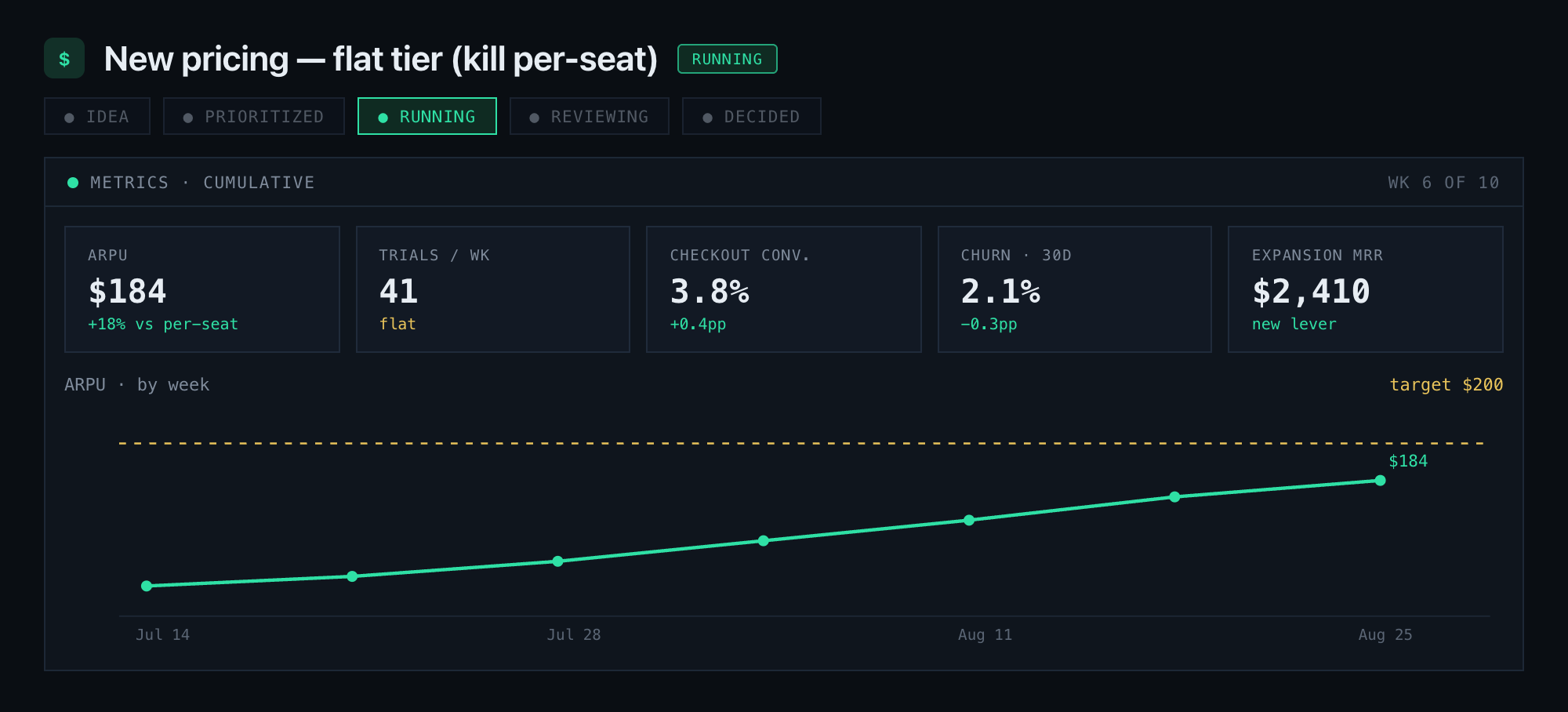
That permanent, timestamped record is what makes an AAR’s “why” question answerable months later instead of reconstructed from memory. If you lead a small team and want pre-decision reasoning sitting right next to your AAR notes, you can see our pricing and start recording your next bet.
FAQ
What are the four steps of an AAR?
The four steps are: define what was expected, establish what actually happened, determine why any difference occurred, and agree what to sustain or change going forward. Wharton’s framework presents these as a fixed sequence rather than topics to cover in any order.
What are the four questions asked in an AAR?
The four questions are: What did we expect to happen? What actually happened? Why was there a difference? What will we sustain or improve? They’re asked in that order so the group agrees on facts before debating causes.
What should be included in an after-action review?
A solid AAR includes a defined scope and standard, objective evidence like timelines and metrics, answers to the four core questions, and a list of action items each with an owner, a verb, and a deadline. The FEMA After-Action Review User Guide also recommends choosing a format, whether a Quick Look Report or a full report, based on the event’s scale.
What’s another word for after-action review?
Common alternative terms include “post-mission analysis,” “team debrief,” and “lessons learned review,” all describing the same structured comparison of planned versus actual results. The exact term tends to vary by industry, though the underlying four-question method stays consistent.
Why should a team conduct an after-action review?
Structured debriefs are linked to measurable performance gains, with one meta-analysis finding roughly a 20 to 25% improvement among teams that use them well. Beyond the performance gain, AARs give teams a repeatable way to catch what worked, fix what didn’t, and avoid relearning the same lesson on the next project.
Sources
- Do Team and Individual Debriefs Enhance Performance? A Meta-Analysis - Scott I. Tannenbaum, Christopher P. Cerasoli, 2013
- After-Action Reviews: A Simple Yet Powerful Tool - Wharton
- After-Action Review User Guide
- After Action Review


