Postmortem Analysis for Founders: Incidents, Autopsies, and Hindsight
Postmortem analysis helps founders compare incident reviews with forensic autopsies, use templates, and log decisions before hindsight shifts the story.

On this page
- Which kind of postmortem analysis do you need?
- How do you run a blameless incident postmortem?
- What does a forensic postmortem (autopsy) involve?
- Why do so many postmortems reach the wrong conclusions?
- What do postmortem templates and worked examples look like?
- How do you turn findings into lasting change?
- Why a decision journal beats hindsight-driven stories
- Make postmortem analysis a habit with Betlog
- FAQ
- Sources
A postmortem analysis is a structured look back at something that already happened. In operations, it is a blameless review that reconstructs the timeline, causes and follow-up actions of an outage, a failed launch or a bad bet. In forensic medicine, it is an autopsy that combines gross examination, histology, toxicology and imaging to determine how someone died. This guide covers both tracks, with copyable templates for teams.
TL;DR:
- For incident reviews, build a timestamped timeline from logs and alerts, then record system conditions, impact, owners, due dates, and verifiable acceptance criteria.
- Before discussing causes, document what people knew and expected at each decision point, then test proposed causes against successful cases with the same conditions.
- For decision reviews, record the hypothesis, confidence as a probability, deciding metrics, and conditions that would disprove it before results arrive, preventing retrospective rewrites.
- Forensic conclusions combine external and internal examinations, tissue analysis, toxicology, and case context; imaging can locate fractures or fragments but cannot replace pathological examination.
- Time of death estimates are probabilistic ranges because cooling, stiffening, and tissue changes vary with temperature, clothing, body composition, and the surrounding setting.
Which kind of postmortem analysis do you need?
The phrase “postmortem analysis” covers two very different jobs, and most confusion comes from mixing them. One is about learning from a failure so it does not repeat. The other is about establishing facts around a death for medical or legal purposes. The methods share a spine, though: collect evidence, reconstruct what happened in order, and resist the urge to explain everything in light of the ending.
Here is a quick way to sort yourself:
- Incident postmortem: you run a service, a product or a team, something went wrong (an outage, a failed pricing test, a missed launch), and you want to prevent a repeat.
- Forensic postmortem: you want to understand how an autopsy works, what it can and cannot tell investigators, or how to read the resulting report.
- Decision postmortem: a variant of the first, where the thing under review is a choice rather than an event, such as a hire, a roadmap bet or a pivot.
If your goal is preventing recurrence, read the sections on incident reviews, bias and templates. If your goal is understanding how cause of death is determined, go to the forensic section. Everyone benefits from the bias section, because hindsight distorts both kinds of review.
You will also run into neighboring terms. A “postmortem meeting” is the live session where a team walks through an incident. An “incident report” is the written output. “Autopsy” and “medicolegal autopsy” refer to the medical examination, the latter being one ordered by a legal authority rather than requested by a family or hospital. Spellings vary too: “post-mortem” and “postmortem” mean the same thing.
One more distinction matters. Incident postmortems are blameless by design, because blame makes people hide information. Forensic postmortems are not about blame either, but they must produce documentation robust enough to survive legal scrutiny years later. Both need records made at the time, not memories reconstructed afterward.
How do you run a blameless incident postmortem?
A good incident postmortem has four goals: reconstruct the timeline, identify systemic contributing factors, produce actions someone can verify, and create a record that supports trend analysis across many incidents. If a review does not deliver all four, it is a conversation, not a postmortem.

Google’s SRE team publishes a widely used model. Their postmortem guidance defines the postmortem as a structured, blameless review capturing the timeline, root causes and follow-up actions.
Google’s postmortem guidance describes its own large-scale infrastructure, so do not treat it as a forecast for your startup. The broader takeaway is useful: most causes live in the system, not with a single person’s mistake.
The standard structure
Each field in a postmortem report has one job:
- Summary: two or three sentences a busy executive can read and understand what happened and how bad it was.
- Impact: who and what was affected, for how long, in terms the business cares about (customers, revenue, trust).
- Timeline: timestamped events from first signal to resolution, including what people knew at each moment.
- Contributing factors: the conditions that made the incident possible, stated as system properties rather than individual failings.
- Action items: specific changes, each with an owner and a due date.
- Verification: how you will confirm each action actually reduced risk.
The timeline deserves the most care. Build it from raw material such as chat logs, deploy records, alerts and dashboards, not from what people remember feeling. Memory edits itself toward a tidy story.
Facilitating without blame
Blameless does not mean consequence-free or opinion-free. It means the review asks “what about our system allowed this?” rather than “who did this?” A facilitator keeps the conversation there with a few habits:
- Ask “what did you know at that moment, and what did you expect to happen?” instead of “why did you do that?”
- Rewrite any sentence with a person as the cause into a sentence with a condition as the cause. “Dana deployed without testing” becomes “the deploy path allowed untested changes to reach production.”
- Invite the people closest to the incident to speak first, before senior voices anchor the room.
- Separate fact-finding from solution-brainstorming so people do not defend a fix before the facts are agreed.
If you want a deeper walkthrough of this style of review, we published a five-stage blameless postmortem for founders, and a set of postmortem questions for teams you can bring to the meeting.
A compact report template
Copy this and fill it in while evidence is fresh:
- Title and date: one line naming the incident.
- Summary: what happened, in plain language.
- Impact: duration, scope, customer effect.
- Detection: how and when we found out, and who noticed first.
- Timeline: timestamped entries with the evidence source for each.
- Contributing factors: conditions, not culprits.
- What went well: the things that limited damage.
- Action items: owner, due date, acceptance criteria.
- Verification plan: how and when we confirm the fix worked.
Pro Tip: Write the contributing factors section last and test every sentence by asking whether it would still be true if a different, equally competent person had been on call that night.
What does a forensic postmortem (autopsy) involve?
A forensic postmortem is a systematic examination of a body, and it is more layered than television suggests. Educational material from the U.S. National Library of Medicine describes an autopsy as combining gross inspection, microscopic histopathology, toxicology and, increasingly, forensic imaging. Pathological examination remains the gold standard for determining cause of death.
The core steps
The sequence generally runs like this:
- External examination: documenting identifying features, injuries, medical devices, signs of disease and the condition of the body.
- Internal (gross) examination: inspecting organs and body cavities, weighing and describing them, and collecting samples.
- Histopathology: examining tissue under a microscope, which can reveal disease or injury invisible to the naked eye.
- Toxicology: testing blood, urine and tissue for drugs, alcohol and poisons.
- Radiologic imaging: using CT or MRI scans, either alongside or sometimes in place of parts of the physical examination.
- Scene and context correlation: matching the findings against medical history, witness accounts and the circumstances of death.
No single step carries the conclusion alone. A pathologist weighs all of them together, and the answer to “what caused this death” often emerges only when toxicology results or tissue slides come back, which may take time.
A comprehensive review of pathological examination in forensic medicine adds that gross and microscopic examination remain indispensable for establishing cause of death, auditing clinical diagnoses and teaching. It also stresses adherence to standard operating procedures and good communication between forensic experts and pathologists.
Where imaging fits
Postmortem CT (PMCT) and postmortem MRI (PMMRI) have become common additions. A RadioGraphics review of postmortem CT describes PMCT as a widely accepted supplementary tool in death investigation, with particular strengths in detecting skeletal injury and foreign bodies. The same review is clear on the limits: interpretation needs specialists who recognize postmortem imaging artifacts, and findings must be integrated with the external exam, the history and the lab results.
In plain terms, imaging complements an autopsy rather than replacing it. A scan can show a fracture or a bullet fragment quickly and without cutting. It is less able to replace tissue examination when the question is a subtle disease process or a poisoning. Where a scan seems to settle the question, a trained reader still has to confirm that what looks like pathology is not a change that happens after death.
Pathological examination remains the gold standard for determining cause of death, and imaging complements it rather than replacing it, according to NLM educational resources on forensic medicine.
Why time of death is an estimate
The postmortem interval (PMI) is the time between death and examination. Estimating it relies on body cooling, stiffening, changes in the tissues and environmental context. Each of these varies with temperature, clothing, body composition and setting, so PMI estimates are best understood as probabilistic ranges rather than a single clock reading. Anyone who offers a precise time of death from the body alone is claiming more than the method supports.
Documentation that holds up
Autopsy findings often become legal evidence and may be revisited years later. Forensic pathology testimony literature stresses comprehensive records, including photographs, autopsy notes, radiographs and toxicology, because experts cannot reliably recall granular details long afterward. Broader practice also depends on gathering evidence from several sources and faces uneven standards and limited resources across jurisdictions, as the National Academies’ report on the U.S. medicolegal death investigation system notes.
Why do so many postmortems reach the wrong conclusions?
Because the people writing them already know how the story ended. That single fact bends nearly every judgment that follows.
A peer-reviewed analysis of why postmortems fail argues that political pressure and cognitive biases routinely undermine retrospective inquiries. Its list of failure modes reads like a checklist of what goes wrong in team reviews too: the hindsight fallacy, cherry-picking, confirmation bias, premature cognitive closure and neglect of comparative methods. Its proposed remedies are humility, comparative checks and a willingness to recognize ambiguity.
Two biases to name out loud
Hindsight bias makes a past event feel like it was predictable all along. Once you know the deploy broke checkout, the warning signs look obvious, and the person who missed them looks careless. Medical investigation literature documents how strongly outcome knowledge influences investigators and suggests reconstructing the messy, uncertain pre-outcome state so that clinicians’ actions are not judged against knowledge they never had.
Outcome bias judges a decision by how it turned out instead of by the quality of the reasoning at the time. A sound bet that lost gets branded a mistake. A reckless one that won gets praised. Both teach the wrong lesson.
Research on retrospective error analysis puts it bluntly: hindsight does not equal foresight. Investigators are warned against anchoring their analysis to the known outcome.
Safeguards that work
You cannot train bias out of people, but you can design the process around it:
- Reconstruct the pre-outcome mindset. Before discussing causes, write down what the team knew and expected at each decision point.
- Use counterfactual prompts. Ask what would have had to be different for the outcome to change, and how likely that difference was.
- Run a premortem before the fact. Imagine the project has failed and list why. Our premortem framework helps lock findings into a decision log before any outcome exists.
- Capture rationale at decision time. A short decision brief written when the call is made gives the review something no one can retroactively edit.
- Bring in an independent reviewer. Someone outside the team is less invested in a flattering story.
Test your causes against the good outcomes
The comparative method deserves its own mention. If you conclude that “rushed testing caused the outage,” check whether rushed testing also preceded clean releases. If it did, it is not a distinguishing cause. Cherry-picking happens when you only inspect cases that ended badly.
Pro Tip: Before you finalize any root cause, name one successful release or decision that shared the same condition and explain why it did not fail. If you cannot, hold the conclusion loosely.
For rituals that keep reviews honest, we also wrote about three practices that beat hindsight bias.
What do postmortem templates and worked examples look like?
Templates remove the blank-page problem, and consistent fields make later comparison possible. Here are two you can adapt today, followed by a worked example.
Template one: ops incident
- Incident name, severity and date.
- One-paragraph summary with no jargon.
- Impact: customers affected, duration, and any money or trust consequences.
- Timeline with evidence links: each line points to a log, alert, ticket or chat message.
- Contributing factors: system conditions only.
- Detection and response: what worked, what slowed us down.
- Actions: owner, due date, and a measurable acceptance criterion.
Template two: decision-journal postmortem
This one reviews a choice, and it only works if the first half was written before the outcome:
- Hypothesis and expected outcome, recorded at decision time.
- Confidence as a probability, not “pretty sure.”
- Trade-offs accepted and what would prove the bet wrong.
- Deciding metrics, named in advance.
- Verdict: won, killed or inconclusive.
- Skill versus luck: what part of the result reflects decision quality and what part reflects chance.
- Learning, written in a sentence the team cannot later reinterpret.
A worked example: a pricing bet
Say a founder believes raising the entry price by $10 per month will not hurt signups.
Later, conversion falls. Measured against her own pre-written criteria, the hypothesis was roughly right: the drop stayed inside the range she called acceptable, and revenue per customer rose. The verdict is a win, but the postmortem asks a harder question. A holiday week landed in the test window, which probably helped conversion. So she logs the learning as “price tolerance looks real, but retest without seasonal lift before another increase.” That nuance survives because the reasoning was recorded in advance.
Minimum evidence for credibility
Whatever the template, a postmortem is only as good as its raw material:
- A timeline built from timestamps, not recollection.
- Primary records such as logs, alerts, tickets or test results.
- Decision records written at the time, not reconstructed afterward.
If one of those is missing, say so in the report rather than papering over it.
How do you turn findings into lasting change?
A postmortem that ends in a document has failed. Every action needs one named owner, a due date and an acceptance criterion that a third person could check. “Improve monitoring” is a wish; “an alert fires when checkout errors pass a set threshold, verified by a staged failure” is an action.
Track a few program-level measures: how long actions take to close, how often similar incidents recur, and, for teams logging decisions, whether stated confidence matches actual results over time. A team whose bets win about as often as its stated confidence suggests is calibrated; a team whose results consistently fall short may be overconfident.
Consistent templates also unlock trend analysis. That is exactly the point of the large-sample root-cause breakdown in Google’s practice: aggregated categories show where systemic fixes pay off most, which no single incident can reveal. If your findings point to process automation, operational growth systems may offer ideas for this kind of follow-through.
In forensic work, the equivalent constraint is resources: testing capacity and standards vary by jurisdiction, so investigators sometimes have to prioritize which tests to order.
- Owner and date on every action.
- Acceptance criteria a stranger could verify.
- Scheduled follow-up to confirm the fix held.
Google’s SRE team reports that software (41.35%) and development process failure (20.23%) together account for the majority of its postmortem root causes, which is why trend analysis across consistent reports points teams toward process fixes, not individual blame.
Why a decision journal beats hindsight-driven stories
My stance is simple: the most valuable part of a postmortem is not the analysis, it is the record you made before you knew the answer. Analysis after the fact is always contaminated. You can be careful, humble and rigorous, and you will still remember the weak signals as louder than they were.
Writing down the hypothesis, the probability and the kill condition at decision time does something retrospective discipline cannot: it removes your ability to quietly rewrite what you believed. That protects you from the oldest habit in teams, crediting wins to skill and blaming losses on bad luck. It also makes losing bets teachable. A high-confidence bet that lost was not necessarily wrong; it may have been an unlikely outcome. Without the written number, that distinction disappears.
For small teams this matters more, not less. You have few bets, so each one is an expensive data point, and you cannot afford to misread it. Treat strategy as a portfolio of bets rather than a series of verdicts on people, and the postmortem becomes a way to tune judgment instead of assign fault.
— Cesar
Make postmortem analysis a habit with Betlog
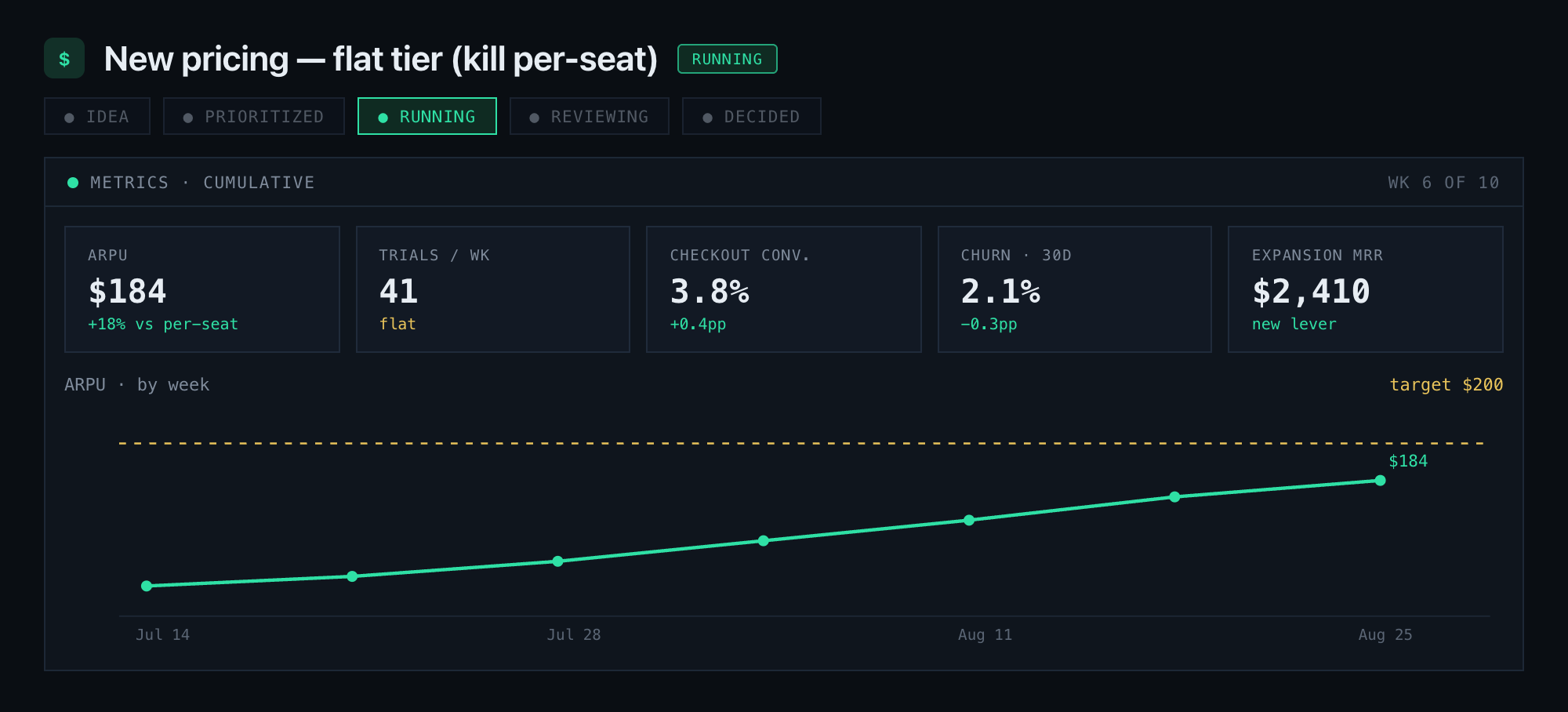
Everything above works only if the pre-outcome record exists. That is the gap we built Betlog to close: a decision journal for founders, product leaders and small teams who make consequential calls under uncertainty.
Here is how it supports the workflow in this article:
- Pre-decision capture: each bet records the hypothesis, expected outcome, confidence as a probability, accepted trade-offs, deciding metrics and what would prove it wrong.
- Explicit stages: bets move through Idea, Prioritized, Running, Reviewing and Decided, so nothing gets judged before its review window.
- Honest verdicts: every bet closes as Won, Killed or Inconclusive.
- Archived postmortems: each closed bet ends with a review that separates skill from luck and stores a learning the team cannot later rewrite.
Over time that timestamped record shows whether your confident bets win as often as you think they do. You can see current plans on our pricing page: one plan at $39 per month or $390 per year. Open it, pick the billing period that suits your team, and log your next bet before you know how it ends.
This article is general information, not a substitute for advice from a qualified doctor. Consult a qualified healthcare professional about your own circumstances before acting on anything here.
FAQ
What exactly happens in a postmortem?
In an incident review, a team reconstructs the timeline, identifies contributing factors and assigns verifiable actions. In a forensic postmortem, a pathologist examines the body externally and internally, then adds histology, toxicology and often imaging. Both rely on records created at the time.
What does a toxicology report show in an autopsy?
It shows whether drugs, alcohol or poisons were present in samples such as blood, urine or tissue, and in what quantities. Toxicology is one of the core autopsy components described by the National Library of Medicine. Results are interpreted alongside the other findings, not alone.
How do you reduce bias in a postmortem?
Write down what people knew and expected before the outcome, ask counterfactual questions, and check whether your supposed cause also appears in successful cases. Research on failed postmortems recommends comparative checks and humility. Decision records made at the time help most.
How do you check a postmortem report?
Look for a clear timeline backed by primary evidence, causes stated as conditions rather than individuals, and actions with owners and verification. For autopsy reports, ask the issuing office or your legal representative about access rules, which vary by jurisdiction.
Sources
- Google SRE - Incident Management: Postmortem Analysis
- Nlm
- Postmortem CT: Applications in Clinical and Forensic Medicine | RadioGraphics


